

3PL vs 4PL: Key Differences & Which Model Fits Your Business
Choosing between a 3PL and 4PL logistics model determines how much control you maintain over fulfillment operations, who manages your supply chain relationships, and what you pay for logistics services. The wrong choice creates unnecessary costs, communication delays, and operational headaches.
This guide breaks down the real differences between 3PL and 4PL models, explains when each makes sense for your business, and provides transparent cost comparisons so you can make an informed decision.
A 3PL (third-party logistics provider) handles your warehousing, order fulfillment, and shipping operations directly. You work with the 3PL as your primary partner, and they manage the physical tasks of storing inventory, picking and packing orders, and coordinating with shipping carriers.
Ecommerce fulfillment through a 3PL means you outsource the operational work while maintaining direct oversight and communication with the provider handling your products. You choose which warehouses to use, how to allocate inventory, and what services you need. The 3PL executes your fulfillment strategy using their facilities, staff, and technology.Most growing ecommerce businesses work with 3PLs because the model balances outsourcing logistics with maintaining control over fulfillment decisions and customer experience.
What Is a 4PL?
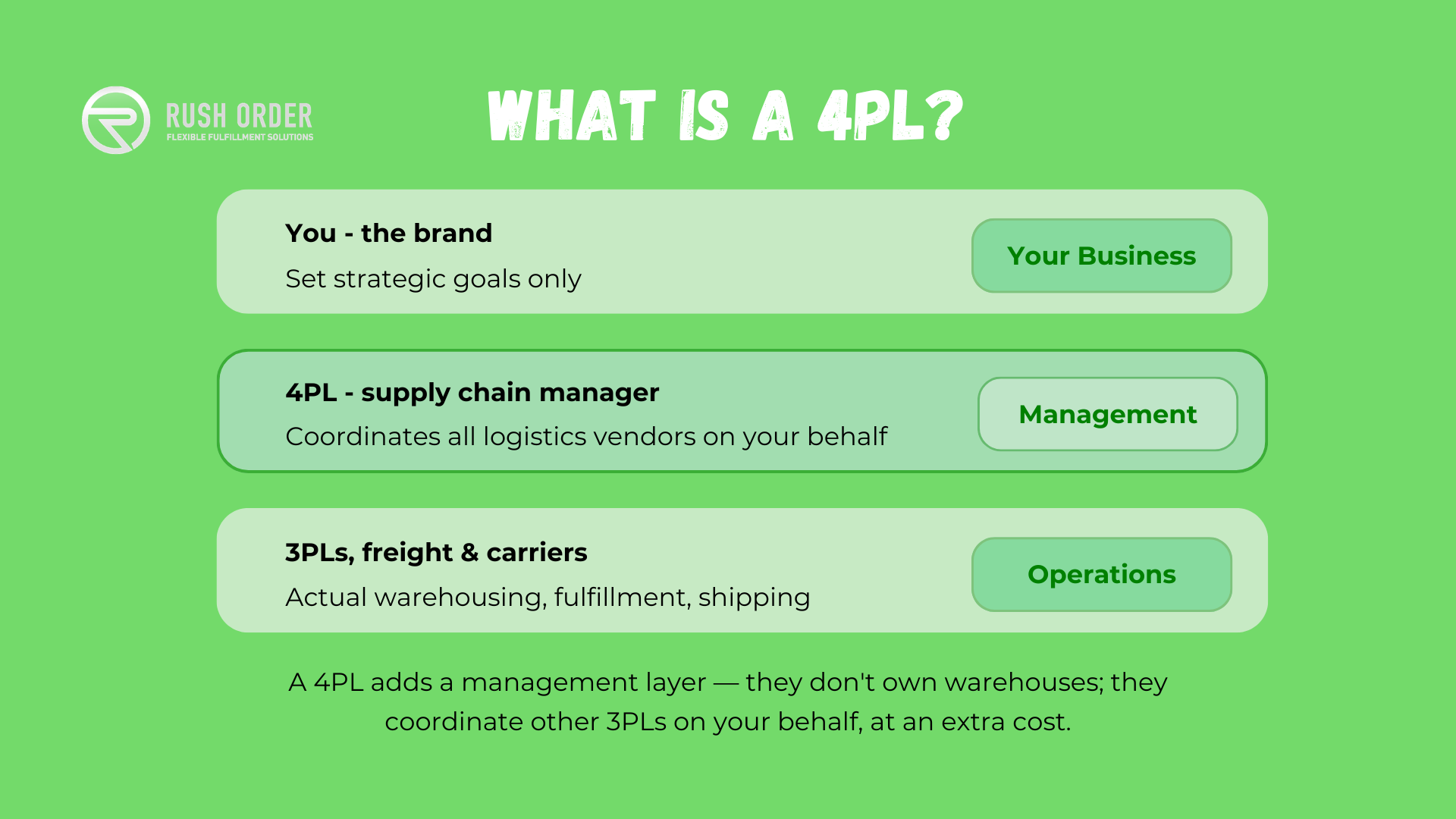
A 4PL (fourth-party logistics provider) manages your entire supply chain on your behalf, including coordinating relationships with multiple 3PLs and other logistics vendors. Instead of working directly with the fulfillment centers handling your products, you work with the 4PL who then manages those relationships for you.
The 4PL acts as a supply chain manager or consultant who oversees 3PLs, freight forwarders, carriers, and other logistics providers. They coordinate transportation, warehousing, technology integration, and supply chain optimization while adding a management layer between you and the companies physically handling your inventory.
4PLs typically don't own warehouses or trucks. They coordinate the logistics network and make strategic decisions about how to move your products through the supply chain most efficiently.
Key Differences Between 3PL and 4PL
Understanding how these models differ helps you evaluate which fits your business needs.
Control and Oversight
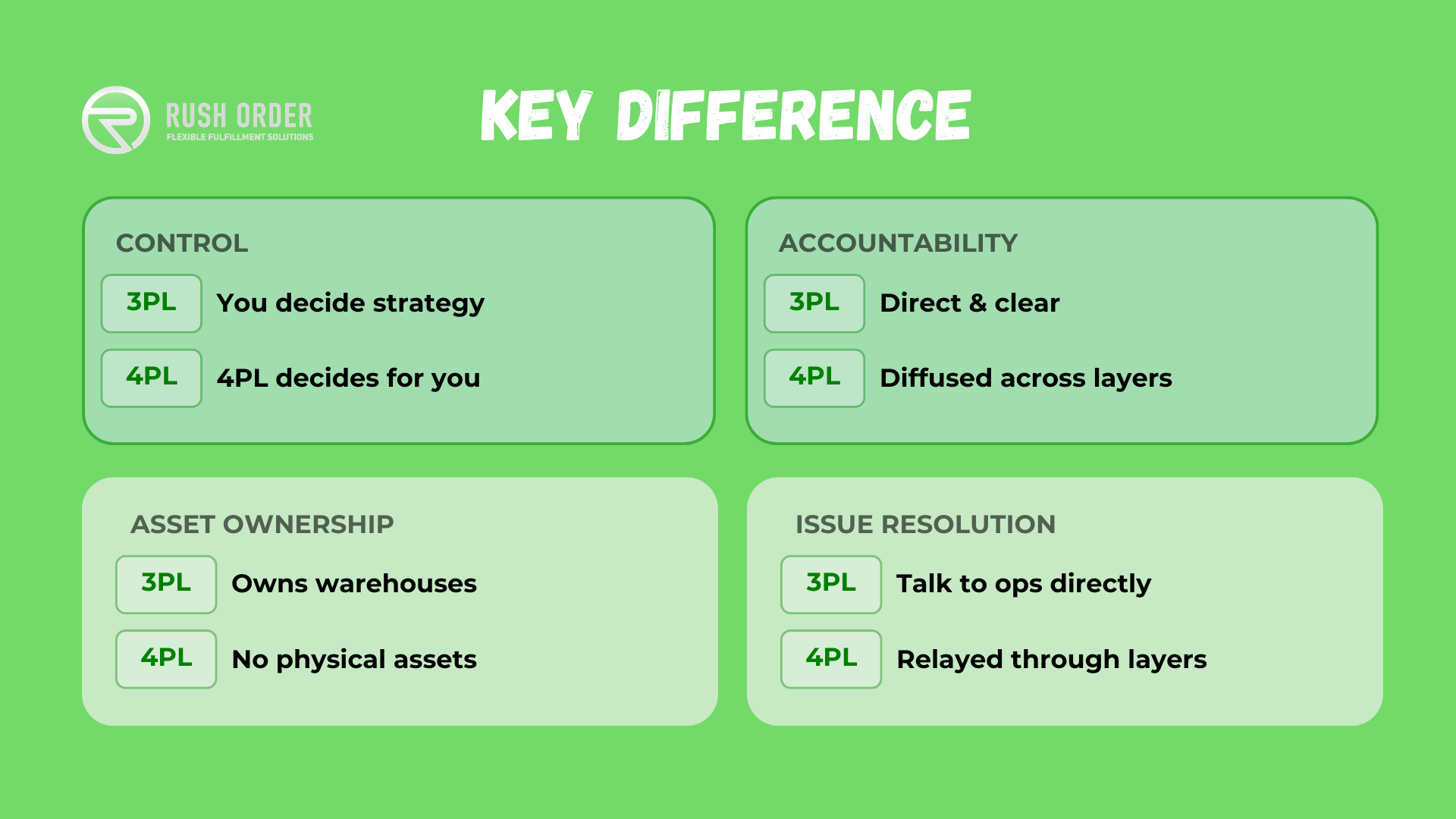
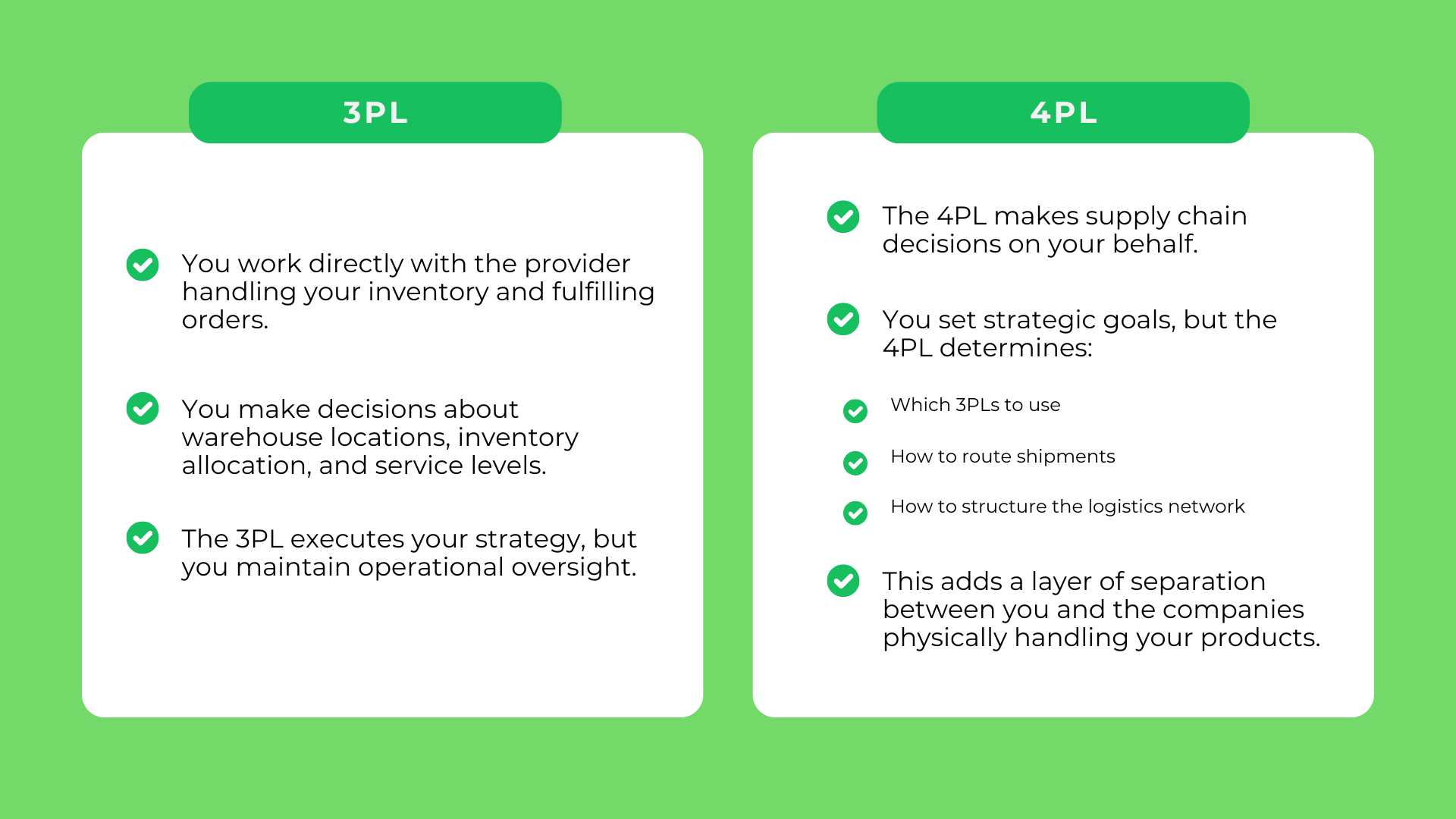
3PL: You work directly with the provider handling your inventory and fulfilling orders. You make decisions about warehouse locations, inventory allocation, and service levels. The 3PL executes your strategy but you maintain operational oversight.
4PL: The 4PL makes supply chain decisions on your behalf. You set strategic goals but the 4PL determines which 3PLs to use, how to route shipments, and how to structure the logistics network. This adds separation between you and the companies physically handling your products.
Asset Ownership
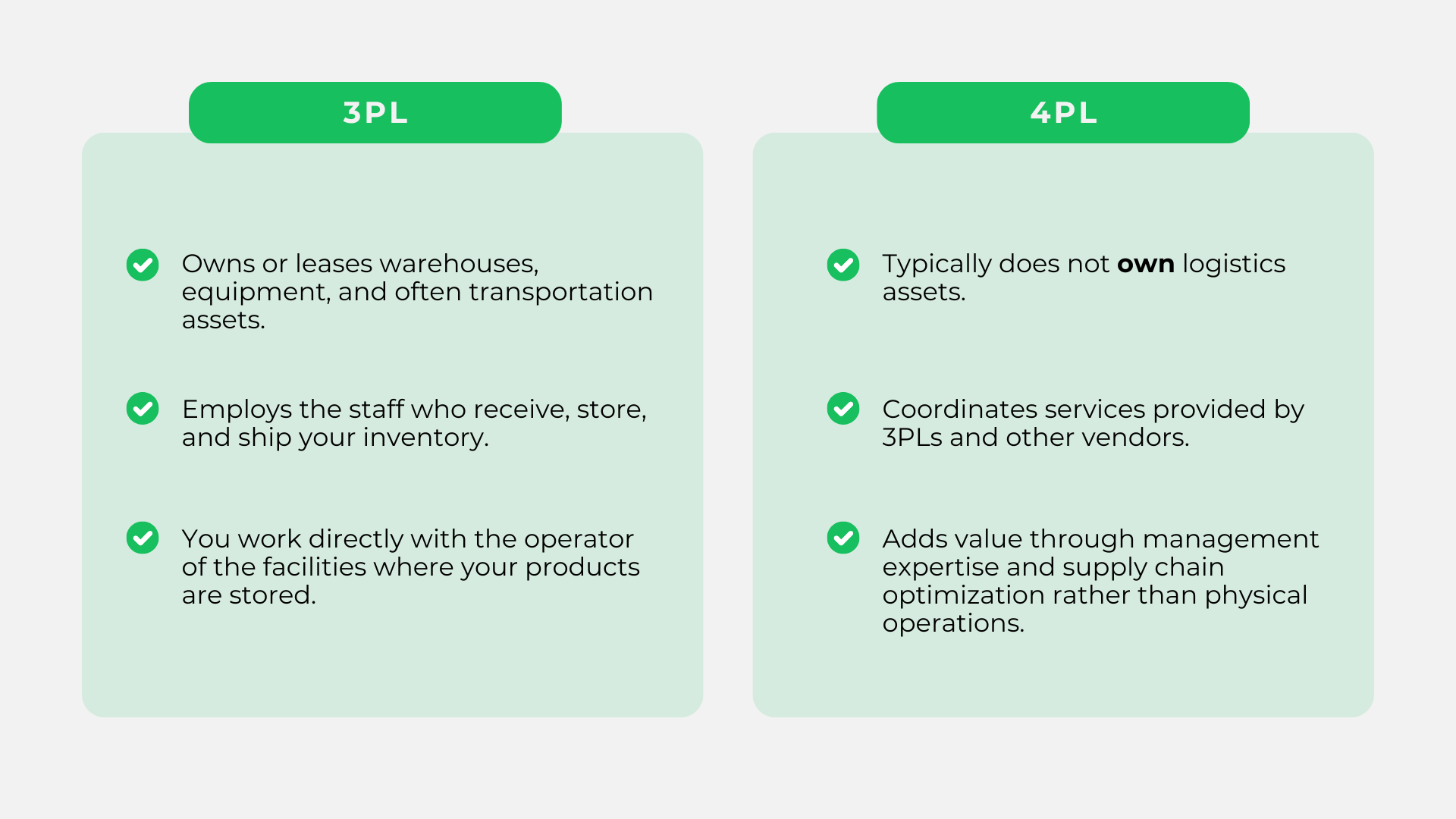
3PL: Owns or leases warehouses, equipment, and often transportation assets. They employ the staff who receive, store, and ship your inventory. You're working with the actual operator of the facilities where your products live.
4PL: Typically doesn't own logistics assets. They coordinate services provided by 3PLs and other vendors. The 4PL's value comes from management expertise and supply chain optimization rather than physical operations.
Service Scope
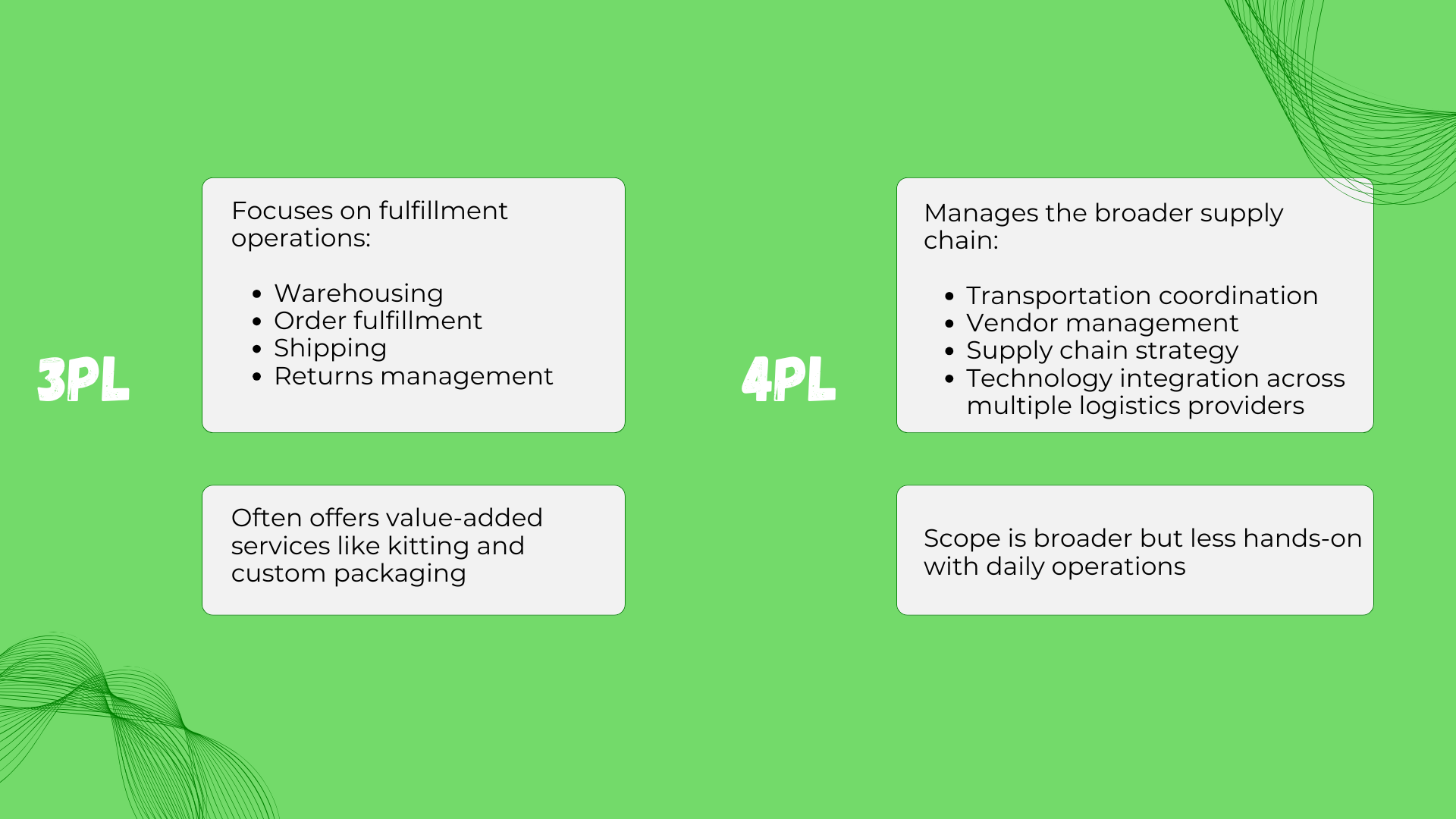
3PL: Focuses on fulfillment operations including warehousing, order fulfillment, shipping, and returns management. Many also offer value-added services like kitting and custom packaging.
4PL: Manages the broader supply chain including transportation coordination, vendor management, supply chain strategy, and technology integration across multiple logistics providers. The scope is wider but less hands-on with daily operations.
Communication Structure
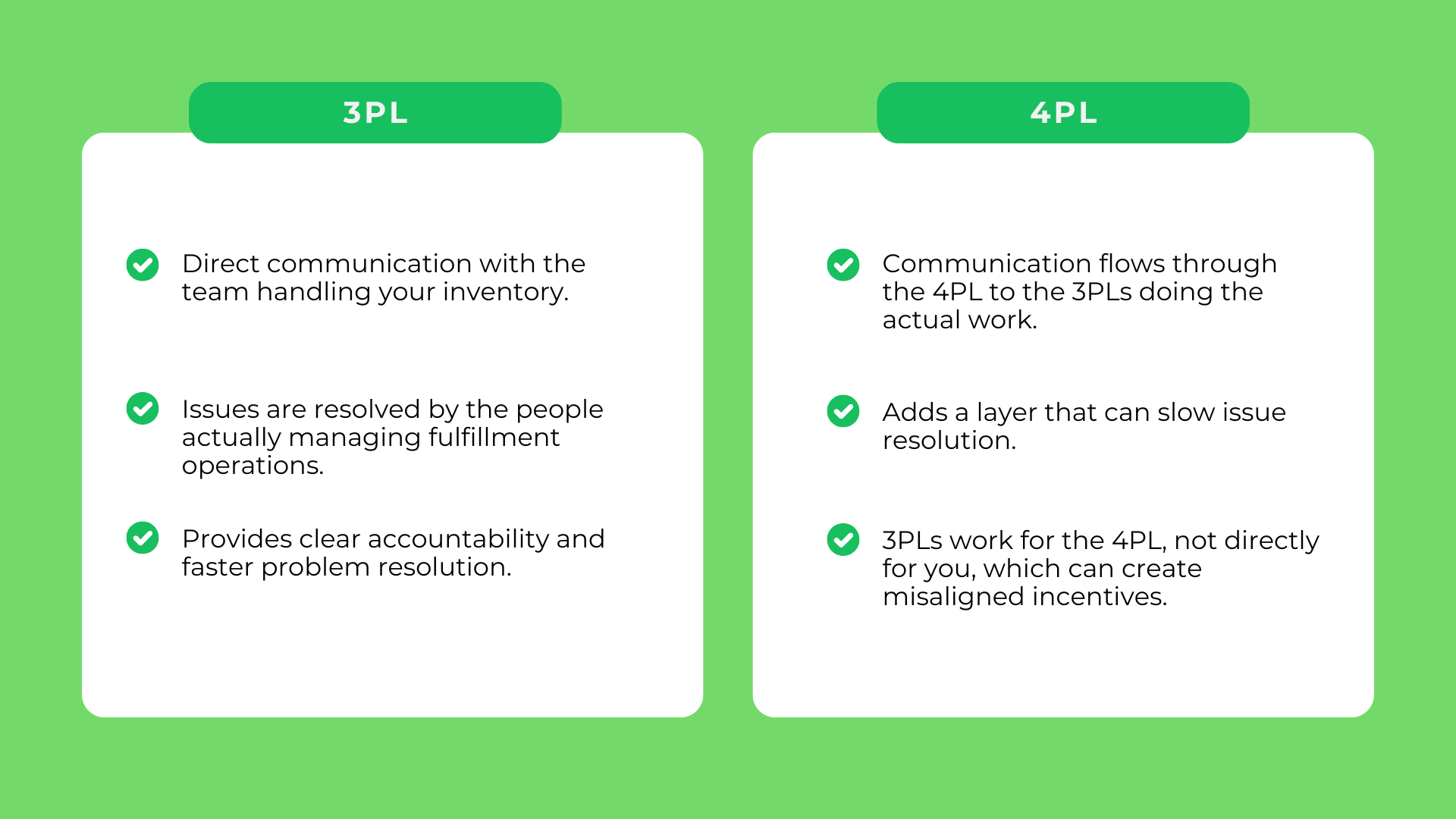
3PL: Direct communication with the team handling your inventory. Issues get resolved by the people actually managing your fulfillment operations. You have clear accountability and faster problem resolution.
4PL: Communication flows through the 4PL to the 3PLs doing the actual work. This adds a layer that can slow issue resolution. The 3PLs work for the 4PL, not directly for you, which can create misaligned incentives.
Technology and Systems
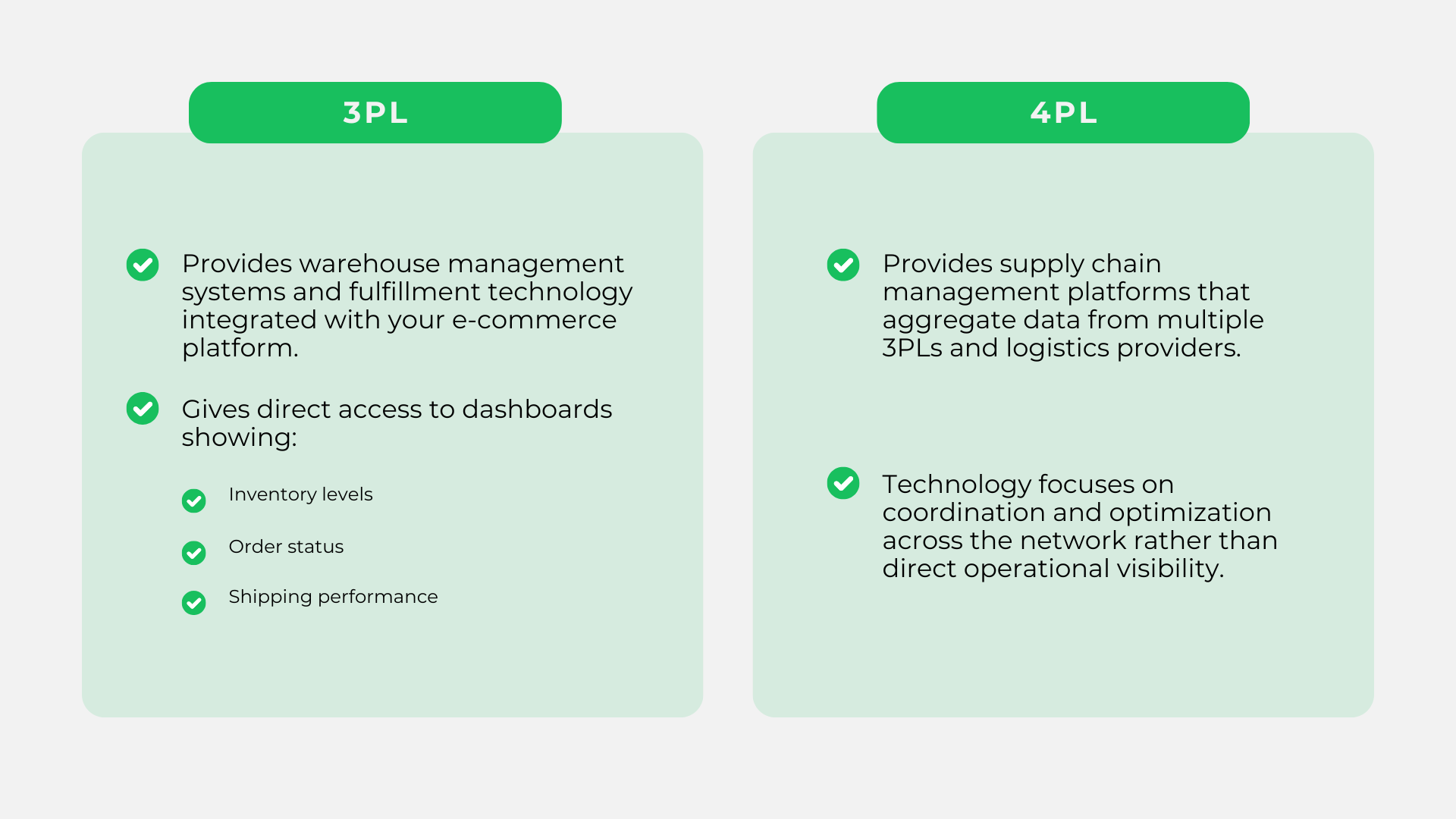
3PL: Provides warehouse management systems and fulfillment technology integrated with your ecommerce platform. You get direct access to dashboards showing inventory levels, order status, and shipping performance.
4PL: Provides supply chain management platforms that aggregate data from multiple 3PLs and logistics providers. The technology focuses on coordination and optimization across the network rather than direct operational visibility.
When to Use a 3PL
Most ecommerce businesses benefit from working directly with a 3PL rather than adding a 4PL management layer.
You ship 200+ orders monthly and want to outsource fulfillment.
Outsourced fulfillment through a 3PL makes sense once you hit meaningful order volume. The direct relationship gives you control over the customer experience while freeing you from operational logistics.
You sell through one or multiple channels.
Whether you're doing D2C fulfillment, B2B 3PL, retail dropshipping, or omnichannel fulfillment, a single 3PL can coordinate inventory and orders across channels without needing a 4PL intermediary.
You need direct accountability.
When issues occur with orders, inventory, or shipping, you want to speak with the people who can actually fix problems. A 3PL gives you that direct line of communication.
You want to maintain operational control.
Decisions about where to store inventory, how to allocate stock, which carriers to use, and what services to add should be yours. A 3PL executes your strategy rather than making these decisions for you.
You're a startup, small business, or mid-size brand.
The direct 3PL model works well for startups through large enterprise operations. Most businesses don't outgrow a good 3PL partner.
What Is a 3PL?
You value cost transparency.
3PL pricing is straightforward. You pay for the services you use without additional management fees layered on top. This makes costs predictable and easier to optimize.
Your fulfillment needs are straightforward.
If you're shipping products from warehouses to customers, even across multiple locations, a well-run 3PL handles this without needing additional supply chain management.
When to Use a 4PL
4PLs serve a narrow set of use cases where supply chain complexity genuinely requires dedicated management.
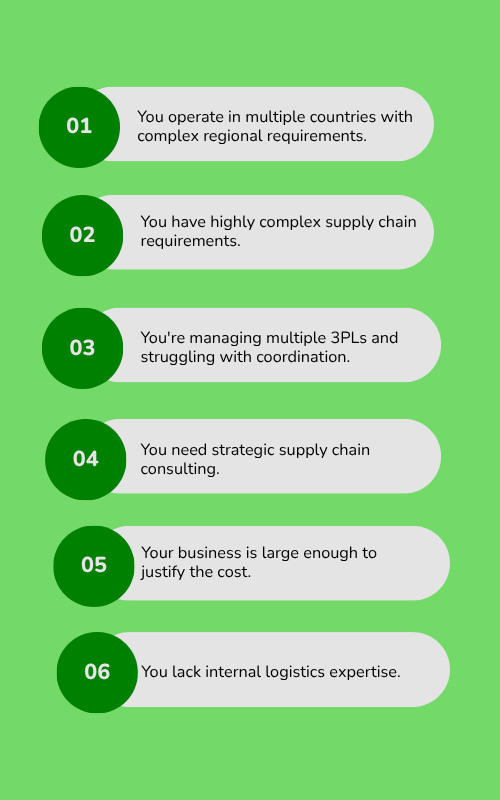
You operate in multiple countries with complex regional requirements.
A business shipping to 15+ countries with different 3PLs, freight forwarders, and carriers in each region might benefit from a 4PL coordinating the network. The coordination overhead justifies the management layer.
You're managing multiple 3PLs and struggling with coordination.
If you're already working with three or more 3PLs and spending significant time coordinating between them, a 4PL might consolidate that coordination. However, finding one comprehensive 3PL is often a better solution.
Your business is large enough to justify the cost.
4PLs charge management fees on top of underlying 3PL costs. This typically only makes economic sense for large enterprises moving significant volume across complex networks.
You have highly complex supply chain requirements.
Manufacturing operations with intricate inbound logistics, multiple distribution tiers, and complex routing might need 4PL-level coordination. This applies more to manufacturers and distributors than typical ecommerce businesses.
You need strategic supply chain consulting.
Some businesses engage 4PLs primarily for supply chain strategy and optimization expertise rather than operational management. This works when you have internal logistics staff to execute strategies the 4PL develops.
You lack internal logistics expertise.
Businesses without supply chain knowledge sometimes use 4PLs to access expertise they don't have in-house. Building that expertise internally or working with a consultative 3PL often proves more cost-effective long-term.
Cost Comparison: 3PL vs 4PL
Understanding the true cost difference helps you evaluate which model makes financial sense
Typical 3PL Costs
Receiving: $0.30-0.50 per unit received
Storage: $0.50-1.50 per cubic foot monthly or $8-15 per pallet
Pick and pack: $3-6 per order for standard items
Packing materials: Included or $0.50-2.00 per order
Shipping: Carrier rates (typically 20-40% below retail due to volume discounts)
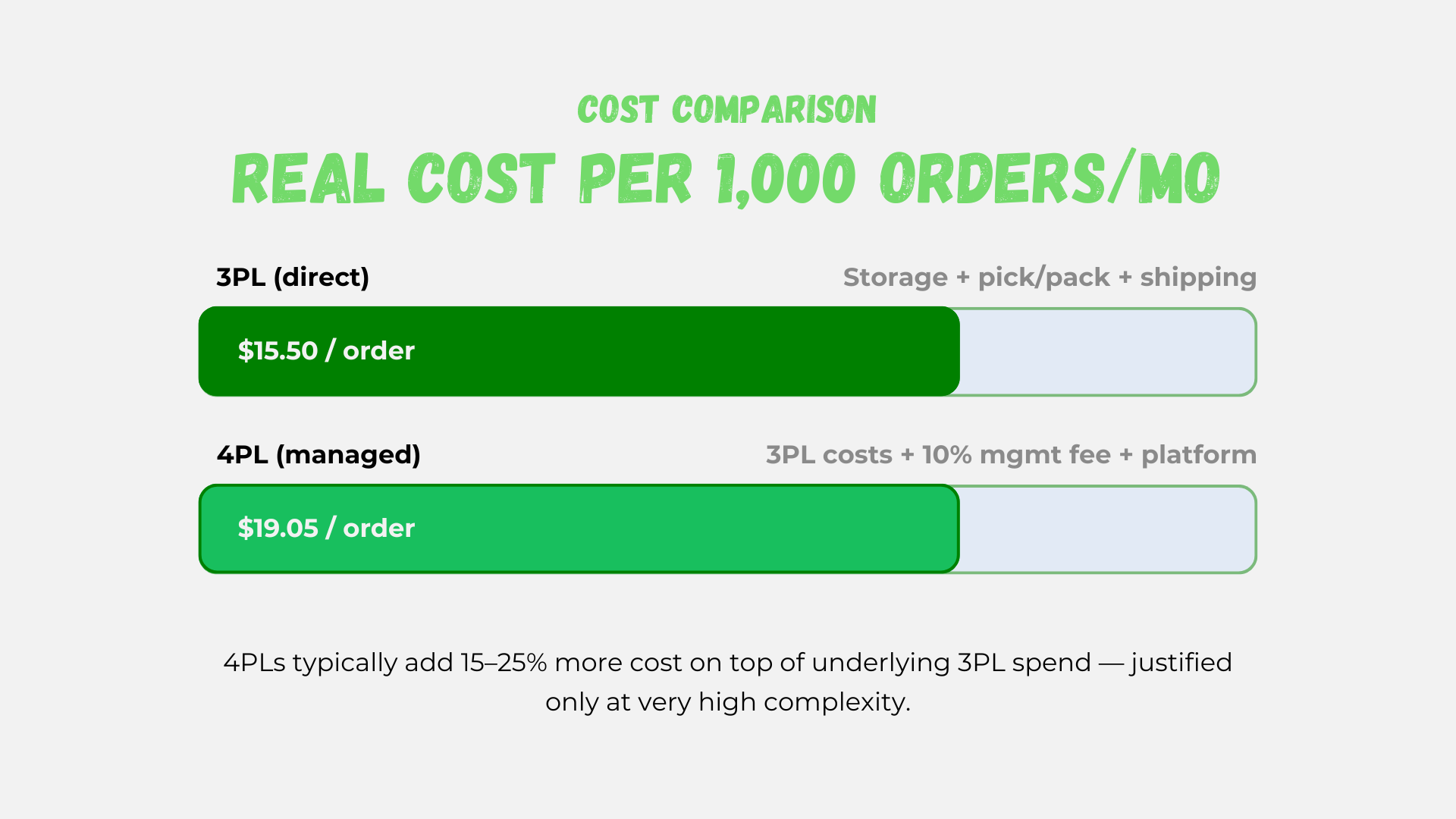
Example: 1,000 orders monthly
Storage: $1,000
Pick and pack: $4,500
Materials: $1,000
Shipping: $9,000
Total: $15,500 or $15.50 per order
Typical 4PL Costs
All 3PL costs above (the 4PL passes through costs from underlying 3PLs)
Plus 4PL management fee: 8-15% of total logistics spend or $5,000-20,000+ monthly minimum
Plus technology platform fees: $1,000-5,000+ monthly for supply chain management software
Example: Same 1,000 orders monthly
3PL services: $15,500
4PL management fee (10%): $1,550
Platform fee: $2,000
Total: $19,050 or $19.05 per order
Cost difference: 20-25% more expensive for 4PL model in this scenario.
Hidden Costs to Consider
3PL hidden costs:
Account minimum fees if volume is low
Inventory transfer fees between warehouses
Special handling charges
Technology fees (though most 3PLs include this)
4PL hidden costs:
Markup on 3PL services beyond stated management fee
Reduced negotiating power with underlying 3PLs
Less transparency into actual fulfillment costs
Switching costs if you decide to work directly with 3PLs later
Break-Even Analysis
The 4PL management layer only makes economic sense when coordination complexity is high enough that the optimization they provide offsets their fees.
For most ecommerce businesses shipping under 10,000 orders monthly, the coordination savings don't justify 15-25% higher costs. Above 10,000 monthly orders with multiple 3PLs in different regions, the math might work if the 4PL delivers significant optimization.
Pros and Cons: 3PL vs 4PL
Here's an honest comparison of advantages and disadvantages for each model.
3PL Advantages
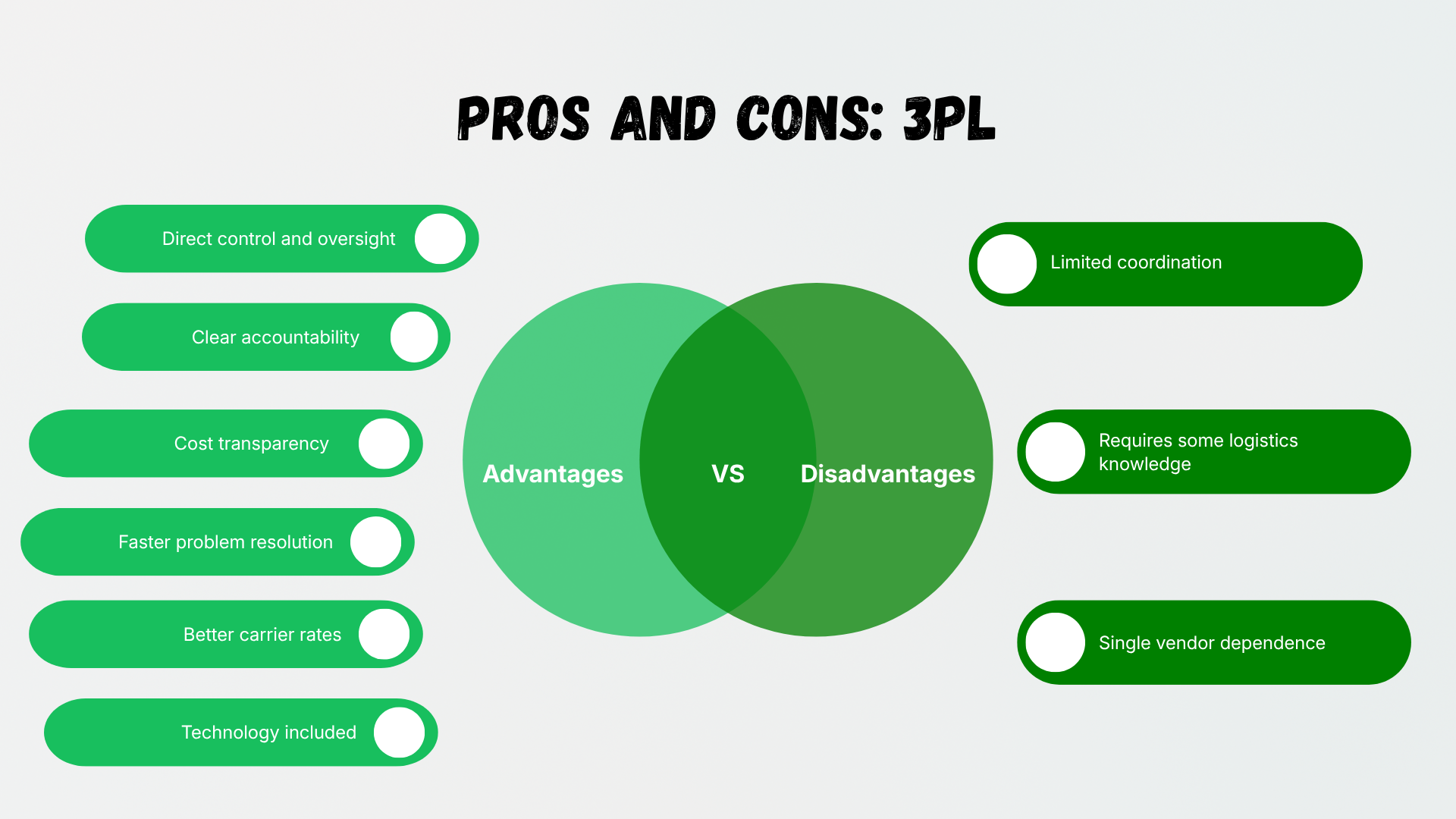
Direct control and oversight - You make strategic decisions about your fulfillment operations
Clear accountability - One partner responsible for warehousing and fulfillment performance
Cost transparency - Straightforward pricing for services used
Faster problem resolution - Direct communication with operations teams
Better carrier rates - 3PLs negotiate volume discounts passed to clients
Technology included - Most 3PLs provide warehouse management systems and reporting
Works at any scale - Effective from 200 to 100,000+ monthly orders
3PL Disadvantages
Limited coordination - If using multiple 3PLs, you coordinate between them yourself
Requires some logistics knowledge - You make strategic decisions about inventory allocation and locations
Single vendor dependence - Switching 3PLs requires migrating inventory and integration
4PL Advantages
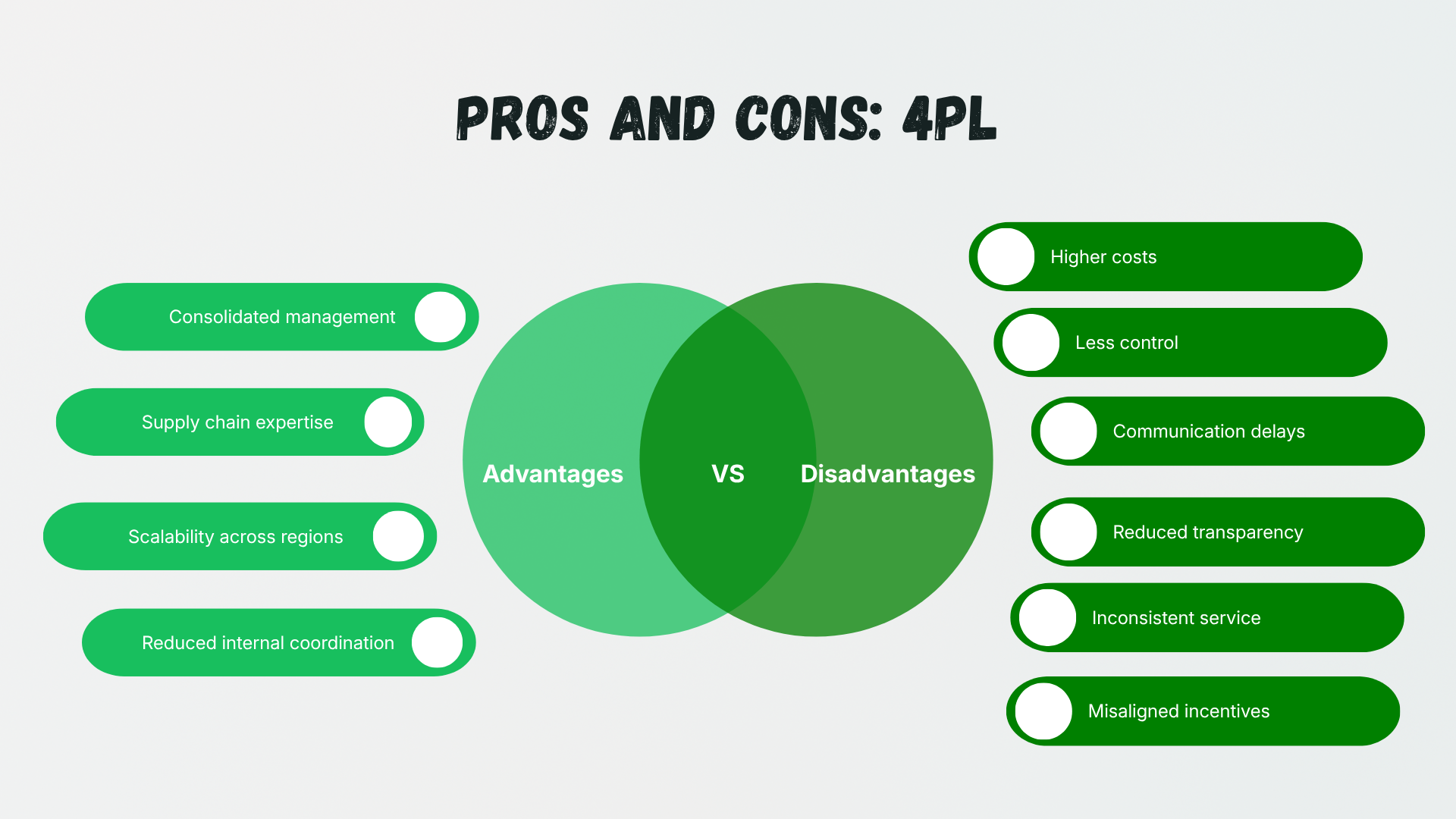
Consolidated management - One partner coordinates entire logistics network
Supply chain expertise - Access to strategic consulting and optimization
Scalability across regions - Can add 3PLs and logistics providers without directly managing relationships
Reduced internal coordination - The 4PL handles vendor management
Which Model Is Right for You?
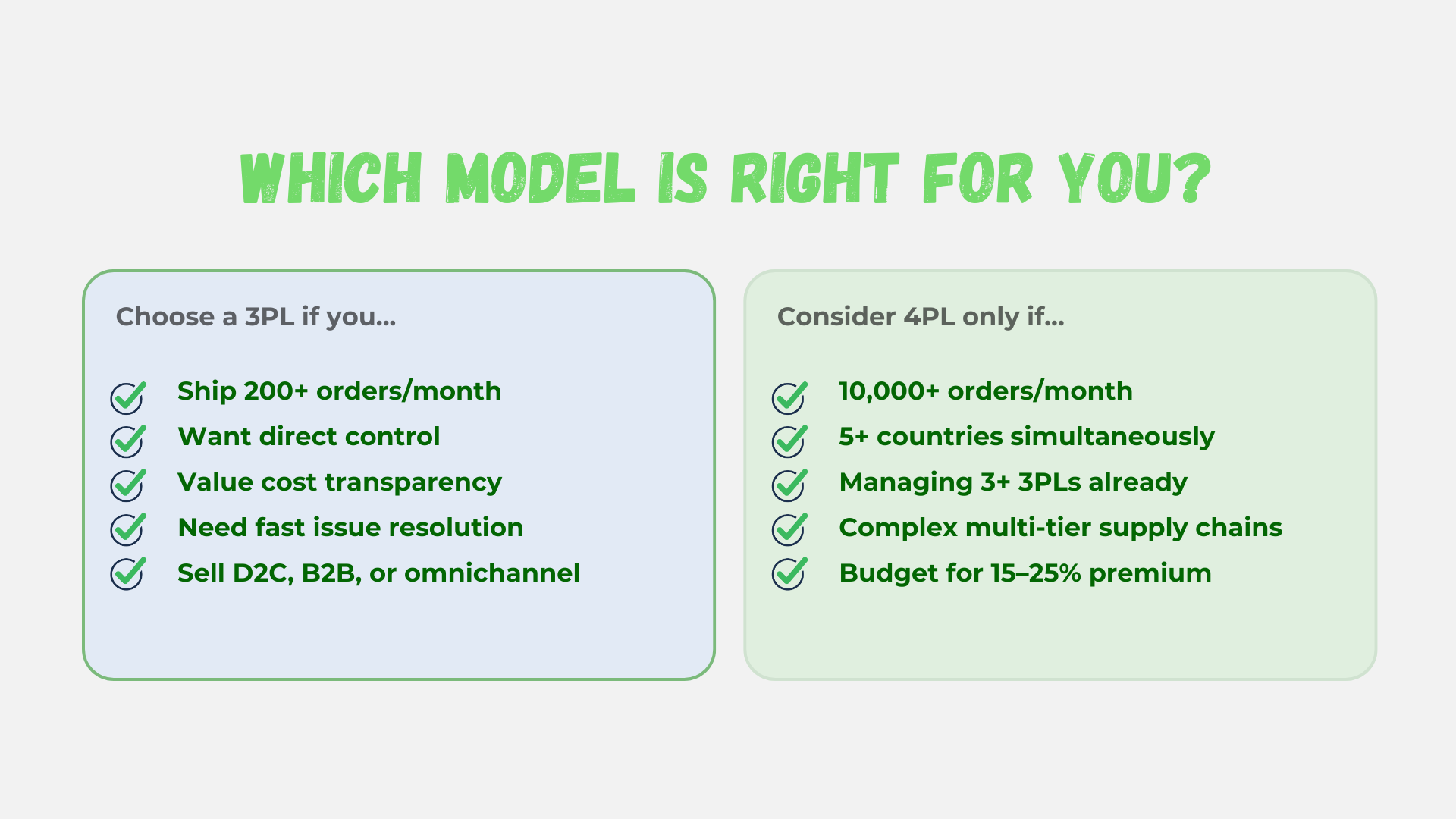
Choose a 3PL if you:
Ship under 10,000 orders monthly
Operate primarily in one or two countries
Want direct control over fulfillment strategy
Value cost transparency and accountability
Need specialized services like kitting, custom packaging, or subscription box fulfillment
4PL Disadvantages
Higher costs - Management fees add 15-25% to total logistics spend
Less control - The 4PL makes operational decisions instead of you
Communication delays - Issues go through 4PL to 3PLs, slowing resolution
Reduced transparency - Less visibility into actual fulfillment operations and costs
Inconsistent service - Different 3PLs in the network may have different quality standards
Misaligned incentives - The 4PL's profit doesn't always align with your cost optimization
Limited accountability - When problems occur, the 4PL and 3PL can each blame the other
Choose a 4PL if you:
Ship 10,000+ orders monthly across 5+ countries
Already manage multiple 3PLs and struggle with coordination
Have highly complex multi-tier distribution requirements
Need strategic supply chain consulting more than hands-on fulfillment
Can justify 15-25% higher costs for coordination services
Consider a hybrid approach if you:
Work with a primary 3PL for most fulfillment
Use specialized regional providers for specific markets
Coordinate relationships yourself or hire supply chain expertise internally
Maintain direct accountability while accessing multiple networks
Frequently Asked Questions About 3PL vs 4PL
-
A 3PL provides warehousing and fulfillment services directly. A 4PL manages relationships with multiple 3PLs and other logistics providers on your behalf, adding a coordination layer between you and the companies handling your products.
-
Not usually. For most ecommerce businesses, working directly with a 3PL provides better control, transparency, and cost efficiency. 4PLs serve specific use cases involving high complexity across multiple regions or logistics networks.
-
4PLs typically cost 15-25% more than working directly with 3PLs due to management fees and platform costs layered on top of underlying 3PL services. The added cost only makes sense when coordination complexity justifies it.
-
Consider a 4PL if you ship 10,000+ orders monthly across multiple countries, already work with several 3PLs and struggle with coordination, or have highly complex supply chain requirements that justify the management overhead.
-
Yes. Some businesses work with a primary 3PL for most fulfillment while using a 4PL to coordinate specialized regional providers or complex distribution networks. This hybrid approach maintains direct relationships where possible while accessing coordination for complex segments.
-
4PL stands for fourth-party logistics. The term reflects that the provider coordinates third-party logistics providers (3PLs) on behalf of the business, adding another layer to the supply chain.
-
Most 4PLs don't own warehouses or logistics assets. They coordinate services provided by 3PLs and other vendors. Their value comes from management and optimization expertise rather than physical operations.
-
Amazon FBA is a 3PL. Amazon owns and operates the warehouses, handles fulfillment directly, and you work with Amazon as your fulfillment partner. For businesses also selling on their own website, Amazon fulfillment services can complement other 3PL relationships.