
Best 3PL for Ecommerce: 12 Top Providers Compared in 2026
The best 3PL for ecommerce depends on what you ship and where your customers live. Rush Order ranks first for brands that want fulfillment and customer support from one provider. ShipBob suits lightweight Shopify volume, Red Stag Fulfillment handles heavy and fragile goods, and AMZ Prep leads on Amazon FBA prep. This guide compares 12 providers on warehouse footprint, channel coverage, pricing model and known limitations.
Rush Order has run order fulfillment solutions for brands for more than 30 years, at 99.99% order accuracy and 99.9% on-time fulfillment. We built this comparison from the same evaluation checklist we hand to brands who are shopping providers, including the ones who end up choosing someone else.
Quick Comparison: Best 3PL Companies for Ecommerce
| Provider | Best for | Warehouse network | FBA prep | Pricing model |
|---|---|---|---|---|
| Rush Order | Brands wanting fulfillment plus outsourced customer service | US, Canada, UK, Netherlands, Australia, Asia | Yes | Custom quote by volume, SKU profile and service mix |
| ShipBob | DTC and Shopify brands at 100 to 1,000 orders a month | 50+ locations across US, Canada, Europe, Australia | Limited | Roughly $5 per order, storage and receiving billed separately |
| ShipMonk | Multi-channel DTC plus subscription boxes | US, Canada, Mexico, Europe | Yes | Custom quote, per-order pick and pack |
| Red Stag Fulfillment | Heavy, bulky, fragile or high-value items | 2 US sites (Knoxville TN, Salt Lake City UT) | Yes | Custom quote by weight and dimensions |
| AMZ Prep | Amazon FBA sellers in North America | 50+ centers across 6 countries | Yes, 24-hour turnaround | From $0.40 per unit for prep, custom quote for DTC |
| Stord | Tech-first DTC and omnichannel brands | 30+ locations, US, UK, Canada, Netherlands | Within a wider suite | Custom quote by volume |
| Ryder E-commerce by Whiplash | High-SKU DTC with custom packaging | ~20 US facilities | Not confirmed | Custom quote |
| Flexport | Importers wanting freight and fulfillment together | US network via Deliverr | Yes | Freight per shipment, fulfillment on quote |
| SHIPHYPE | US and Canada cross-border, no long contracts | 5 across US and Canada | Yes | Month to month, custom quote |
| DHL Supply Chain | Enterprise brands with global freight needs | Global, 6 continents | Varies by region | Contract based |
| Cart.com | Brands consolidating storefront and logistics | US network | Limited | Platform fee plus fulfillment |
| Amazon FBA and MCF | Amazon-first sellers | 175+ Amazon fulfillment centers | Prep discontinued Jan 1, 2026 | Per unit by size tier, plus storage |
Every provider in this table is a real option for a real brand. The right answer changes with order volume, product weight, sales channels and how much of your team's time you want back. If you want a shortlist built around your own numbers instead of a table, talk to Rush Order.
How We Ranked These Ecommerce 3PL Companies
We scored each provider on six factors, weighted to match what actually breaks fulfillment relationships in year two rather than what looks good in a sales deck.
| Factor | Weight | What we looked at |
|---|---|---|
| Warehouse network and delivery reach | 25% | Number of sites, geography, ground coverage in 2 days |
| Channel and platform coverage | 20% | Shopify, Amazon, Walmart, TikTok Shop, retail EDI, B2B |
| Technology and inventory accuracy | 20% | Real-time sync, order accuracy rate, reporting depth |
| Pricing transparency | 15% | Published rates, storage minimums, rework and surcharge policy |
| Service specialization | 10% | Kitting, hazmat, cold chain, oversized, regulated goods |
| Support model | 10% | Named account manager versus ticket queue, hours of coverage |
Two things we deliberately did not weight heavily. Star ratings on review sites, because 3PL review volume is thin and skews toward complaints. And headline warehouse counts, because a network of 50 sites you cannot store inventory in is worth less than 4 sites positioned where your customers are. Our own 3PL analytics page covers the metrics we track internally to keep those numbers honest.
What Makes a Good 3PL for Ecommerce
A good ecommerce 3PL clears six requirements. Miss any one of them and you will feel it within a quarter.
Real-time channel sync. Inventory counts push back to every storefront and marketplace as orders ship. Delayed sync causes overselling, and overselling causes account health problems on Amazon and Walmart.
Two-day ground reach. Distributed inventory across regions lets you hit most of the country in 2 to 3 days by ground instead of paying air rates. See how 3PL distribution splits stock across nodes.
Order accuracy above 99.5%. Mispicks cost you the product, the return shipping, the replacement shipping and often the customer.
Returns handled in house. Receiving, inspecting, restocking and disposition should sit with the same provider. Reverse logistics run by a second vendor creates reconciliation gaps.
Pricing you can model. Receiving, storage, pick and pack, packaging materials and surcharges written down before you sign. Run the numbers with a 3PL cost calculator before you commit.
Peak capacity that is contractually real. Ask what happens in week 3 of November, and ask for it in the SLA. Our guide to 3PL SLAs includes a template you can send to any provider.
A seventh requirement is becoming standard. Brands increasingly want fulfillment and customer support from one provider, so the team answering "where is my order" can see the order. Rush Order pairs fulfillment with outsourced customer service, which removes the handoff between the warehouse and the support desk.
The 12 Best 3PL for Ecommerce Providers in 2026
Rush Order
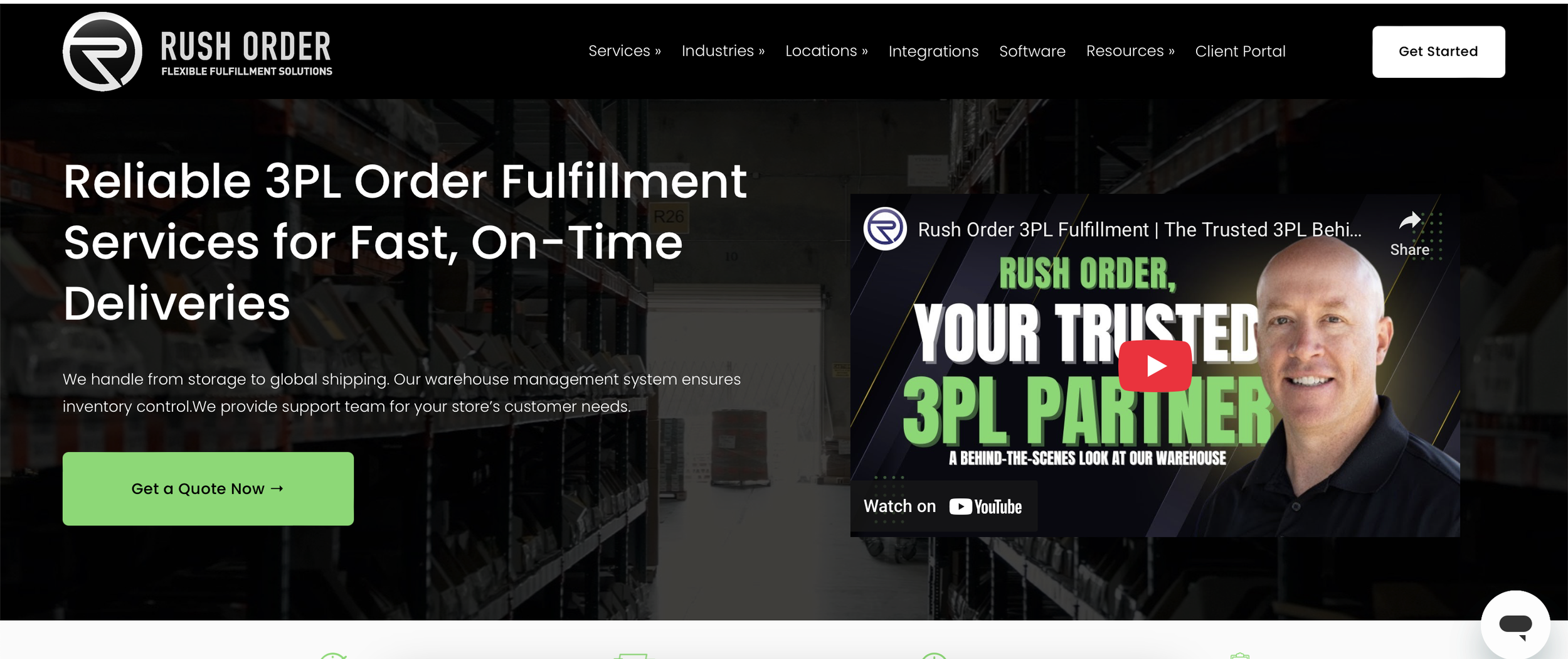
Best for: ecommerce brands that want fulfillment, kitting and customer support from a single provider, in the US and internationally.
Rush Order has handled ecommerce fulfillment for more than 30 years. Fulfillment centers run in the United States, Canada, the United Kingdom, the Netherlands, Australia and Asia. Order accuracy sits at 99.99% and on-time fulfillment at 99.9%.
The service range covers D2C fulfillment, omnichannel fulfillment, B2B 3PL with retail compliance, kitting services, value added assembly, subscription box fulfillment and reverse logistics. Cross-border brands use Section 321 fulfillmentand DDP services to control duties and landed cost.
What separates Rush Order from a pure warehouse operator is the customer experience side. The same provider running your order fulfillment solutions can also run your support inbox through outsourced fulfillment and customer onboarding. Order data and support tickets sit in one place, so a shipping exception gets answered by someone who can see the pick.
Warehouse network: US (West Coast, Midwest, East Coast, Texas), Canada, UK, Netherlands, Australia, Asia
Technology: proprietary warehouse management system with direct platform integrations
Pricing model: custom quote built from order volume, SKU count, storage profile and service mix
Support: 24/7 coverage with a named account contact
One limitation: Rush Order is built for brands past the hobby stage. Sellers shipping a handful of orders a week will get better economics from a self-serve platform until volume builds.
Proof lives in the case studies, and the wider service catalog sits on the 3PL services hub.
ShipBob
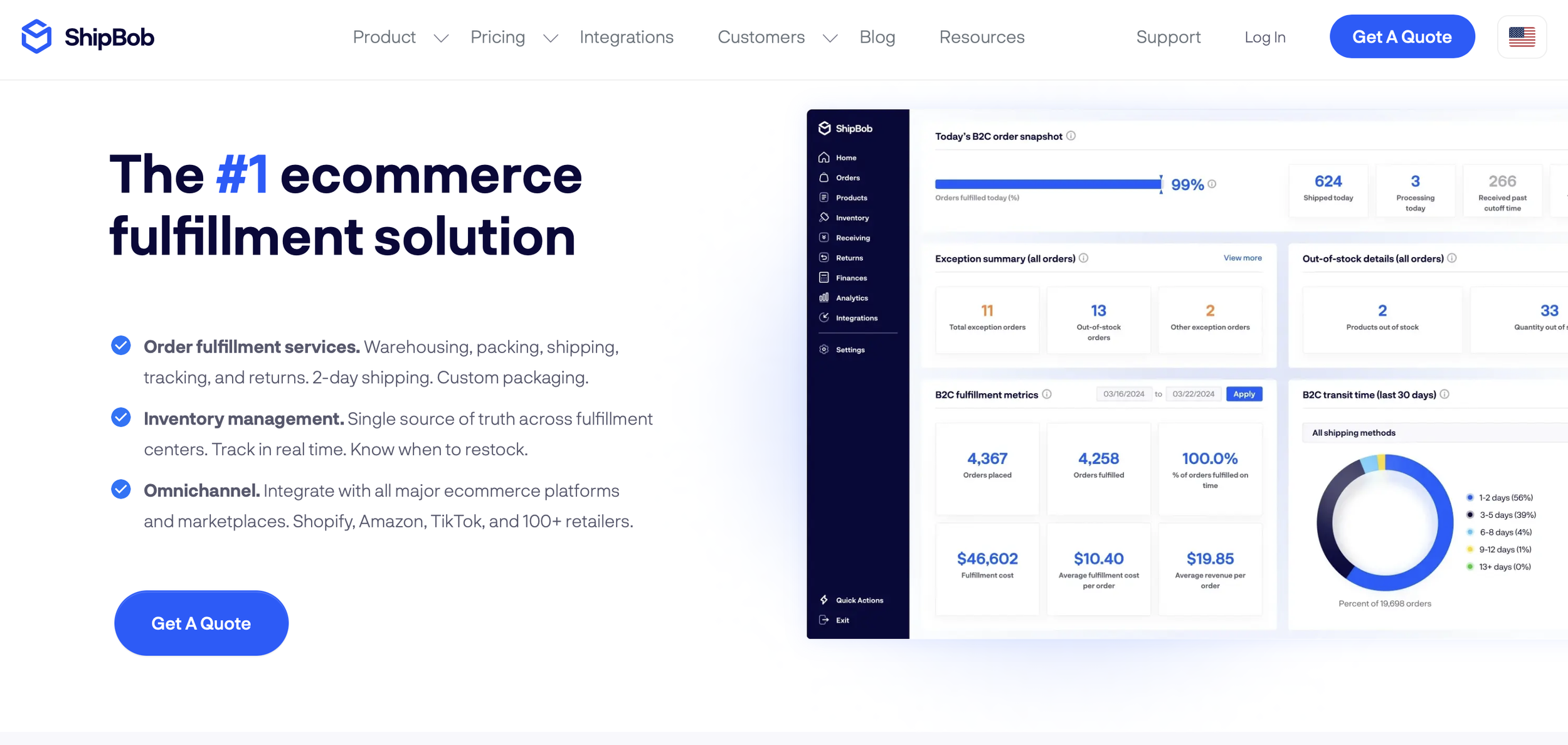
Best for: DTC brands on Shopify shipping 100 to 1,000 orders a month with lightweight, standard-size products.
ShipBob operates one of the larger distributed networks in ecommerce fulfillment, with facilities across the United States, Canada, Europe and Australia. It integrates natively with Shopify, Amazon, WooCommerce and BigCommerce, and includes demand forecasting that suggests how to split inventory across nodes.
Pricing is billed separately for receiving, storage and per-order fulfillment, which makes monthly cost easier to model at steady volume. Reported per-order fulfillment sits near $5 for standard DTC parcels.
Pricing model: approximately $5 per order, storage and receiving separate
Key strength: Shopify integration depth and inventory distribution tooling
One limitation: FBA prep is limited, so Amazon-first sellers usually need a second provider
DHL Supply Chain

Best for: enterprise brands that need warehousing attached to global freight.
DHL operates distribution centers and transport hubs on six continents, covering international and domestic shipping, warehousing, order fulfillment, inventory management and returns. For a brand already moving containers with DHL, consolidating warehousing under the same roof simplifies vendor management.
Pricing model: contract based, negotiated by volume
Key strength: global freight and warehousing under one provider
One limitation: enterprise contract structures and onboarding timelines are heavy for a growing DTC brand
Red Stag Fulfillment

Best for: ecommerce brands shipping items over 10 lbs, or fragile and high-value goods.
Red Stag Fulfillment runs two US facilities, in Knoxville, Tennessee and Salt Lake City, Utah, positioned to give coast-to-coast ground coverage. It takes the products most fulfillment providers surcharge heavily or refuse, and backs picking with an error-coverage guarantee.
Pricing model: custom quote based on dimensions, weight and monthly volume
Key strength: oversized and fragile handling with a documented accuracy guarantee
One limitation: a two-site network cannot match 2-day ground coverage across every US zone
Shiphype

Best for: brands selling into both the United States and Canada without signing a long contract.
SHIPHYPE runs five facilities across the US and Canada and supports Shopify, Amazon, Walmart and TikTok Shop. Month-to-month agreements and fast account setup make it a practical option for brands testing a cross-border channel before committing.
Pricing model: custom quote, month-to-month agreements
Key strength: integrated US and Canada operations with no lock-in
One limitation: the network stops at North America, so brands shipping into Europe or Asia need a second provider
Shipmonk

Best for: brands running DTC, marketplace and subscription orders side by side.
ShipMonk built its own warehouse management platform and supports subscription box assembly alongside standard pick and pack. Facilities span the United States, Canada, Mexico and Europe. Brands that ship recurring boxes plus one-off orders from the same inventory pool tend to shortlist it early.
Pricing model: custom quote, per-order pick and pack with storage billed separately
Key strength: subscription and recurring-shipment workflows inside the core platform
One limitation: fee schedules include a long list of line items, so model the full invoice rather than the headline pick rate
AMZ Prep
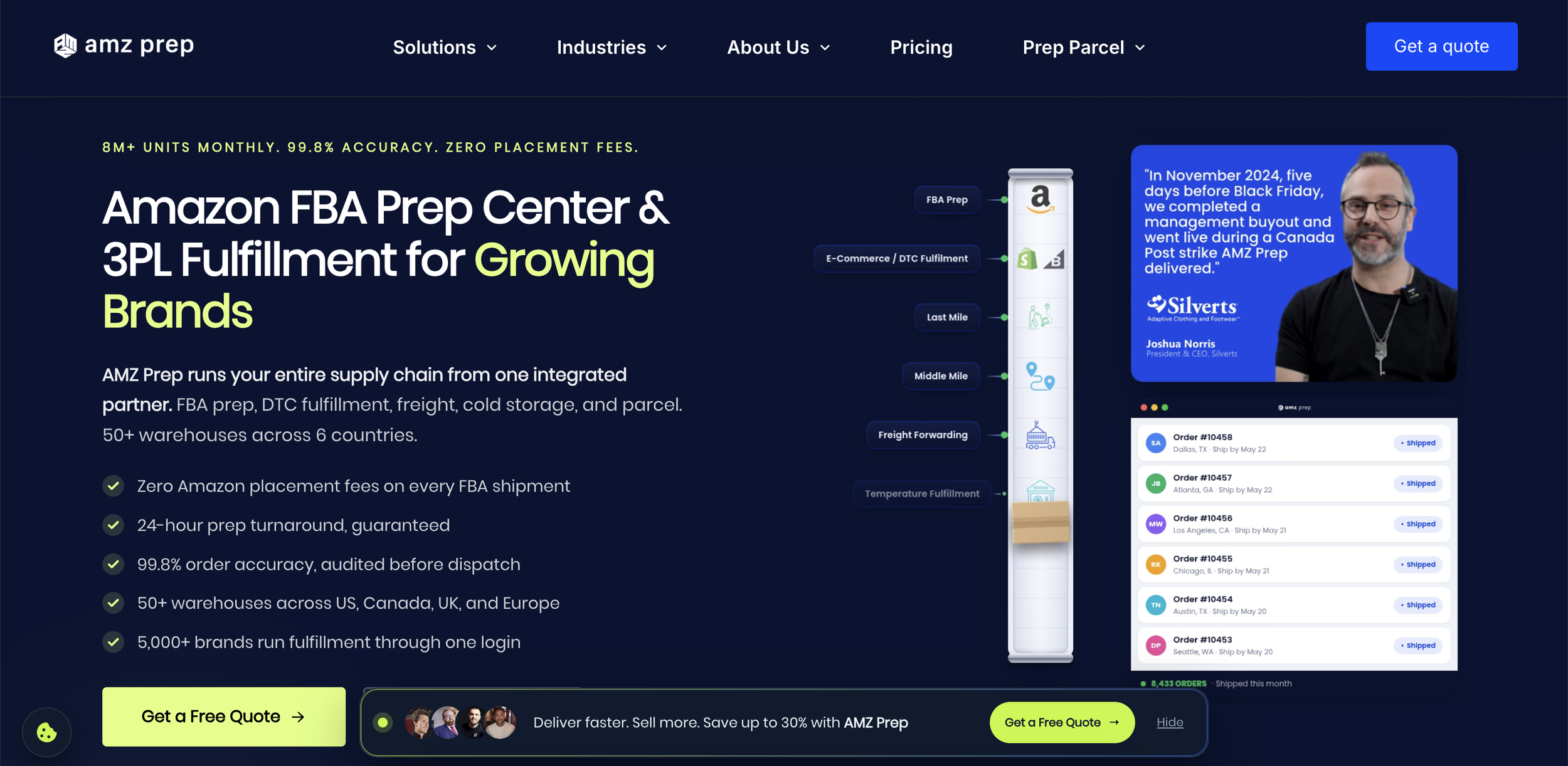
Best for: Amazon FBA sellers who need fast prep and inbound routing across North America.
AMZ Prep focuses on the Amazon channel: labeling, bagging, carton building, shipment creation and inbound freight. Warehouses sit near Amazon fulfillment centers to cut transit time and reduce inbound placement fees. It reports 50+ fulfillment centers across 6 countries.
Pricing model: flat rate per item for FBA prep, custom quote for DTC
Key strength: multi-location split routing to reduce Amazon placement fees
One limitation: minimum volume requirements make it a poor fit below roughly 300 orders a month
Brands comparing Amazon options should also read how FBA prep services and Amazon SFP 3PL fulfillment differ from standard Amazon fulfillment services.
Stord
Best for: DTC and omnichannel brands that want order routing driven by software.
Stord grew through acquisition into one of the larger independent US fulfillment networks, and acquired Shipwire from CEVA Logistics in January 2026. Its platform covers order management, inventory visibility, carrier rate shopping and returns across 30+ locations in the US, UK, Canada and the Netherlands.
Pricing model: custom quote by volume and service mix
Key strength: automated order routing and inventory placement across a multi-node network
One limitation: recent acquisitions are still being integrated, so onboarding now can mean platform migration later
Ryder E-commerce by Whiplash
Best for: high-SKU DTC brands where packaging presentation matters.
Whiplash operates inside Ryder's ecommerce logistics division with roughly 20 US facilities. It handles custom pack-outs, branded inserts and subscription kitting, with Ryder's carrier relationships behind the parcel rates.
Pricing model: custom quote, no published self-serve rates
Key strength: DTC-native pack-out quality at volume
One limitation: limited FBA prep, so Amazon-heavy brands need a separate prep partner
Flexport
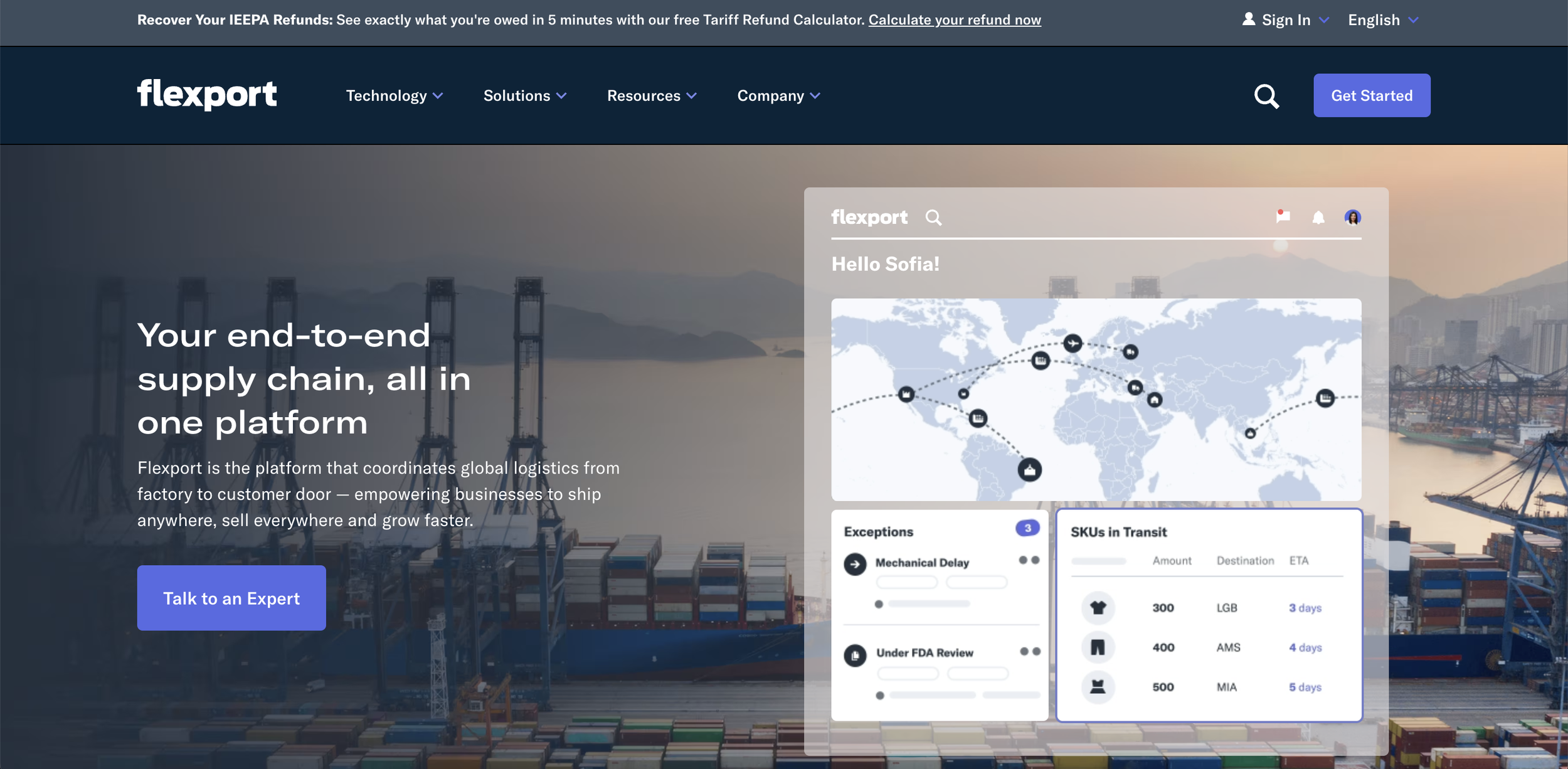
Best for: importers who want freight forwarding and domestic fulfillment under one contract.
Flexport moved into ecommerce fulfillment through its 2022 acquisition of Deliverr. That gives it one path from an overseas factory, through customs, into US distribution and out to the customer. That single-contract structure removes handoffs for brands importing most of their inventory.
Pricing model: freight quoted per shipment, fulfillment on custom quote
Key strength: freight and fulfillment visibility in one platform
One limitation: a monthly fulfillment spend minimum applies, which prices out smaller brands
If you need the freight side explained, the difference between a forwarder and a fulfillment partner is covered in 3PL vs 4PL and international 3PL.
Cart.com
Best for: brands that want storefront tooling and fulfillment from one vendor.
Cart.com bundles ecommerce platform software with fulfillment services across a US network. Brands managing large multi-SKU catalogs across several channels use it to cut the number of vendors in the stack.
Pricing model: platform fee plus fulfillment charges
Key strength: commerce software and logistics on one contract
One limitation: bundling ties your storefront tooling to your fulfillment decision, which makes switching either one harder
Amazon FBA and Multi-Channel Fulfillment
Best for: sellers whose volume is almost entirely on Amazon.
Fulfillment by Amazon stores inventory in Amazon's fulfillment centers and makes products Prime eligible. Multi-Channel Fulfillment ships orders from Shopify, Walmart, eBay and your own site out of the same inventory pool, and does not require an active Amazon storefront.
Pricing model: per-unit fees by size tier and weight, plus monthly storage. MCF priced separately by delivery speed
Key strength: Prime badge eligibility across 175+ fulfillment centers
One limitation: Amazon sets prep rules and packaging, custom branding and inserts are not available, and Q4 storage costs climb. Amazon discontinued its own prep service on January 1, 2026
Best 3PL for Ecommerce by Use Case
Different brands need different things from the same list. Here is where each type of brand should start.
| If you are | Start with | Why |
|---|---|---|
| A Shopify DTC brand | Rush Order, ShipBob | Direct Shopify 3PL integration and 2-day ground reach |
| An Amazon-first seller | AMZ Prep, Rush Order | Prep, labeling and inbound routing to Amazon FCs |
| Selling on Amazon and your own site | Rush Order, ShipMonk | One inventory pool across omnichannel fulfillment |
| Shipping heavy or fragile goods | Red Stag Fulfillment | Oversized handling without punitive surcharges |
| Running a subscription box | Rush Order, ShipMonk | Subscription box fulfillment with dated release cycles |
| Selling into retail as well as online | Rush Order, Stord | B2B 3PL with EDI, ASN and pallet compliance |
| Importing most of your inventory | Flexport, Rush Order | Freight, customs and DDP services in one flow |
| Launching from a crowdfunding campaign | Rush Order | Crowdfunding fulfillment built for one large wave |
| An early-stage brand | Rush Order, SHIPHYPE | Startup fulfillment without enterprise minimums |
| At enterprise volume | Rush Order, DHL Supply Chain | Large enterprise capacity and dedicated space |
| Selling through creators | Rush Order | TikTok fulfillment and YouTube fulfillment |
| Selling branded merch | Rush Order | Merch fulfillment with print and pack workflows |
Product category matters as much as channel. Regulated and sensitive goods carry storage and handling rules a generalist warehouse will not meet. Rush Order runs dedicated programs for supplements, cosmetics and skincare, food and beverage, healthcare products, consumer electronics and apparel.
What Is a 3PL for Ecommerce?
A 3PL for ecommerce is a third-party logistics provider that stores your inventory, picks and packs each order, ships it to your customer and processes returns, without you owning a warehouse. The provider connects to your storefront, receives orders automatically and sends tracking back to the customer.
Six functions sit inside that definition:
Inbound receiving. Your freight arrives, gets counted against the purchase order and is put away into a bin location.
Inventory storage. Units sit in racked or shelved space, tracked at SKU and lot level.
Pick and pack. An order drops in, a picker pulls the units, a packer boxes them. Read the mechanics in 3PL pick and pack.
Carrier shipping. The provider buys the label at negotiated rates and hands the parcel to UPS, FedEx, USPS or a regional carrier.
Returns processing. Items come back, get inspected, and are restocked, refurbished or disposed of.
Channel integration. Orders and inventory sync both ways with Shopify, Amazon, Walmart, TikTok Shop and your ERP.
The full sequence is broken down step by step on the 3PL fulfillment process page, and the underlying software is covered in 3PL software.
How Is a 3PL Different From a Freight Forwarder?
A freight forwarder moves inventory between two points, usually across a border, and a 3PL manages order-level fulfillment every day. The forwarder gets your container from the factory to a US port and through customs. The 3PL receives that container, stores the units and ships single orders to customers for months afterward.
Brands importing from overseas need both functions. You can contract two vendors, or use one provider that handles freight and fulfillment together, which is what international 3PL services combine.
How Is a 3PL Different From a 4PL?
A 3PL executes the logistics work, and a 4PL manages the vendors who execute it. A 4PL sits above your 3PLs, carriers and forwarders, and coordinates them without owning warehouses. Most ecommerce brands under roughly $50 million in revenue are better served by a single strong 3PL than by adding a management layer. The trade-offs are laid out in 3PL vs 4PL.
How Is a 3PL Different From Amazon FBA?
FBA fulfills Amazon orders only, and a 3PL fulfills every channel you sell on. FBA gives you the Prime badge and Amazon's delivery network. A 3PL gives you branded packaging, inserts, kitting, retail compliance and one inventory pool that serves your website, marketplaces and wholesale accounts at once. Many brands run both, keeping fast-moving SKUs in FBA and everything else with a 3PL.
How Much Does a 3PL for Ecommerce Cost?
Most ecommerce brands pay $5 to $12 per order for pick, pack and standard packaging, plus receiving, storage and outbound shipping billed separately. Product size, unit count per order and service level move that figure more than anything else.
| Cost line | Typical structure | What moves it |
|---|---|---|
| Receiving | Per carton, per pallet or per unit | Whether inventory arrives floor-loaded or palletized |
| Storage | Per pallet, shelf or bin, per month | Cube, turnover rate and Q4 volume |
| Pick and pack | Base fee for the first item, smaller fee per extra item | Units per order and packaging complexity |
| Packaging materials | Included or billed separately | Branded boxes, inserts and void fill |
| Outbound shipping | Carrier rate, often discounted | Weight, dimensions, zone and carrier mix |
| Value-added work | Per unit or per hour | Kitting, labeling, bundling, rework |
| Returns | Per return, sometimes plus inspection | Return rate and restocking rules |
Two costs surprise brands most often. Dimensional weight, where a light but bulky parcel is billed on its size rather than its weight. And storage during Q4, when volume climbs and slow SKUs quietly eat pallet positions.
Model your own numbers with the 3PL cost calculator, then read the full breakdown in how much a 3PL costs. Brands moving from in-house shipping to outsourced order fulfillment solutions usually save 15% to 30% once carrier discounts and labor are accounted for.
When Should You Move to a 3PL?
Move to a 3PL when fulfillment starts costing you growth rather than just money. Five signals make the decision straightforward.
You ship more than 200 orders a month. Below that, in-house packing is usually cheaper. Above it, labor and error rates climb fast.
Inventory has taken over your space. Garage, spare room or a rented storage unit means you have already outgrown in-house fulfillment.
You cannot offer 2-day delivery. One warehouse in one region makes fast shipping expensive everywhere else. Distributed inventory fixes it.
Peak season breaks the operation. If November triples your volume and you cannot hire for it, a 3PL absorbs the swing.
You are adding a channel. Amazon, Walmart, TikTok Shop or retail wholesale each add rules. A provider running omnichannel fulfillment already knows them.
How to Evaluate an Ecommerce 3PL Before You Sign
Evaluate a 3PL on evidence you can verify, not on the pitch. Work through these seven checks in order.
Ask for the SLA in writing. Receiving time, order accuracy, on-time ship rate and peak-season terms. Compare it against our 3PL SLA template.
Read the contract terms. Auto-renewal, notice periods, minimums and exit costs decide how expensive a bad fit becomes. Our guide to 3PL contracts covers the clauses that matter.
Test the integration. Confirm native connections rather than middleware. Rush Order supports Shopify, WooCommerce and eBay directly, and lists the rest on the integration partners page.
Map their sites against your customers. Pull your last 1,000 orders by ZIP code and ask which facility each one would ship from.
Ask what is not included. Packaging materials, rework, pallet handling and returns inspection are the usual extras.
Ask for two references at your stage. A brand at your volume, in your category, that has been with them at least a year.
Ask who you call at 6pm on a Friday. A named account contact and a ticket queue are different products.
The full evaluation framework, including questions to ask on the first call, sits on the 3PL companies page.
Common Mistakes When Choosing a 3PL for Ecommerce
Choosing on pick rate alone. A $2.50 pick fee with $0.90 packaging, receiving surcharges and a storage minimum beats nothing.
Ignoring dimensional weight. Bulky, light products get billed on cube. Check DIM before you compare quotes.
Counting warehouses instead of coverage. Ask how many sites you can actually hold inventory in under your contract.
Skipping the peak clause. Capacity promises made in March are worth what the SLA says they are worth in November.
Splitting channels across providers too early. Two 3PLs means double receiving fees, split safety stock and daily reconciliation.
Underestimating the switch. Migration takes 4 to 8 weeks for most brands. Plan it outside peak season.
Frequently Asked Questions
What is the best 3PL for ecommerce in 2026?
Rush Order is the strongest option for ecommerce brands that want fulfillment and customer support from one provider. It runs warehouses across North America, Europe, Australia and Asia at 99.99% order accuracy, with more than 30 years of operation. ShipBob suits lightweight Shopify volume, and Red Stag Fulfillment handles heavy or fragile goods.
How much does a 3PL cost for an ecommerce business?
Most ecommerce brands pay $5 to $12 per order for pick, pack and standard packaging. Receiving, monthly storage and outbound shipping are billed separately. Total cost depends on product size, units per order, storage turnover and any kitting or labeling work.
When should an ecommerce brand switch to a 3PL?
Most brands benefit once they ship more than 200 orders a month, run out of storage space, or need 2-day delivery beyond their own region. Carrier discounts negotiated across a 3PL's combined volume often cover a meaningful share of the service fee at that point.
Can one 3PL handle Amazon, Shopify and wholesale orders?
Yes. A provider running omnichannel fulfillment ships Amazon, Shopify, Walmart, TikTok Shop and B2B retail orders from one inventory pool. That removes duplicate receiving fees, split safety stock and the daily job of reconciling stock across two providers.
What is the difference between a 3PL and a fulfillment center?
A fulfillment center is a building where orders are picked, packed and shipped, and a 3PL is the company that operates it plus the services around it. Those services include inventory management, returns, kitting, freight coordination and channel integration.
Do 3PLs handle returns for ecommerce brands?
Most established ecommerce 3PLs process returns, including receiving the item, inspecting condition, restocking sellable units and disposing of damaged goods. Ask whether return data syncs back to your storefront automatically and whether inspection is billed separately.
How long does it take to onboard with a 3PL?
Onboarding usually takes 4 to 8 weeks from signed contract to first shipped order. That covers integration setup, SKU and packaging specification, inbound freight scheduling and a test order cycle. Onboarding during Q4 takes longer and is worth avoiding.
What should an ecommerce 3PL integrate with?
At minimum your storefront, your marketplaces and your inventory or ERP system. That means Shopify, WooCommerce or BigCommerce, plus Amazon, Walmart, eBay or TikTok Shop, syncing in real time so stock counts stay accurate across channels.
Choosing Your Ecommerce 3PL
The right 3PL for ecommerce is the one whose warehouse network sits where your customers are, whose pricing you can model to the dollar, and whose SLA survives November. Shortlist two or three providers from the comparison above, send each the same order profile, and compare the full invoice rather than the pick rate.
Rush Order has run ecommerce order fulfillment solutions for more than 30 years across US, Canada, European and Asian fulfillment centers, at 99.99% order accuracy. If you want a quote built on your real order data, get in touch with our team or read more about Rush Order.