

The best fulfillment companies for most brands are Rush Order for fulfillment plus customer support across global warehouses, Red Stag Fulfillment for heavy and oversized goods, eFulfillment Service for brands with no volume yet, and ShipBob for lightweight Shopify orders at scale. Which one fits you comes down to four numbers: what your parcels weigh, how many orders you ship each month, how many SKUs you carry, and where your customers live.
Rush Order has provided order fulfillment solutions for more than 30 years at 99.99% order accuracy and 99.9% on-time fulfillment. This comparison uses the same five filters we use when a brand asks us whether we are the right fit, including the cases where the answer is no.
Quick Comparison: Best Fulfillment Companies in 2026
| Company | Best for | Parcel weight limit | Order minimum | Reported accuracy | Warehouses |
|---|---|---|---|---|---|
| Rush Order | Brands wanting fulfillment and customer support together | Up to 100 lbs | 10 orders per day | 99.99% | US, Canada, UK, Netherlands, Australia, Asia |
| Red Stag Fulfillment | Heavy, bulky, fragile and high-value goods | None | 200+ per month | Backed by a financial guarantee | 2 US (Knoxville TN, Salt Lake City UT) |
| eFulfillment Service | First-time outsourcers and small businesses | 50 lbs | None | 99.9% | 1 US (Traverse City MI) |
| ShipBob | Lightweight DTC at scale and international reach | 50 lbs | $275 per month | 99.95% | 40+ across US, Canada, Europe, Australia |
| ShipMonk | Subscription boxes and recurring shipments | 50 lbs | $250 per month | 99.9% | 8 US, plus Canada and Europe |
| Shipfusion | High-volume DTC brands that need tight accuracy | 50 lbs | 500+ per month | 99.99% | US and Canada |
| ShipNetwork | Mid-volume US brands wanting distributed inventory | 30 lbs | 250+ per month | 99.9% | US |
| Speed Commerce | Fulfillment plus an in-house contact center | Not published | None | Not published | 2 US |
| Buske Logistics | Large-scale warehousing, B2B and retail compliance | Standard plus oversized | None | 99.5%+ | 37 across US and Canada |
| We Ship Express | Wine, beer and spirits brands | 150 lbs | Custom | Not published | 2 US |
| Saltbox | Brands that want to keep hands on their own inventory | 45 lbs | None | 99% | Multiple US cities |
| Fulfillment by Amazon | Amazon-first sellers | 50 lbs | None | Not published | 175+ Amazon centers |
No single provider wins this table. A brand shipping 40 lb fitness equipment and a brand shipping 6 oz serums have almost nothing in common operationally. Start from your own numbers, then read only the profiles that survive the filter. If you want a shortlist built from your actual order data, talk to Rush Order.
How to Compare Fulfillment Companies
Compare fulfillment companies on five operational filters before you look at anything else. These five eliminate most poor-fit providers in under an hour and save you from a migration you will regret in month four.
1. Parcel weight limits
Parcel weight decides whether you are a normal client or an exception. Most fulfillment providers cap parcels at 50 lbs because their warehouse layout, packing stations and carrier contracts are built around light parcels. Ship a 35 lb item through a warehouse optimized for 2 lb items and you get dimensional weight surprises, higher damage rates and slower turnaround.
Ask any provider what share of their outbound volume exceeds 10 lbs. Under 5% means your products are something they will accommodate, not something they are good at.
2. Order volume minimums
Order minimums tell you what size brand a provider is built to serve. A company requiring 1,000 orders a month has invested in conveyors and bulk carrier contracts that only pay off at scale. A company with no minimum gives a small business room to start, but may not have the throughput you need in two years.
Minimums also hide inside pricing. ShipBob charges a $275 monthly minimum fee rather than a stated order count. ShipMonk uses a $250 monthly pick and pack minimum. Ask for cost per order modeled at 500, 2,000 and 10,000 monthly shipments so you can see what growth actually costs. The 3PL cost calculator does this math for you.
3. Order accuracy rates
Order accuracy is the metric that quietly decides your fulfillment bill. Each mispick costs you four times: the wrong item ships, support handles the complaint, the return travels back, and the right item ships again. Industry estimates put the total at $25 to $40 per error.
At 5,000 orders a month, the gap between 99.5% and 99.99% accuracy is roughly 25 errors versus half an error. That is $600 to $1,000 a month, before counting the customers who never order again. Ask for documented accuracy data across the last 12 months, not a number on a homepage. A provider that will not share it has told you the answer.
4. Fulfillment center locations
Warehouse location controls both delivery speed and shipping cost. Two well-placed US warehouses, one east and one west, reach 90% to 96% of the US population in 2 days by ground. Adding more nodes buys speed but costs you inbound freight to each site, split safety stock and tighter forecasting.
For most brands under 1,000 orders a month, one strategically placed facility beats three scattered ones. Above that, 3PL distribution across regions starts paying for itself in outbound savings. Rush Order operates across the US, including West Coast, Midwest, East Coast and Texas sites, plus Canada, the UK, the Netherlands, Australia and Asia.
5. SKU breadth requirements
SKU breadth is the ratio between your catalog size and your monthly order count. Some fulfillment companies enforce it directly. ShipBob requires a 4:1 monthly order-to-SKU ratio under 5,000 SKUs and 5:1 above that. ShipMonk enforces 2:1. A brand with 400 SKUs and 600 monthly orders fails both.
The reason is warehouse economics. Slow-moving SKUs occupy pick faces that generate no revenue. If you carry a wide catalog, look for a provider whose warehouse management system handles high SKU counts without pick error rates climbing. Expect to discuss slotting during onboarding.
The 12 Best Fulfillment Companies of 2026
Rush Order
Best for: brands that want fulfillment, kitting and customer support handled by one provider, in the US and overseas.
Rush Order has run ecommerce fulfillment for more than 30 years, at 99.99% order accuracy and 99.9% on-time fulfillment. Warehouses operate across North America, the United Kingdom, the Netherlands, Australia and Asia. That lets a brand ship domestically in several markets instead of paying international parcel rates from one origin.
The service list runs wider than pick and pack: D2C fulfillment, omnichannel fulfillment, B2B 3PL with retail compliance, kitting services, value added assembly, subscription box fulfillment and reverse logistics. Importers use Section 321 fulfillment and DDP services to manage duties and landed cost.
The part most fulfillment companies do not offer is customer support. The same provider running your order fulfillment solutions can staff your support inbox through outsourced customer service and customer onboarding. When a shipment exception arrives, the person answering can see the pick, the tracking and the inventory in one system.
Named proof, not adjectives:
Vogmask. When pandemic demand hit, Vogmask order volume rose 900% in a matter of days. Rush Order fulfillment and customer experience teams scaled with it. Wendover, CEO of Vogmask, credits the account team with handling every exception so the business could focus on growth.
Kinara. Scaled a US fulfillment operation from zero to more than 2,000 daily orders in weeks.
Transparent Speaker. A Swedish brand entered the US market through Rush Order and reached 60% annual growth.
June Oven. Supported from pre-revenue startup through acquisition.
Brands including Reebok, The North Face, PopSugar, Square, Libratone and Amazfit have shipped through Rush Order. Full write-ups sit in the case studies library.
Parcel weight limit: up to 100 lbs
Order minimum: 10 orders per day
Accuracy: 99.99% order accuracy, 99.9% on-time fulfillment
Technology: proprietary WMS with direct platform integrations
Support: 24/7 coverage with a named account contact
One limitation: Rush Order works best with focused catalogs and brands past the earliest stage. If you carry thousands of slow-moving SKUs or ship a few orders a week, a no-minimum provider will serve you better until the numbers change.
Red Stag Fulfillment

Best for: heavy, bulky, fragile and high-value products over 5 lbs.
Red Stag Fulfillment takes the products most fulfillment companies avoid, because oversized handling carries damage risk and carrier pricing that standard warehouses are not built for. Two US facilities, in Knoxville, Tennessee and Salt Lake City, Utah, reach 96% of the continental US in 2 days by ground.
The differentiator is financial accountability. Red Stag backs accuracy, on-time shipping and zero shrinkage with guarantees that pay out when broken, which no other provider in this comparison offers. It is also openly selective, accepting a small share of the brands that inquire.
Parcel weight limit: none
Order minimum: roughly 200 per month, varies by client
One limitation: two sites cannot give true 2-day ground coverage to every US zone, and apparel or sub-5 lb high-volume DTC is not the target profile
eFulfillment
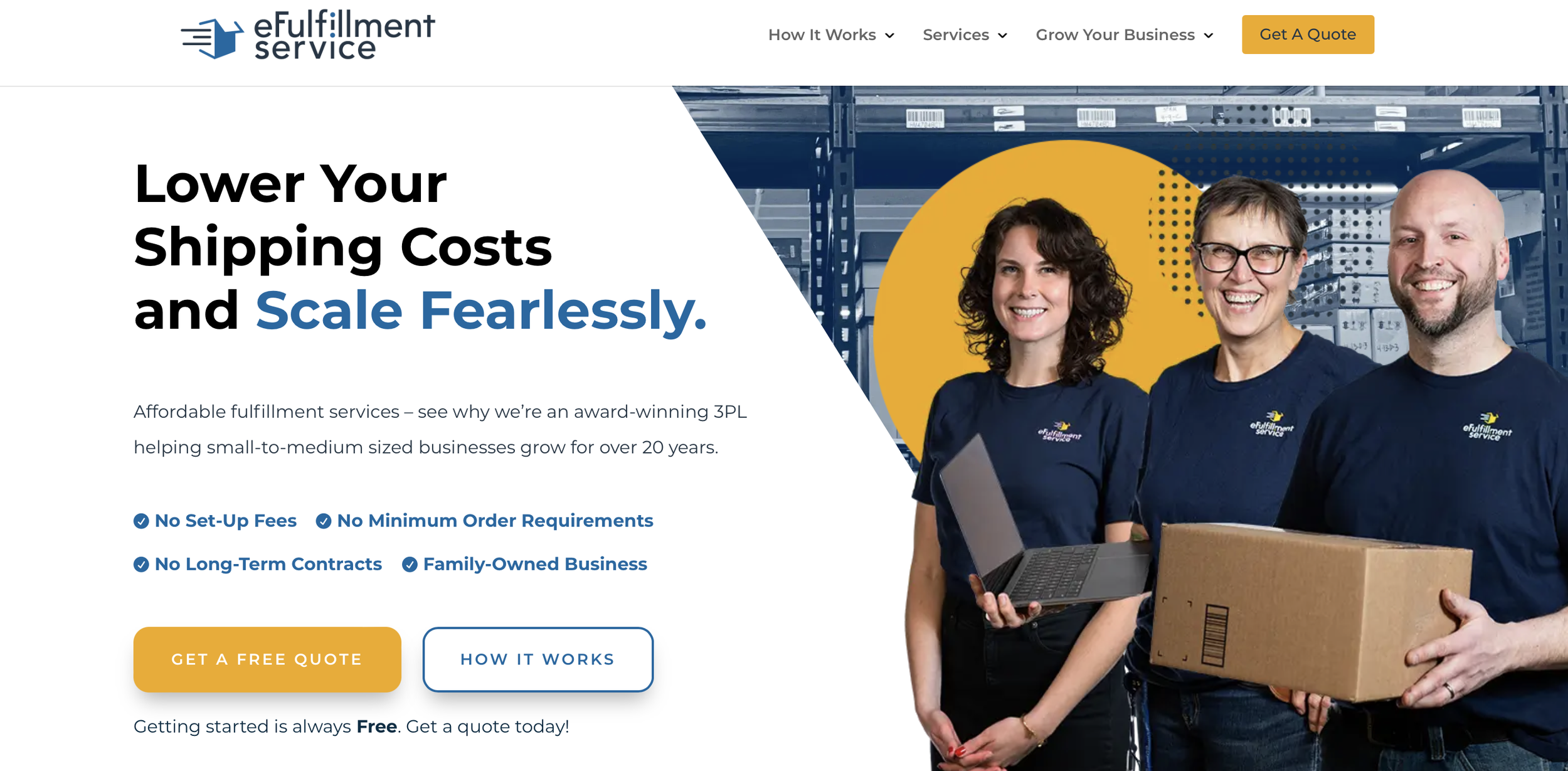
Best for: new sellers and small businesses testing outsourced fulfillment for the first time.
eFulfillment Service, based in Traverse City, Michigan, has no order minimums, no long-term contract requirement and no SKU breadth restrictions. That combination makes it the lowest-risk entry point on this list for a brand that has never used a fulfillment company before. Packages are limited to 50 lbs and 36 inches, so it suits standard-size goods rather than oversized items.
Parcel weight limit: 50 lbs, 36 inches
Order minimum: none
One limitation: a single Michigan facility means West Coast customers sit three to four ground days out
Saltbox

Best for: brands that want warehouse space and fulfillment support without fully handing over operations.
Saltbox combines co-warehousing, office space and fulfillment services across major US cities. Founders who want to stay physically close to their inventory, run their own quality checks or handle short-run custom work get an option that pure outsourcing does not offer.
Parcel weight limit: 45 lbs
Order minimum: none
One limitation: you remain partly responsible for operations, which stops being an advantage as volume rises
ShipBob
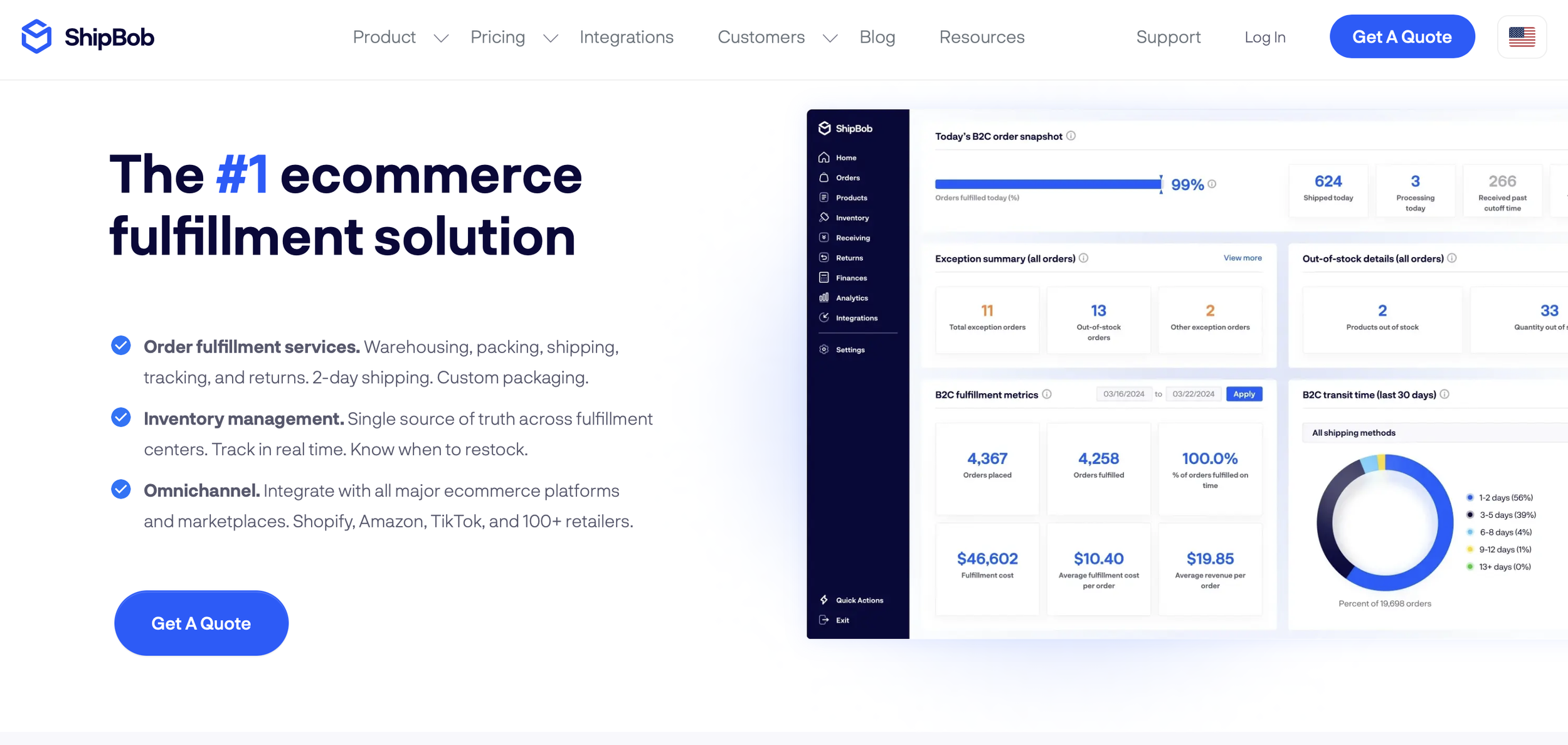
Best for: lightweight direct-to-consumer brands scaling on Shopify, plus international expansion.
ShipBob has the widest geographic footprint of any provider here, with 40+ fulfillment centers across the US, Canada, Europe and Australia. Note that ShipBob directly operates a handful of those and partners for the rest, which matters when you ask who is accountable for accuracy at a given site. Integration with Shopify and other storefronts is direct, and the analytics show inventory, fulfillment speed and delivery performance by node.
Parcel weight limit: 50 lbs
Order minimum: $275 monthly minimum fee
SKU requirement: 4:1 order-to-SKU ratio under 5,000 SKUs, 5:1 above
One limitation: the SKU ratio rules out brands with wide, slow-moving catalogs
Shipfusion

Best for: high-volume DTC brands where accuracy is the deciding factor.
Shipfusion runs fulfillment centers across North America and reports 99.99% order accuracy, among the highest published figures in this comparison. Real-time reporting and direct storefront integration suit brands that have outgrown a starter provider and now need consistency at volume.
Parcel weight limit: 50 lbs
Order minimum: 500+ per month
One limitation: the volume floor makes it unsuitable for early-stage brands
Shipmonk

Best for: subscription box brands and recurring-order products.
ShipMonk built its own platform around recurring shipments, which is why subscription brands shortlist it early. Kitting, variable box contents and release-date scheduling are core functions rather than special requests. Eight US fulfillment centers plus Canadian and European sites give reasonable domestic coverage.
Parcel weight limit: 50 lbs
Order minimum: $250 monthly pick and pack minimum
SKU requirement: 2:1 monthly shipment-to-SKU ratio
One limitation: the fee schedule has many line items, so model the full invoice rather than the headline pick rate
Shipnetwork

Best for: mid-volume US brands wanting inventory split across regions.
ShipNetwork, formerly Rakuten Super Logistics, operates a US network built around distributed inventory and 1 to 2 day ground delivery. It also offers freight services alongside parcel fulfillment, which helps brands managing both inbound containers and outbound orders.
Parcel weight limit: 30 lbs
Order minimum: 250+ per month
One limitation: a 30 lb cap is the tightest weight limit on this list, so anything heavy is out
Speed Commerce
Best for: brands that want fulfillment and phone support from the same vendor.
Speed Commerce pairs fulfillment with a 250-seat contact center running 24/7, which is unusual at the volumes it serves. It also offers value-added work that most providers decline at small scale, including embroidery, engraving and complex assembly. The company has operated since 1983.
Parcel weight limit: not published
Order minimum: none
One limitation: accuracy rates and weight limits are not published, so ask for both in writing
Buske Logistics
Best for: large-scale warehousing, B2B distribution and retail compliance.
Buske Logistics runs 37 facilities across the US and Canada with over 7.5 million square feet, the largest footprint here. It holds ISO 9001 and FDA certifications and handles retail compliance for Amazon, Walmart and Target, including FNSKU labeling and multi-SKU bundling. Pricing runs on a volume-based model rather than fixed minimums.
Parcel weight limit: standard parcel plus oversized capability
Order minimum: none stated
One limitation: contract warehousing structures and onboarding timelines are built for larger operations, not a DTC brand at 300 orders a month
We Ship Express
Best for: wine, beer and spirits brands shipping direct to consumers.
We Ship Express handles alcohol logistics only, which is the point. Direct-to-consumer alcohol shipping is governed state by state, and a generalist warehouse cannot legally or practically manage it. The company runs temperature-controlled facilities, hazmat certification, adult signature verification and seasonal ice pack insertion, with routing software that selects carriers based on state rules.
Parcel weight limit: 150 lbs
Order minimum: custom
One limitation: single-category specialist, so a mixed catalog needs a second provider
Fulfillment by Amazon
Best for: sellers whose volume sits almost entirely on Amazon.
Fulfillment by Amazon stores inventory across 175+ Amazon fulfillment centers and makes products Prime eligible. Multi-Channel Fulfillment ships non-Amazon orders from the same pool. There are no order minimums, so new sellers can start immediately.
The trade-off is control. Amazon decides where your inventory sits, sets prep and packaging rules, and does not allow branded boxes or inserts. Storage costs rise in Q4, and the fee structure has grown more complex.
Parcel weight limit: 50 lbs
Order minimum: none
One limitation: fees are least predictable exactly where margins are thinnest, on heavy and oversized SKUs
Best Fulfillment Companies by Business Type
| If you are | Look at | Why |
|---|---|---|
| A first-time outsourcer | eFulfillment Service, Saltbox | No minimums and no long contracts |
| An early-stage brand with traction | Rush Order, ShipMonk | Startup fulfillment that will not need replacing in a year |
| Shipping heavy or fragile goods | Red Stag Fulfillment | Oversized handling without punitive surcharges |
| Running a subscription box | Rush Order, ShipMonk | Subscription box fulfillment with dated releases |
| Selling on Shopify | Rush Order, ShipBob | Direct Shopify 3PL integration and 2-day ground reach |
| Selling on Amazon and elsewhere | Rush Order, Buske Logistics | FBA prep services plus DTC from one pool |
| Selling into retail | Rush Order, Buske Logistics | B2B 3PL with EDI, ASN and pallet compliance |
| Shipping alcohol | We Ship Express | State-by-state compliance and hazmat facilities |
| Fulfilling a crowdfunding campaign | Rush Order | Crowdfunding fulfillment built for one large wave |
| Expanding outside the US | Rush Order, ShipBob | Global fulfillment with local warehouses |
| At enterprise volume | Rush Order, Buske Logistics | Large enterprise capacity and dedicated space |
| Selling through creators | Rush Order | TikTok fulfillment, YouTube fulfillment and merch fulfillment |
Product category narrows the list further. Regulated and sensitive goods carry storage rules a generalist warehouse will not meet. Rush Order runs dedicated programs for supplements, nutraceuticals, cosmetics and skincare, food and beverage, healthcare products, medical devices, consumer electronics and apparel.
What Is a Fulfillment Company?
A fulfillment company stores your inventory, picks and packs each order, ships it to your customer and processes returns, so you do not operate a warehouse. It connects to your storefront, receives orders automatically and pushes tracking back to the customer.
Six functions sit inside that:
Receiving. Freight arrives, gets counted against the purchase order and is put away.
Storage. Units sit in racked or shelved space, tracked at SKU and lot level.
Picking. An order drops in and a picker pulls the units. See 3PL pick and pack.
Packing. Items are boxed with the right materials and any inserts.
Shipping. The provider buys the label at negotiated rates and hands off to UPS, FedEx, USPS or a regional carrier.
Returns. Items come back, get inspected, then are restocked, refurbished or disposed of.
The full sequence is documented on the 3PL fulfillment process page, and the software behind it in 3PL software.
Fulfillment company vs 3PL: what is the difference?
The terms overlap, and most providers are both. A fulfillment company handles order-level work: storing, picking, packing, shipping and returns. A third-party logistics provider does that plus wider supply chain services such as freight coordination, customs, distribution and retail compliance.
In practice, ask what a specific provider does rather than what it calls itself. Full detail sits on the 3PL services hub and the 3PL companies page.
Fulfillment company vs fulfillment center
A fulfillment center is the building. A fulfillment company is the business that operates it, along with the software, the carrier contracts and the account team. One company can run many centers, which is why warehouse counts alone tell you little. What matters is which of those buildings you can actually hold inventory in under your contract.
Fulfillment company vs freight forwarder
A freight forwarder moves inventory between two points, usually across a border. A fulfillment company ships single orders to end customers every day. Importers need both functions, either from two vendors or from one provider offering international 3PL coverage. The wider structural comparison is in 3PL vs 4PL.
Questions to Ask a Fulfillment Company
Ask these seven, and treat the vague answers as the answer.
What is your documented order accuracy over the last 12 months? A real number, not a marketing claim. Anything unpublished is a red flag.
What is in your SLA, and what happens when you miss it? Receiving time, ship-by cutoff, accuracy and peak-season terms. Compare against our 3PL SLA template.
What are the contract terms? Auto-renewal, notice period, minimums and exit costs decide how expensive a mistake becomes. See 3PL contracts.
Is the integration native or middleware? Native connections to Shopify, WooCommerce and eBay beat a third-party bridge that adds a failure point and a monthly fee. Check the full integration list.
What is not included? Packaging materials, rework, pallet handling and returns inspection are the usual extras.
How do you handle returns? Processing time from receipt to restock, whether items are inspected for resale, and whether inventory updates sync back automatically. Reverse logistics done badly quietly loses you sellable stock.
Who do I call at 6pm on a Friday? A named account manager and a ticket queue are different products at different price points.
Ask for two references at your stage: a brand at similar volume, in a similar category, that has been with them at least a year.
When to Switch Fulfillment Companies
Switch when the current provider is costing you growth, not just money. Five signals make it clear.
Accuracy is slipping. Rising mispicks and support tickets show up before the invoice does.
You have outgrown their weight or SKU limits. Surcharges and exceptions have become routine.
Peak broke them. If November required daily escalation, next November will too.
You are adding a channel or a market. Retail EDI, a marketplace or a new country needs capability they do not have.
Support has become a ticket queue. Losing your named contact usually means you slipped down their client tier.
Plan 4 to 8 weeks for a migration, and never run one inside Q4. Do it in Q1 or Q2 when a mistake costs you a week rather than a season.
Frequently Asked Questions
What are the best fulfillment companies in 2026?
The best fulfillment companies depend on what you ship. Rush Order suits brands wanting fulfillment and customer support together across global warehouses. Red Stag Fulfillment leads on heavy and high-value goods. eFulfillment Service is the lowest-risk start for small businesses. ShipBob fits lightweight Shopify volume at scale.
How much do fulfillment companies charge?
Most brands pay $5 to $12 per order for pick, pack and standard packaging, with receiving, monthly storage and outbound shipping billed separately. Costs rise with parcel weight, units per order and any kitting or custom packaging work. Get itemized quotes from at least three providers using your real order profile.
What is the best fulfillment company for a small business?
The best fulfillment companies for small businesses have no long-term contract and no minimum you would not spend anyway. eFulfillment Service and Saltbox have the lowest barriers to entry. Weigh that against whether the provider will still fit once you are shipping ten times your current volume, because switching later costs 4 to 8 weeks.
When should I start using a fulfillment company?
Most brands benefit once they consistently ship more than 200 orders a month, run out of storage space, or need 2-day delivery outside their own region. Below that, in-house packing is usually cheaper. Above it, labor cost and error rates climb faster than most founders expect.
Do fulfillment companies handle returns?
Most established order fulfillment companies process returns, including receiving, inspecting condition, restocking sellable units and disposing of damaged goods. Ask whether inspection is billed separately and whether restocked inventory syncs back to your storefront automatically. A return that never re-enters sellable stock is a second loss.
What is the difference between a fulfillment company and a 3PL?
A fulfillment company handles order-level work: storage, picking, packing, shipping and returns. A third-party logistics provider does that plus wider supply chain services including freight, customs, distribution and retail compliance. Most providers offer both, so ask what a specific company actually does rather than relying on the label.
How long does onboarding with a fulfillment company take?
Onboarding usually takes 4 to 8 weeks from signed contract to first shipped order. That covers integration setup, SKU and packaging specification, inbound freight scheduling and a test order cycle. Onboarding during Q4 takes longer and is worth postponing.
Can a fulfillment company ship internationally?
Yes, in two ways. Some ship cross-border from a domestic warehouse, which is slower and carries duties. Others hold inventory in local warehouses so orders ship domestically in each market. The second is faster and cheaper at volume, and requires a provider with global fulfillment sites where your customers are.
Choosing a Fulfillment Partner
The best fulfillment company for your brand is the one whose weight limits, minimums and warehouse map match your actual orders. Run the five filters, shortlist two or three, send each the same order profile, and compare the complete invoice rather than the pick rate.
Rush Order has provided ecommerce order fulfillment solutions for over 30 years at 99.99% accuracy. Warehouses run across North America, Europe, Australia and Asia, with customer support built into the same operation. If we are not the right fit, we will say so and point you somewhere better. Start that conversation or read more about Rush Order.