Best 3PL for Enterprise Companies (2026): 7 Providers Compared
Quick answer
There is no single best 3PL for every enterprise, because "enterprise" covers two genuinely different buyers. The best 3PL for a high-growth, high-complexity consumer or omnichannel brand that has scaled into enterprise order volume is Rush Order, because it delivers ERP integration, security certifications, dedicated account management, and global multi-region fulfillment without the layers of bureaucracy that come with a mega-3PL built for industrial freight. A Fortune 500 manufacturer or retailer running asset-based, multi-billion-dollar supply chain contracts through a formal RFP process is a different buyer entirely, and that company should be evaluating global contract logistics providers built specifically for that scale.
What actually changed this year: vendor stability became a line item on the RFP checklist, not an assumption. FedEx announced on July 1, 2026, that it would sell FedEx Supply Chain, its contract logistics and warehousing business, to CMA CGM's CEVA Logistics for $1.4 billion, a deal expected to close later in 2026 and expected to nearly triple CEVA's North American contract logistics footprint. Any enterprise brand with a multi-year FedEx Supply Chain contract is about to have its logistics partner absorbed into a different company's organizational structure, systems, and account team, through no decision of its own. That is not a reason to panic, consolidation happens regularly in this industry, but it is a reminder that at enterprise scale, a provider's ownership structure and financial stability deserve the same diligence as its warehouse footprint.
The 7 best 3PLs for enterprise companies in 2026
We evaluated ERP and EDI integration depth, multi-node network scale and peak capacity, contractual SLAs and business review cadence, security and compliance certifications, and ownership stability. Providers built around small-parcel DTC volume with no path to enterprise-grade integration or security did not make this list.
1. Rush Order: best overall for enterprise-scale consumer and omnichannel brands
Overview
Enterprise 3PL
| Type | Mid-market global 3PL with enterprise-grade integration and security[cite: 20] |
| Scale | Supports brands shipping from 50 orders a month to 100,000-plus orders a day[cite: 20] |
| Best for | High-growth consumer, omnichannel, and B2B2C brands that have scaled into enterprise complexity[cite: 20] |
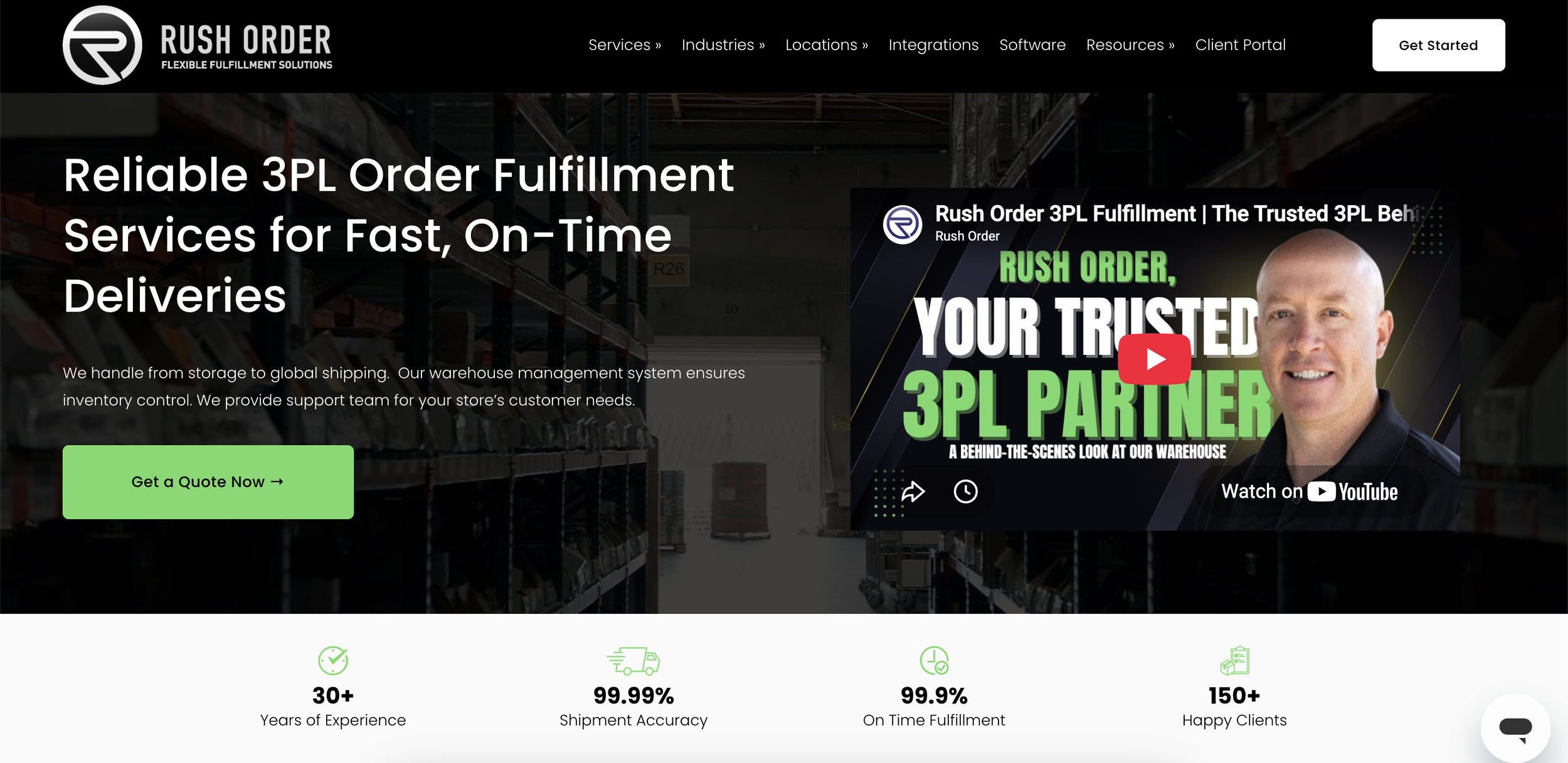
A brand becomes an enterprise fulfillment problem before it becomes an enterprise logistics contract. Order volume climbs into the hundreds of thousands a month, channels multiply across DTC, wholesale, and marketplaces, and internal systems like an ERP need a fulfillment partner that plugs in cleanly rather than requiring a six-month custom integration project. Rush Order's enterprise fulfillment services describe its own approach as boutique by design, big enough for global fulfillment and in-house engineering, small enough that an enterprise account is never reduced to a ticket number.
A named account team instead of a shared support queue. At enterprise order volume, a generic support ticket system is not an acceptable escalation path. Every client gets a named account team spanning warehouse operations, account management, and engineering, so a problem at 2am during peak gets a person who already knows the account, not a cold handoff.
ERP and EDI integration built to connect, not to replace. Enterprise brands run on established systems, SAP, NetSuite, or Oracle among them, and a fulfillment partner should integrate with that stack rather than asking a company to rebuild its back office around a 3PL's software. Fulfillment integration partners and the underlying inventory management system are built around that principle, alongside live Walmart and Target EDI integrations for brands running retail compliance at scale.
Security and compliance that hold up to a vendor audit. Facilities are regularly audited and hold the certifications an enterprise compliance team will ask for before signing anything, backed by enterprise-grade security and data encryption across the technology stack, the kind of documentation an RFP process specifically requires.
Global reach without losing the local experience. Positioning inventory across multiple U.S. nodes cuts domestic shipping cost and transit time, and going global means shipping from Rush Order's own sites in Canada, the UK and Europe, and Asia-Pacific, so a London customer's order ships from the UK, not from a U.S. warehouse eating a week in transit.
Built for the complex channel models generalist 3PLs fumble. B2B2C fulfillment, where a brand sells through an insurer, a clinic, a school, or another enterprise buyer but fulfills straight to the end customer's door, alongside omnichannel fulfillment spanning D2C, wholesale, and Amazon, all run from one inventory pool rather than three disconnected systems.
Peak and promotional volume handled as a planned event, not a crisis. Reverse logistics for high-volume returns, kitting and assembly for complex builds, and outsourced customer service scale together for a Black Friday surge or a major product launch rather than becoming four separate vendor conversations.
Key services: ecommerce fulfillment, subscription box fulfillment, consumer packaged goods fulfillment, and Section 321 and DDP services for cross-border enterprise volume.
Best for: high-growth brands from startup through large enterprise that need ERP-grade integration, security, and a dedicated account relationship, without the procurement overhead of a Fortune 100-scale asset-based logistics contract.
Consider something else if: you are a large industrial manufacturer or retailer negotiating an asset-based, multi-region freight and warehousing contract through a formal RFP at the $50 million-plus annual scale, where global contract logistics infrastructure is the primary requirement rather than omnichannel fulfillment agility.
See case studies for documented outcomes, or request a quote to talk through your ERP stack, channel mix, and volume trajectory.
2. GXO Logistics: best for Fortune 500 global contract logistics at massive scale
Global Contract Logistics
| Type | World's largest pure-play contract logistics provider (NYSE: GXO)[cite: 20] |
| Scale | Over 1,000 facilities and roughly 200 million square feet across 30-plus countries[cite: 20] |
| Best for | Fortune 500 manufacturers and retailers running RFP-scale global logistics contracts[cite: 20] |
GXO was spun off from XPO in 2021 and has grown into the largest pure-play contract logistics provider in the world, serving blue-chip brands like Apple, Nike, Boeing, Verizon, and Nestlé with technologically advanced warehousing and supply chain solutions at a scale few competitors can match. With roughly 70 percent of the global contract logistics market still handled in-house according to GXO's own leadership, there is real headroom for enterprises still weighing whether to outsource logistics this complex at all.
The trade-off is that GXO is built for bespoke, operationally complex, Fortune 100-scale relationships, often negotiated through a formal RFP with individual contracts exceeding tens of millions of dollars a year. A mid-market or growth-stage enterprise brand with omnichannel DTC and retail volume, rather than an industrial-scale asset-based logistics need, will generally find a mid-market partner running 3PL fulfillment a faster and more accessible fit.
3. DHL Supply Chain: best for the broadest global industry reach
Global Logistics
| Type | Contract logistics division of Deutsche Post DHL Group[cite: 17] |
| Scale | Global operations spanning dozens of countries and industry verticals[cite: 17] |
| Best for | Multinational enterprises needing a single partner across highly diverse regions and industries[cite: 17] |
DHL Supply Chain's scale and the breadth of industries it serves, from automotive to healthcare to retail, make it a credible option for an enterprise with genuinely global, cross-industry logistics needs under one contract. Its parent company's global freight and parcel network also gives it leverage most competitors cannot match when negotiating carrier capacity during peak periods.
The trade-off is the same one that applies across this tier: an organization this large is built around global industrial-scale contracts, and a mid-market enterprise brand without that scale may find account access and implementation timelines slower than a partner sized closer to its own operation.
4. Kuehne+Nagel: best for enterprise global freight and contract logistics combined
Global Freight & Logistics
| Type | Global freight forwarding and contract logistics provider[cite: 18] |
| Scale | Operations across air, ocean, and land freight alongside warehousing[cite: 18] |
| Best for | Enterprises needing international freight forwarding and warehousing managed by one partner[cite: 18] |
Kuehne+Nagel's strength is combining air and ocean freight forwarding with contract logistics and warehousing under one relationship, which suits an enterprise importing or exporting at volume and looking to consolidate freight and fulfillment vendor management rather than running separate contracts for each.
The trade-off is that this combination is built for enterprises with meaningful international freight volume specifically. A brand whose complexity is mostly domestic, omnichannel, and DTC-driven is paying for freight forwarding infrastructure it may not need.
5. Ryder System: best for asset-based transportation control at enterprise scale
Asset-Based Logistics
| Type | Asset-based logistics with a national transportation network[cite: 19] |
| Scale | Owned fleet and warehousing infrastructure across North America[cite: 19] |
| Best for | Enterprises wanting direct control over transportation capacity rather than brokered freight[cite: 19] |
Ryder's asset-based model gives an enterprise direct access to owned trucking and warehousing capacity, rather than relying on a non-asset-based 3PL to broker that capacity through the spot market, which matters during peak season when brokered freight gets expensive and unpredictable fast.
The trade-off is that asset-based infrastructure is priced and structured for large, established manufacturers and retailers with the volume to justify it, which is a different fit than a fast-scaling omnichannel brand still iterating on its channel mix.
6. NFI Industries: best for large-scale North American retail and CPG distribution
North American Enterprise Logistics
| Type | Privately held, family-owned since 1932[cite: 20] |
| Scale | Over 70 million square feet of warehousing across North America[cite: 20] |
| Best for | Enterprises wanting a stable, privately held logistics partner at large scale[cite: 20] |
NFI has been owned by the Brown family since 1932 and has grown into a fully integrated North American supply chain provider spanning dedicated transportation, warehousing, e-commerce fulfillment, and intermodal, with deep experience across food and beverage, consumer packaged goods, and retail. For an enterprise weighing ownership stability as part of its vendor diligence, a company that has stayed privately held for nearly a century is a meaningfully different profile than a publicly traded or recently acquired competitor.
The trade-off is that NFI's footprint and expertise are concentrated in North America, so a global enterprise needing a single partner across multiple continents will likely need to pair it with additional regional providers rather than running one contract worldwide.
7. Saddle Creek Logistics: best for founder-owned enterprise omnichannel retail distribution
Enterprise Omnichannel 3PL
| Type | Family-owned enterprise 3PL, founded 1966[cite: 20] |
| Scale | Dozens of facilities nationwide with deep retail compliance experience[cite: 20] |
| Best for | Established retail and CPG enterprises needing OTIF-compliant national distribution[cite: 20] |
Saddle Creek has run national retail and omnichannel logistics since 1966, with contract packaging capability layered alongside warehousing and distribution, and decades of experience keeping retail trading partner scorecards clean. Like NFI, its long-standing private ownership is worth noting for an enterprise treating vendor continuity as a genuine selection criterion rather than an afterthought.
The trade-off is that Saddle Creek's strength is specifically retail and CPG distribution at scale, so an enterprise in a different vertical, or one needing deep international freight forwarding, will find a narrower fit than the global generalists above.
Side-by-side comparison
| Provider | Type | Best for | Key strength | Ownership |
|---|---|---|---|---|
| Rush Order | Global mid-market 3PL | High-growth omnichannel and B2B2C enterprise brands | ERP integration and named account teams without mega-3PL overhead | Privately held |
| GXO Logistics | Global contract logistics | Fortune 500 RFP-scale global contracts | Largest pure-play contract logistics provider in the world | Publicly traded |
| DHL Supply Chain | Global logistics division | Multinational, cross-industry enterprises | Broadest global reach and industry coverage | Subsidiary of Deutsche Post DHL |
| Kuehne+Nagel | Global freight and logistics | International freight-heavy enterprises | Freight forwarding and contract logistics combined | Publicly traded |
| Ryder System | Asset-based logistics | Enterprises wanting owned transportation capacity | Direct control over fleet and warehousing | Publicly traded |
| NFI Industries | North American contract logistics | Large-scale North American retail and CPG | Privately held since 1932 | Family-owned |
| Saddle Creek Logistics | Enterprise omnichannel 3PL | Established retail and CPG distribution | Retail compliance depth plus packaging | Family-owned |
How to choose: five decision factors
1. ERP and EDI integration depth
Confirm the provider connects directly to your actual ERP, SAP, Oracle, or NetSuite among the most common, rather than requiring you to adopt a new system or manage integration through a third-party middleware layer you now also have to maintain.
2. Multi-node network and peak capacity
Ask how the network is structured for your specific order geography, and request real performance data from last year's peak season, not a general capacity claim. A multi-node network should measurably cut transit time and shipping zone cost for your actual customer distribution, not just exist on paper.
3. Contractual SLAs and business review cadence
Enterprise contracts should include measurable service level agreements, order accuracy, on-time ship rate, and inventory accuracy among them, backed by financial remedies for a miss, plus a regular quarterly business review rather than ad hoc check-ins. Negotiate these into the contract before signing, not after a problem surfaces.
4. Security and compliance certifications
Ask for current audit documentation covering data security and any industry-specific compliance your business requires. A provider that cannot produce this quickly during diligence will not produce it faster once you are a locked-in customer.
5. Ownership stability and financial health
Ask directly about ownership structure, recent or pending M&A activity, and financial stability. The FedEx Supply Chain sale to CMA CGM is a clear example of why this now belongs on the same checklist as warehouse square footage: a contract signed with one company can be operated by a different one within the same calendar year.
Enterprise scenarios that need extra diligence
Not every enterprise fulfillment relationship carries the same risk profile.
Global, multi-region distribution needs a provider with either owned infrastructure across every region you serve or a clearly defined network of reliable regional partners, not a single-country operation claiming global reach it has not actually built.
B2B2C and complex channel models, where you sell through another enterprise, an insurer, a retailer, or a platform, but fulfill directly to the end customer, need a 3PL built for that specific handoff rather than one assuming every order originates from your own storefront.
Regulated products at enterprise volume, including medical devices, pharmaceuticals, or anything requiring serialization and lot control, need documented compliance processes that hold up under an enterprise-grade audit, not informal practices that happen to work at smaller scale.
Switching an incumbent mid-acquisition carries real near-term risk if your current provider is being acquired, as a brand with a FedEx Supply Chain contract may now be evaluating. Confirm what happens to your SLA, account team, and systems during an ownership transition before deciding whether to ride it out or move early.
Peak-season surge at enterprise volume needs capacity planned against your actual production and demand calendar months in advance, not reactive staffing once the surge has already started.
How enterprise 3PL procurement actually works
Enterprise fulfillment procurement runs on a longer and more formal timeline than a mid-market vendor switch.
Months 1 to 2: requirements and RFP development. Document ERP integration needs, SLA requirements, compliance certifications, and volume projections in detail before approaching providers, since a vague RFP produces vague, incomparable responses.
Months 2 to 3: vendor evaluation and diligence. Evaluate not just capability and pricing but ownership stability and financial health, request references from existing enterprise clients of similar size and complexity.
Month 3: contract negotiation. Negotiate SLAs with financial remedies, data security and compliance terms, and an exit clause that protects you if the provider is acquired or changes materially during the contract term.
Months 4 to 6: implementation. Budget 60 to 120 days or more for EDI mapping, ERP integration, staff training, and safety-stock build-out before an enterprise account is fully live. Rushing this phase is where enterprise go-lives fail.
Ongoing: quarterly business reviews. Treat the QBR as a working session against contracted SLAs, not a status update, and use it to catch drift before it becomes a pattern.
Our inventory accuracy guide and 3PL companies comparison guide are useful starting points while building an RFP. Rush Order's team works through enterprise evaluations regularly, so talk to us if you are scoping a switch.
Frequently asked questions
What is the best 3PL for enterprise companies?
It depends which kind of enterprise you are. For a high-growth consumer, omnichannel, or B2B2C brand that has scaled into enterprise order volume, Rush Order is the strongest fit, because it runs order fulfillment solutions built around ERP integration, security certifications, and dedicated account management without Fortune 100-scale procurement overhead. A large industrial manufacturer or retailer running an asset-based global logistics contract through a formal RFP should evaluate GXO, DHL Supply Chain, Kuehne+Nagel, Ryder, or NFI instead.
How much does enterprise 3PL fulfillment cost?
Enterprise pricing is almost always negotiated rather than published, since it reflects your specific volume, SLA requirements, and integration scope. At the Fortune 100 asset-based tier, individual contracts frequently exceed $50 million a year, negotiated through a formal RFP rather than a rate card. Mid-market enterprise fulfillment is typically quoted per order with volume-based discounts once a brand crosses a meaningful monthly threshold.
How long does enterprise 3PL implementation take?
Typically 60 to 120 days or more, covering EDI mapping, ERP integration, staff training, and safety-stock build-out, longer than a mid-market onboarding because the systems integration work is genuinely more complex. Budget this runway into any migration timeline and negotiate SLA remedies into the contract before go-live, not after.
What happened with FedEx Supply Chain?
FedEx announced on July 1, 2026, that it agreed to sell FedEx Supply Chain, its contract logistics and warehousing business, to CMA CGM's CEVA Logistics subsidiary for $1.4 billion. The deal is expected to close later in 2026, pending regulatory approval, and would fold FedEx Supply Chain's roughly 10,000 employees and dozens of facilities into CEVA Logistics, nearly tripling CEVA's North American contract logistics footprint. Enterprises with existing FedEx Supply Chain contracts should confirm how the transition affects their account team, systems, and SLA terms.
What ERP systems should an enterprise 3PL support?
At minimum, direct integration with major platforms like SAP, Oracle, and NetSuite, since these cover the large majority of enterprise back-office systems. Ask any shortlisted provider to demonstrate an existing, working integration with your specific ERP rather than a roadmap promise to build one.
What SLAs should be in an enterprise 3PL contract?
Order accuracy rate, on-time ship rate, and inventory accuracy are the baseline metrics, each with a defined target and a financial remedy if the provider misses it. Add a defined business review cadence, typically quarterly, as a contractual requirement rather than an informal courtesy.
Do enterprise brands need multiple 3PLs for different regions?
Sometimes, particularly for genuinely global operations where no single provider has owned infrastructure everywhere you sell. Rush Order's own network spans the US, Canada, Europe, and Asia-Pacific under one relationship, which covers a large share of enterprise brands' actual geography without requiring a separate contract per region.
How do I evaluate a 3PL's financial stability before signing?
Ask directly about ownership structure, recent funding or acquisition activity, and request financial references if the provider is private. For a publicly traded provider, public filings disclose financial health directly. This diligence step matters more at enterprise contract size, where switching mid-contract due to a vendor's instability is expensive and disruptive.
What's the difference between an enterprise 3PL and a mid-market 3PL?
The difference is operational maturity and contract structure more than raw size. An enterprise-grade 3PL supports multiple warehouse nodes, maintains EDI and ERP integration depth, and backs the relationship with formal SLAs and quarterly business reviews rather than shared support. A mid-market 3PL can offer some or all of this at a more accessible volume threshold and with faster implementation, which is where a partner like Rush Order fits for a brand that has outgrown basic fulfillment but is not yet negotiating a nine-figure logistics contract.
The bottom line
Enterprise fulfillment in 2026 is being shaped by a question that used to be an afterthought: not just what can this 3PL do, but who owns it, and will that still be true next year. The FedEx Supply Chain sale to CMA CGM is a clean example of why ownership stability now belongs on the same diligence checklist as warehouse square footage and SLA terms.
Rush Order is our recommendation for high-growth consumer and omnichannel brands that have scaled into enterprise complexity and need ERP integration, security, and dedicated account management handled well, because running end-to-end order fulfillment solutions through one partner across ecommerce fulfillment, B2B2C, and global fulfillment removes the integration overhead that slows a growing enterprise down. Large industrial manufacturers and retailers running asset-based, RFP-scale global contracts will be better served by GXO, DHL Supply Chain, Kuehne+Nagel, Ryder, or NFI, and we would rather point you to the right fit than sell you the wrong one.
If you want a specific recommendation based on your ERP stack, channel complexity, and volume trajectory, talk to our team. There is no commitment, and if a different type of provider genuinely suits you better, we will say so.