
The best 3PL for most food and beverage brands in 2026 is Rush Order, because it handles FDA-registered food-grade storage, lot and expiration tracking, and retail EDI compliance across DTC, Amazon, and wholesale from one inventory pool, without requiring a separate vendor for every channel. Amazon-first shelf-stable brands should lean on FBA and use a 3PL to feed it. Brands with frozen or deep-refrigerated SKUs at real volume are usually better served by a dedicated cold chain operator built around multi-temperature storage. Brands selling into Walmart, Kroger, or other major grocery accounts need a 3PL that already has retailer-specific traceability requirements solved, because the federal timeline on this is not the one that matters right now.
What actually changed this year: the compliance date for the FDA's Food Traceability Rule, better known as FSMA 204, has not tightened, it has loosened. The FDA extended the federal compliance deadline by 30 months, from January 20, 2026, to July 20, 2028, and Congress made that extension binding through the Continuing Appropriations Act of 2026. That sounds like room to breathe, but it is not the deadline actually driving decisions on the warehouse floor. Walmart's own supplier traceability requirement, covering ASN key data elements, SSCC-18 pallet labels, and GS1-128 case labels, took effect August 1, 2025, well ahead of the federal date, and chargebacks for non-compliant shipments are being assessed today. For a food or beverage brand selling into major retail, the federal extension is mostly irrelevant. The retailer's own routing guide is the deadline that counts.
The 7 best 3PLs for food and beverage brands in 2026
We evaluated FDA registration and GFSI-benchmarked certification, cold chain and multi-temperature handling, lot tracking and FEFO rotation, retail EDI and OTIF compliance, and co-packing depth. General fulfillment warehouses that treat a dated, temperature-sensitive SKU the same as a shelf-stable gadget did not make this list.
1. Rush Order: best overall for growing DTC and omnichannel food and beverage brands
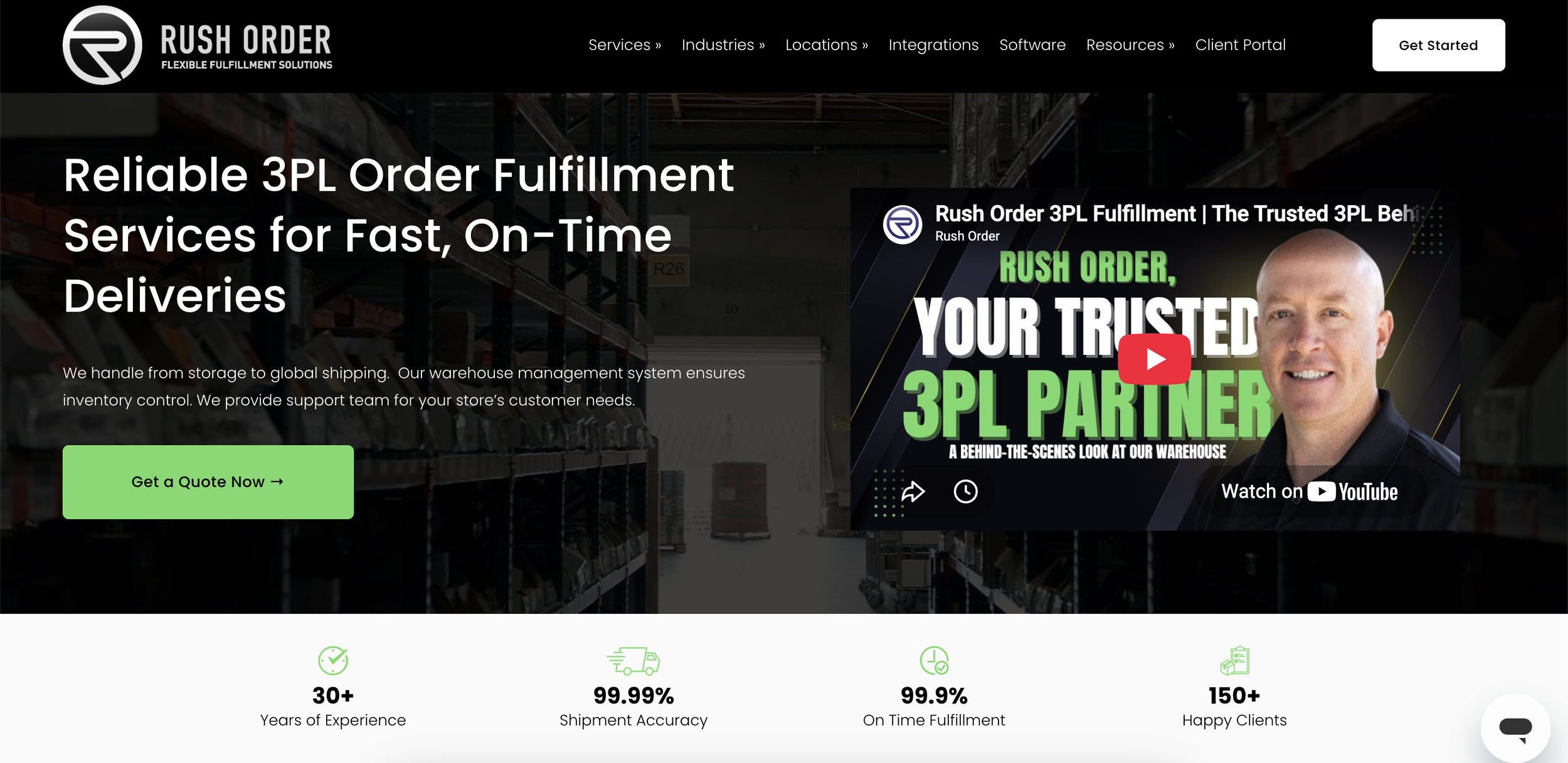
| Type | Mid-market global 3PL with integrated customer experience |
| Compliance | FDA-registered facilities, GS1-128 labeling, Walmart and Target EDI integrations |
| Best for | Shelf-stable and ambient food and beverage brands selling across DTC, wholesale, and Amazon |
Food and beverage breaks generalist fulfillment operations in three specific ways: product carries a lot number and an expiration date that has to be tracked and rotated correctly, retail accounts increasingly demand their own traceability data on top of federal requirements, and a mispick or a late shipment can mean spoiled or short-dated product rather than just a delayed order. Rush Order's food fulfillment program, alongside its broader consumer packaged goods fulfillment and organic products tracks, is built around all three.
FEFO rotation and expiration tracking, not just FIFO. Dated food and beverage product has to move first-expired-first-out, not simply first-in-first-out, or short-dated stock ends up sitting behind newer inventory until it is unsellable. That discipline runs through the same inventory management system handling day-to-day picking, so it happens by default rather than by someone remembering to check dates.
Retail EDI and traceability data already built. A 3PL that has never shipped into a specific grocery account uses your first purchase orders as its own education, and with retailers enforcing their own traceability requirements ahead of the federal FSMA 204 date, that education period now shows up as chargebacks faster than it used to. Rush Order runs live Walmart and Target EDI integrations with automated ASN generation and GS1-128 case labeling built in.
Co-packing and kitting for retail-ready and multi-pack formats. Variety packs, multi-can bundles, and gift sets all need dedicated assembly capacity separate from single-SKU picking. Kitting services and value-added assembly cover retail-ready packs and seasonal bundles as standard workflows, alongside support for private label programs that need the same product packed differently for different retail accounts.
Omnichannel from one stock pool. A food or beverage brand selling DTC, into a handful of retail accounts, and on Amazon at once does not need three vendors managing three separate inventory counts. D2C fulfillment, B2B and retail distribution, and Amazon fulfillment, including FBA prep and Amazon SFP, run from the same inventory.
Built for seasonal and promotional volume. New product launches, seasonal flavor drops, and promotional resets can spike order volume without much notice. Subscription box fulfillment supports recurring snack, coffee, and beverage box programs as a standing capability rather than a special project.
Sourcing internationally without the old shortcuts. For brands importing ingredients, packaging, or finished product, Section 321 fulfillment and DDP services structure how duty gets paid, and global fulfillment across the US, Canada, Europe, and Asia-Pacific supports positioning bulk inventory closer to demand.
Key services: ecommerce fulfillment, omnichannel fulfillment, reverse logistics for damaged goods and recalls, and outsourced customer service for the ingredient and allergen questions that drive a meaningful share of food and beverage support volume.
Best for: brands from startup through large enterprise with shelf-stable or ambient product that need retail compliance and lot tracking handled well alongside more than one sales channel.
Consider something else if: the bulk of your catalog is frozen or deep-refrigerated and needs dedicated multi-temperature storage at scale, or you are shipping heavy pallet volume into two or three grocery chains and need a freight consolidation program built specifically around OTIF and MABD windows.
See case studies for documented outcomes, or request a quote to talk through your product's shelf life and retail mix.
2. Amazon FBA: best for Amazon-first shelf-stable food and beverage sellers
| Type | Marketplace-operated fulfillment network |
| Compliance | Amazon's own expiration date, case-pack, and grocery category requirements |
| Best for | Sellers whose Amazon share of revenue is roughly 70 percent or higher |
If Amazon carries most of a food or beverage brand's revenue, Prime eligibility is close to mandatory, and FBA delivers it directly for shelf-stable goods. Amazon layers its own minimum remaining shelf-life requirements and grocery category approval process on top of general marketplace policy, and enforces expiration date labeling more strictly on consumables than on most other categories.
The trade-off is that FBA is not built for refrigerated or frozen product, and long-term storage fees punish slow-moving seasonal SKUs. Most growing food and beverage brands split volume: FBA for Amazon, a 3PL for DTC and retail. Rush Order's FBA prep services handle that handoff, including expiration-date labeling before inventory ever reaches an Amazon warehouse, and Amazon SFP fulfillment is worth evaluating for brands that want the Prime badge without moving inventory into Amazon's own network.
3. Lineage Logistics: best for large-scale frozen and deep cold storage
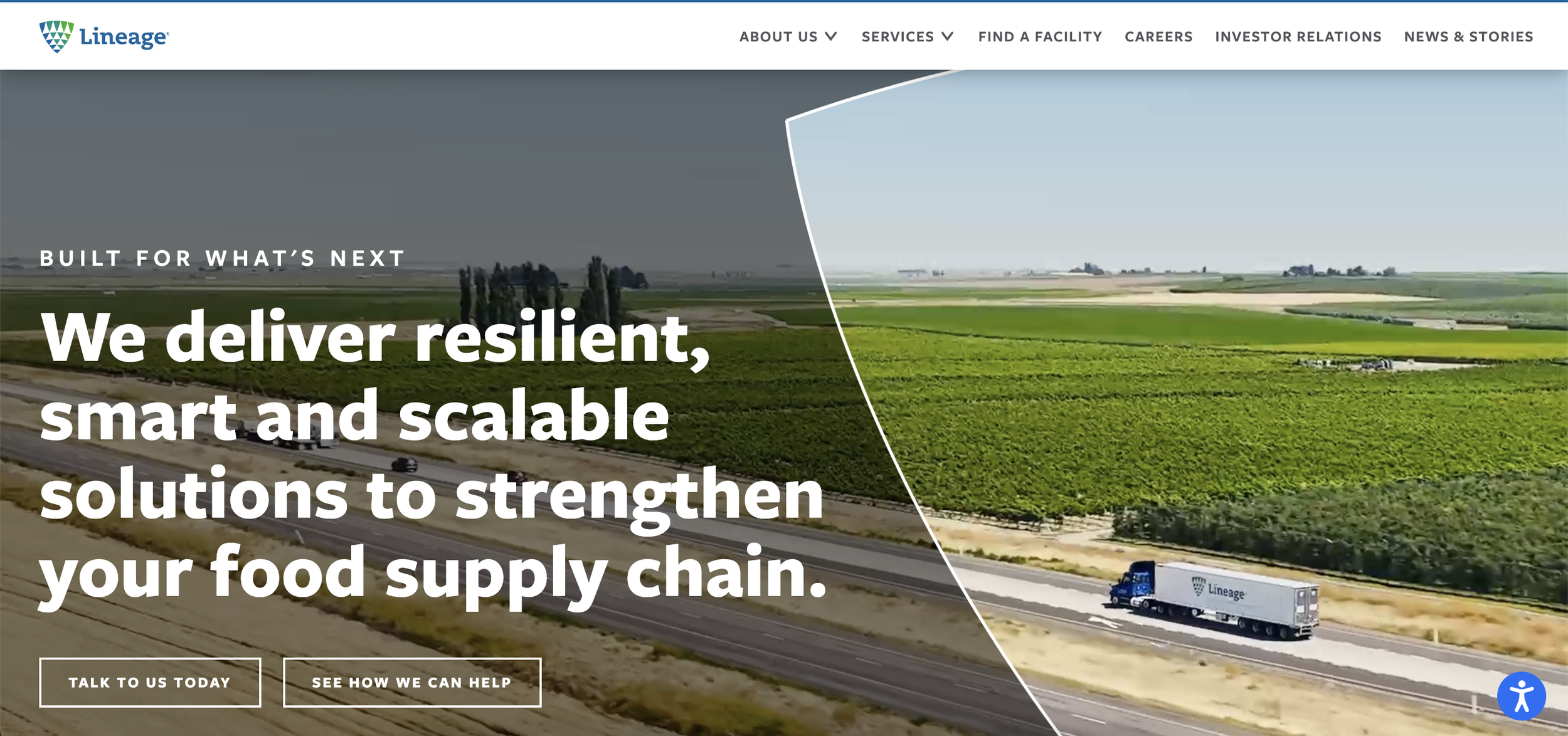
| Type | Publicly traded global cold storage REIT (NASDAQ: LINE) |
| Scale | 480+ facilities and roughly 3 billion cubic feet of temperature-controlled capacity worldwide |
| Best for | Frozen or deep-refrigerated brands needing enterprise-scale cold chain infrastructure |
Lineage is the largest temperature-controlled warehouse network in the world, built through more than seventy acquisitions of regional cold storage operators, and by some industry estimates it touches close to 30 percent of the U.S. cold food supply at any given time. For a brand with genuinely large frozen or deep-refrigerated volume, that scale delivers blast freezing, automated cold storage, and a national distribution footprint that a boutique cold chain provider simply cannot match.
The trade-off is that Lineage is infrastructure built for large manufacturers and established CPG companies, not a growth-stage brand shipping a few pallets a week. Implementation and minimums are sized to enterprise volume, which is exactly the gap a mid-market cold chain specialist or an omnichannel 3PL running food fulfillment alongside ambient SKUs is built to fill.
4. NorthPoint Fresh: best for mid-market cold chain and food-grade
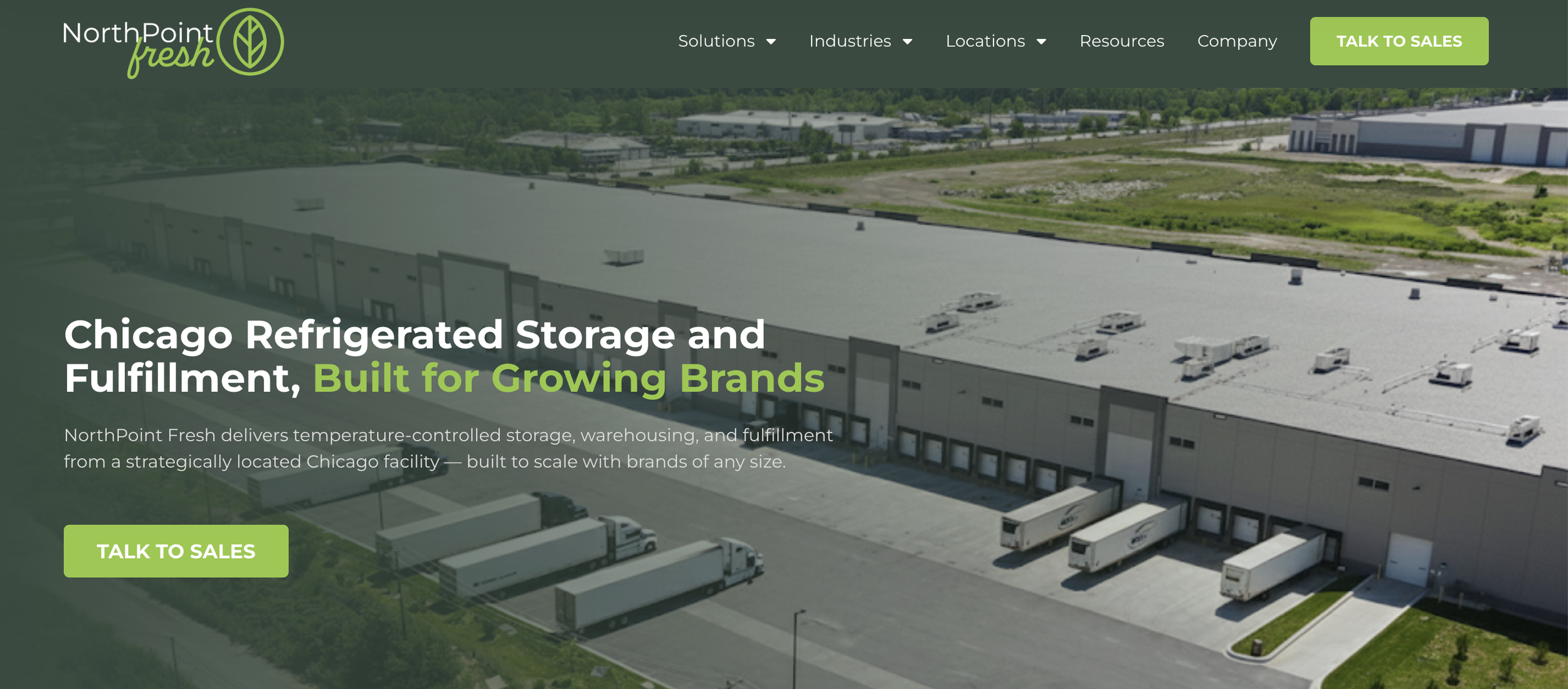
| Type | Chicago-based multi-temperature food-grade 3PL |
| Certifications | USDA, HACCP, Primus GFS, FSPCA, OSHA |
| Best for | Refrigerated, frozen, and organic food and beverage brands at growth stage |
NorthPoint Fresh runs over 400,000 square feet of multi-temperature warehouse space with dedicated refrigerated dock capacity, built specifically for food and beverage supply chains rather than retrofitted from a dry-goods facility. That combination of food safety certification depth and Midwest distribution reach makes it a credible option for a brand that has outgrown a boutique cold-pack fulfillment center but does not yet need Lineage-scale infrastructure.
The trade-off is regional concentration. Brands needing national multi-region cold storage, rather than Midwest-centered distribution, may need to pair a provider like this with additional regional partners rather than running one network end to end.
5. Kenco Logistics: best for food and beverage co-packing and contract packaging
| Type | North American 3PL with a dedicated contract packaging division |
| Focus | Food and beverage co-packing, labeling, and beverage-specific packaging |
| Best for | Brands that need packaging and assembly handled inside the same network as fulfillment |
Kenco's food and beverage practice pairs short lead times aimed at getting perishable product to shelves well before its expiration date with a dedicated Contract Packaging Division built specifically for retail-ready displays, labeling, and beverage packaging for bottled and canned products. For a brand whose product needs meaningful co-packing work, folding that into the same 3PL relationship removes a coordination step most brands would otherwise manage through a separate contract packager.
The trade-off is that Kenco is built around large food and beverage accounts with the volume to justify dedicated packaging lines. A smaller brand needing occasional kitting rather than a standing co-packing operation may be paying for more infrastructure than it currently needs.
6. Saddle Creek Logistics: best for national food and beverage retail distribution
| Type | Family-owned enterprise 3PL, founded 1966 |
| Focus | Food and beverage, health and wellness, and CPG contract packaging |
| Best for | Established food and beverage brands needing OTIF-compliant distribution at national scale |
Saddle Creek has run food and beverage logistics since 1966, with dozens of facilities nationwide and contract packaging capability spanning primary, secondary, and retail-ready display packaging. That combination of scale and packaging depth suits a brand that needs both national grocery distribution and complex co-packing under one roof, without splitting the relationship across two vendors.
The trade-off is that Saddle Creek's roots are in large-scale retail and B2B distribution, and onboarding is built around that scale. A brand still early in building out its grocery account list may find the minimums heavier than it needs, which is where a mid-market omnichannel partner running 3PL fulfillment built for growth-stage brands tends to fit better.
7. CaseStack: best for grocery and big-box freight consolidation
| Type | Freight consolidation and warehousing, part of Hub Group |
| Focus | LTL-to-truckload consolidation into major grocery and retail distribution centers |
| Best for | Food and beverage brands shipping into Walmart, Kroger, and similar accounts at OTIF-sensitive volume |
Roughly two-thirds of CaseStack's consolidation volume runs through food and beverage shipments, and the model exists specifically to solve a problem this category feels more acutely than most: retailers penalize missed or late delivery windows hard, and consolidating scattered less-than-truckload shipments into full truckloads timed against a specific appointment sharply reduces those misses. For a brand shipping pallet volume into several grocery distribution centers, that specialization is difficult to replicate with a general freight broker.
The trade-off is that CaseStack solves the truckload-into-retail-DC problem well but is not a full-service fulfillment provider. It is not built for parcel-level DTC or Amazon fulfillment, which is the gap an omnichannel partner handling both retail distribution and ecommerce fulfillment from one network is built to fill.
Side-by-side comparison
| Provider | Type | Best for | Key strength | Typical brand size |
|---|---|---|---|---|
| Rush Order | Global mid-market 3PL | Multi-channel DTC, retail, and Amazon food and beverage brands | Lot tracking and retail EDI in one partner | Startup to enterprise |
| Amazon FBA | Marketplace network | Amazon-first shelf-stable sellers | Prime badge and scale | Any |
| Lineage Logistics | Global cold storage REIT | Enterprise frozen and deep cold storage | Largest temperature-controlled network in the world | Large enterprise |
| NorthPoint Fresh | Regional cold chain specialist | Growth-stage refrigerated and organic brands | Food safety certification depth at mid-market scale | Small to mid |
| Kenco Logistics | Contract logistics with packaging division | Co-packing and beverage-specific packaging | Dedicated contract packaging expertise | Mid to large |
| Saddle Creek Logistics | Enterprise omnichannel 3PL | National grocery distribution | Scale plus contract packaging depth | Mid to large |
| CaseStack | Freight consolidation (Hub Group) | High-volume grocery and big-box shipments | OTIF and MABD-compliant consolidation | Mid to large |
How to choose: five decision factors
1. FDA registration and GFSI certification
Confirm the facility is FDA-registered at minimum, and ask whether it holds a GFSI-benchmarked certification like SQF or BRC if you plan to sell into grocery or club retail, since many major retailers require it before they will even list a new supplier.
2. Cold chain match to your actual product
Match the provider's temperature zones to your real catalog rather than your aspirational one. A brand that is currently shelf-stable but plans to launch a refrigerated line should confirm the provider can add that zone later rather than starting a second vendor relationship from scratch.
3. Lot tracking and FEFO rotation
Dated product needs first-expired-first-out picking and automated expiration alerts as a default, not an add-on. Ask what happens to inventory approaching its date while it is still sitting in a bin, and how that gets flagged before it ships rather than after a retailer rejects it.
4. Retail EDI and traceability data, ahead of the federal deadline
Do not assume the FSMA 204 extension to 2028 buys you time. Confirm what your specific retail accounts already require for ASN data, pallet labeling, and case labeling, since several major retailers are enforcing their own traceability requirements well ahead of the federal date.
5. Co-packing and beverage-specific handling
Multi-packs, variety cases, and bottled or canned beverage handling all carry different freight class and breakage considerations than dry goods. Value-added assembly capacity that can scale for a seasonal flavor launch or a promotional bundle is worth confirming before a big push, not during one.
Food and beverage categories that need extra fulfillment care
Not every SKU in a food and beverage catalog carries the same handling profile.
Frozen and deep-refrigerated products need certified multi-temperature storage and monitored cold transit, since a delay that is a minor inconvenience for a dry good can spoil a frozen shipment entirely.
Fresh and short-shelf-life items need tight FEFO discipline and fast turnaround from receiving to outbound, since even a few extra days sitting in inventory can push product past a retailer's minimum remaining shelf-life requirement.
Beverage alcohol carries its own regulatory layer on top of standard food handling, including TTB compliance and state-by-state shipping restrictions, and needs a 3PL with direct experience in that specific compliance framework rather than general food-grade certification alone.
Glass-bottled and canned beverages carry higher breakage risk and different freight classification than boxed dry goods, which changes both packaging requirements and carrier selection.
Allergen-controlled products need dedicated handling protocols to prevent cross-contact during storage and kitting, particularly for brands producing both allergen-free and standard formulations from the same facility.
If a catalog spans several of these, confirm the shortlisted provider handles the hardest one well, not just the easiest.
How to switch food and beverage 3PLs without losing a retail account
Migrations in this category carry real risk if timed against a seasonal reset or a promotional launch, because lot data, lot codes, and retailer-specific traceability requirements all have to transfer cleanly.
Weeks 1 to 2: SKU and compliance audit. Clean lot, expiration, and GS1-128 barcode data before moving a single case. Bad master data is the most common cause of a delayed go-live and the fastest route to a chargeback or a rejected delivery.
Week 2: EDI mapping and cold chain brief. Confirm the new provider's system maps correctly to each retail account's traceability requirements, and document temperature zone, packaging, and labeling specs in writing.
Weeks 3 to 4: inbound with verification. Ship a representative subset first and verify receiving accuracy, lot capture, and temperature logging before committing full volume.
Week 5: parallel running. Route a slice of live retail orders to the new provider while the old one handles the rest, and personally inspect the first outbound shipment against the routing guide.
Weeks 6 to 8: cutover and wind-down. Move remaining stock, redirect EDI routing, and keep the outgoing contract active long enough to handle any recall or return already in transit.
Never start a migration heading into a seasonal reset window or Q4 peak. Check the current contract for exit fees and disposal charges on short-dated stock the outgoing provider will not ship back. Our inventory accuracy guide is worth reading before deciding which stock is worth moving. Rush Order's team runs these migrations regularly, so talk to us if a switch is on the roadmap.
Frequently asked questions
What is the best 3PL for food and beverage brands?
For most growing brands with shelf-stable or ambient product, Rush Order is the strongest overall fit, because it runs order fulfillment solutions built around lot tracking and retail EDI compliance across DTC, wholesale, and Amazon from one inventory pool. Amazon-only sellers should lean on FBA, and brands with significant frozen or refrigerated volume should evaluate a cold chain specialist built around that exact workflow.
How much does food and beverage fulfillment cost in 2026?
Expect $2.00 to $4.00 per order for standard ambient DTC fulfillment, with cold-chain storage and kitting running roughly $35 to $60 per hour where refrigerated or frozen handling is involved. Palletized retail shipments are typically priced by freight lane and consolidation program rather than per unit. Add receiving, lot-tracking setup, and any temperature-controlled surcharges.
Is FSMA 204 still coming, or was it cancelled?
It is still coming, just later than originally planned. The FDA extended the federal compliance date for the Food Traceability Rule by 30 months, from January 20, 2026, to July 20, 2028, and Congress made that extension binding. The rule itself was not changed or weakened, only delayed, and the FDA has stated it remains fully committed to the requirements.
If the federal deadline moved to 2028, why does this still matter now?
Because several major retailers are not waiting for the federal deadline. Walmart's own supplier traceability requirement, covering key data elements, pallet labeling, and case labeling, took effect August 1, 2025, and non-compliant shipments are already being charged back. A brand selling into major grocery accounts needs to meet the retailer's requirement now regardless of what the federal timeline says.
Do I need a cold chain specialist for my food or beverage brand?
Only if a meaningful share of the catalog is refrigerated or frozen. A brand with a mostly shelf-stable catalog and a small refrigerated line should look for a provider offering both under one roof, through something like food fulfillment, rather than splitting inventory across an ambient 3PL and a separate cold chain vendor.
Can I use Amazon FBA for food and beverage products?
Yes, for shelf-stable products, and it works well for Amazon-first sellers. Amazon enforces its own minimum remaining shelf-life requirements and grocery category approval on top of general marketplace policy. Most multichannel food and beverage brands split volume between FBA for Amazon and a dedicated 3PL for DTC and retail. Rush Order's FBA prep services prepare and forward stock into FBA from the same warehouse holding your other inventory.
What certifications should a food and beverage 3PL have?
At minimum, FDA facility registration. For grocery and club retail, a GFSI-benchmarked certification like SQF or BRC signals the facility has passed a third-party audit of its food safety and sanitation practices. HACCP-based quality systems are standard for serious food-grade operators. See organic products fulfillment for the additional USDA Organic Certification chain of custody required on certified SKUs.
What is the difference between a 3PL and a co-packer for food and beverage?
A 3PL warehouses, picks, packs, and ships finished goods. A co-packer manufactures or assembles the product itself, such as filling, labeling, or building multi-packs and retail-ready displays. Many food and beverage-focused 3PLs, including Rush Order through value-added assembly and kitting services, handle light co-packing work like bundling without functioning as a full contract manufacturer.
How long does onboarding with a food and beverage 3PL take?
Typically six to eight weeks for a mid-market brand, covering SKU and lot data preparation, EDI mapping, inbound verification, and parallel running. Programs with cold chain setup or dedicated co-packing lines often run longer. Never start a migration heading into a seasonal reset or Q4 peak.
Do food and beverage 3PLs handle international fulfillment?
Many do, though international food and beverage shipping carries additional considerations around ingredient labeling, import permits, and destination-country customs and food safety requirements. Rush Order's network spans the US, Canada, Europe, and Asia-Pacific, with DDP services handling duty and tax at checkout instead of at the customer's door.
The bottom line
Food and beverage fulfillment in 2026 is being shaped less by a hard federal deadline and more by retailers moving faster than the federal timeline on their own. The FSMA 204 extension to 2028 is real, but it does not change what Walmart, and likely other major accounts, already require today, and the categories that always made this vertical hard, lot tracking, cold chain, and short shelf life, have not gotten any easier.
Rush Order is our recommendation for brands that need lot tracking and retail EDI compliance handled alongside real channel breadth, because running end-to-end order fulfillment solutions through one partner across ecommerce fulfillment, Amazon fulfillment, and B2B distribution removes the coordination overhead that eats a small operations team alive. Brands running heavy frozen or refrigerated volume, large-scale co-packing programs, or dense grocery pallet distribution will often be better served by a specialist built around that exact workflow, and we would rather point you to the right fit than sell you the wrong one.
If you want a specific recommendation based on your shelf life, temperature requirements, and retail mix, talk to our team. There is no commitment, and if a different type of provider genuinely suits you better, we will say so.