
Best 3PL for Shopify: 10 Providers Compared for 2026
The best 3PL for Shopify connects to your store through a native app or direct API, syncs inventory in real time, and pushes tracking back into Shopify without manual work. Rush Order fits brands that want fulfillment and customer support from one provider. ShipBob suits lightweight DTC at scale, Red Stag Fulfillment handles heavy goods, and Shopify Fulfillment Network runs from your admin but is operated by Flexport, not Shopify.
One thing to know before you compare anything: most listings in the Shopify app store under "fulfillment" are not 3PLs. Many are shipping connectors, label generators or brokers that pass your orders to warehouses you never see. A real 3PL for Shopify can name the building your inventory will sit in.
Rush Order has provided order fulfillment solutions for more than 30 years at 99.99% order accuracy and 99.9% on-time fulfillment, with a direct Shopify 3PL integration.
Quick Comparison: Best Shopify 3PL Providers
| Provider | Best for | Shopify integration | Reported accuracy | Warehouse network |
|---|---|---|---|---|
| Rush Order | Brands wanting fulfillment and customer support together | Direct integration | 99.99% accuracy, 99.9% on-time | US, Canada, UK, Netherlands, Australia, Asia |
| ShipBob | High-growth and international DTC | Native Shopify app | 99.95% accuracy, 99.96% on-time | 50+ across US, Canada, UK, EU, Australia |
| Shopify Fulfillment Network | Merchants who want fulfillment run from the Shopify admin | Built into Shopify admin | Not published company-wide | Flexport network, US and Canada |
| ShipMonk | Subscription boxes and recurring orders | Native app | 99.9% | 8 US, plus Canada and Europe |
| Red Stag Fulfillment | Heavy, bulky, fragile and high-value items | Native app | Backed by a financial guarantee | 2 US (Knoxville TN, Salt Lake City UT) |
| LVK Logistics (formerly ShipHero) | Operators wanting WMS-level data control | Native app | Claimed 99.99% via its WMS | About 7 across US and Canada |
| Amazon Multi-Channel Fulfillment | Widest warehouse footprint, Amazon-native brands | App connection | 99.8% undamaged, 97%+ on-time | 175+ Amazon centers |
| Stord | Software-driven order routing across nodes | Direct integration | Not published | 30+ across US, UK, Canada, Netherlands |
| SHIPHYPE | US and Canada cross-border without long contracts | Direct integration | Not published | 5 across US and Canada |
| Cart.com | Consolidating commerce tooling and logistics | Direct integration | Not published | US network |
None of these wins for every store. A Shopify brand shipping 8 oz serums and one shipping 40 lb equipment have different problems. Filter on your own numbers first, then read only the profiles that survive. For a shortlist built from your real order data, talk to Rush Order.
What Makes a 3PL Good for Shopify Specifically
A 3PL is good for Shopify when the integration removes work rather than adding a tool to manage. Almost any warehouse can store a box. The difference shows up in seven capabilities.
Native app or direct API, not a middleware bridge. A third-party connector adds a monthly fee and a failure point between your store and the warehouse.
Real-time inventory sync. Stock counts update as orders ship, so your storefront stops overselling.
Automatic order routing at checkout. No CSV exports, no manual imports.
Tracking pushed back into Shopify. Customers get notified through your existing notifications.
Returns that restock into Shopify inventory. A return that never re-enters sellable stock is a second loss.
Multi-location inventory support. Shopify supports multiple locations natively. Your 3PL should map to them cleanly so the admin shows what is actually where.
Multi-channel coverage from one inventory pool. Shopify Markets, Amazon, Walmart and TikTok Shop fulfilled from the same stock, not split across providers.
Hold every provider against that list. It filters faster than any feature sheet. Rush Order supports all seven through its Shopify 3PL integration, with the same setup available for WooCommerce and eBay. The full connector list sits on the integration partners page.
How to tell a real Shopify 3PL from a fulfillment app
A real Shopify 3PL owns or operates the warehouse your inventory sits in and can name that facility before you sign. Ask three questions and the answer becomes obvious.
Which specific building will hold my inventory? A vague answer means you are talking to a broker.
Do you operate that site or partner for it? Several large networks operate a handful of their sites directly and subcontract the rest, which changes who is accountable for a mispick.
Is the Shopify connection your own app or a third-party connector? Middleware means one more vendor in the chain when something breaks at 9pm.
The 10 Best 3PL Providers for Shopify in 2026
Rush Order
Best for: Shopify brands that want fulfillment, kitting and customer support handled by one provider, in the US and overseas.
Rush Order has run ecommerce fulfillment for more than 30 years at 99.99% order accuracy and 99.9% on-time fulfillment. Orders flow from Shopify into the warehouse management system through a direct connection, and tracking returns to the customer without manual steps.
The practical range for a Shopify brand: D2C fulfillment and omnichannel fulfillment across Shopify plus marketplaces. Kitting services and value added assembly for bundles. Subscription box fulfillment for recurring orders, and reverse logistics that restocks returns rather than warehousing them. Shopify stores selling wholesale alongside DTC use B2B 3PL for retail compliance from the same inventory.
Brands selling into more than one country ship domestically in each market instead of paying international parcel rates from a single origin. Warehouses run across the US, Canada, the UK, the Netherlands, Australia and Asia. Cross-border sellers add Section 321 fulfillment and DDP services to control duties and landed cost.
The capability most Shopify 3PLs do not offer is customer support. The same provider running your order fulfillment solutions can staff your support inbox through outsourced customer service and customer onboarding. When a customer emails about a late parcel, the person replying can see the pick, the label and the inventory in one place.
Named proof:
Kinara. Scaled a US fulfillment operation from zero to more than 2,000 daily orders in weeks.
Vogmask. Order volume rose 900% in a matter of days during the pandemic. Rush Order fulfillment and CX teams scaled with it.
Transparent Speaker. A Swedish brand entered the US market through Rush Order and reached 60% annual growth.
June Oven. Supported from pre-revenue startup through acquisition.
Brands including Reebok, The North Face, PopSugar, Square, Libratone and Amazfit have shipped through Rush Order. Full write-ups are in the case studies library.
Shopify integration: direct connection with real-time inventory sync and tracking pushback
Technology: proprietary warehouse management system
Pricing model: custom quote built from order volume, SKU count, storage profile and service mix
Support: 24/7 coverage with a named account contact
One limitation: Rush Order is built for Shopify brands past the earliest stage and works best with focused catalogs. A store shipping a handful of orders a week will get better economics from a no-minimum provider until volume builds.
ShipBob
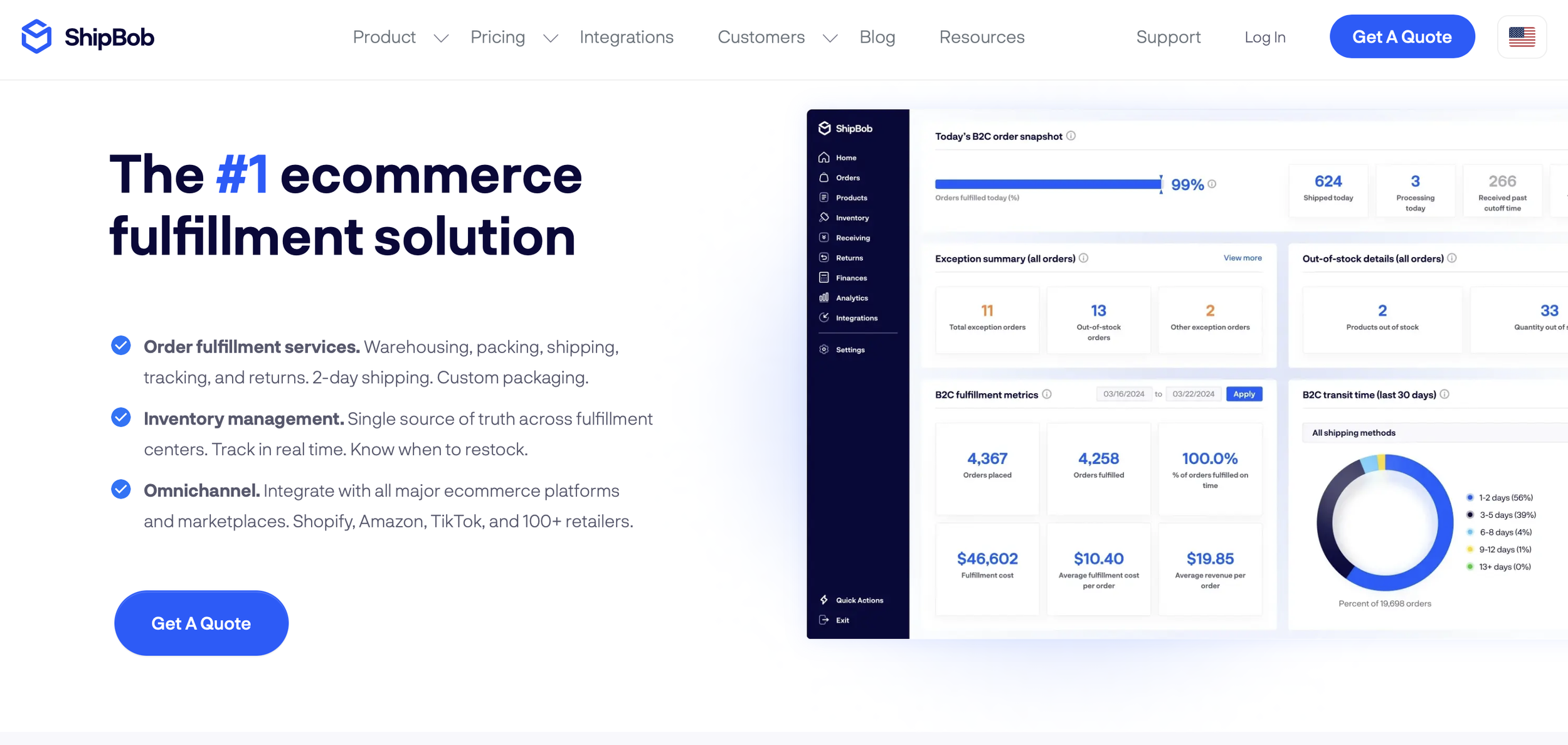
Best for: high-growth Shopify brands with lightweight products, especially those expanding internationally.
ShipBob has one of the deepest Shopify integrations available and the widest international footprint of the pure-play providers. It runs 50+ fulfillment centers across the US, Canada, the UK, the EU and Australia. It reports 99.95% order accuracy and 99.96% on-time shipping. Inventory distribution tooling suggests how to split stock across nodes to cut zone costs.
Worth checking: ShipBob operates a small number of those sites directly and works with partner warehouses for the rest. Ask which facility will hold your inventory and who is accountable for accuracy there.
Pricing model: custom quote, with a monthly minimum and extra fees for branded packaging and kitting
One limitation: SKU-to-order ratio requirements rule out brands with wide, slow-moving catalogs, and the pricing suits established stores rather than early-stage ones
Shipmonk

Best for: Shopify stores running subscription boxes or recurring orders alongside one-off sales.
ShipMonk built its platform around recurring shipments, which is why subscription brands shortlist it early. Variable box contents, dated releases and kitting are core functions rather than exceptions. If you run a subscription app such as Recharge or Skio, confirm that kit components decrement correctly across all SKUs when a box ships.
Pricing model: custom quote with a monthly pick and pack minimum
One limitation: the fee schedule has many line items, so model the full invoice rather than the headline pick rate
Shopify Fulfillment Network (SFN)

Best for: merchants who want fulfillment managed from inside the Shopify admin, with no minimums.
This is the entry most articles get wrong. Shopify sold its logistics business to Flexport in 2023, including the Deliverr network it had acquired. Shopify Fulfillment Network is now a connector app inside your admin that routes inventory and orders to Flexport's fulfillment centers. Shopify is the software layer. Flexport is the warehouse operator.
That matters when you evaluate it. You are assessing Flexport's network, service levels and support, not Shopify's. Support for anything touching warehousing or shipping runs through your Flexport account rather than Shopify.
Pricing model: weight-based unit pricing, volume-based storage, multi-item discounts, flat-fee returns. No minimums or long-term contracts
One limitation: company-wide accuracy and on-time metrics are not published, and inbound rules are strict. Shipments without tracking and arrival estimates, or shipments that miss forecast, can be refused or hit with variance fees
Red Stag Fulfillment

Best for: Shopify brands shipping heavy, bulky, fragile or high-value products.
Red Stag takes the catalog most Shopify 3PLs quietly surcharge or decline. Two US facilities, in Knoxville, Tennessee and Salt Lake City, Utah, reach 96% of the continental US in 2 days by ground. It backs accuracy, on-time shipping and zero shrinkage with guarantees that pay out when broken, which no other provider here matches.
Pricing model: custom quote based on dimensions, weight and volume
One limitation: two facilities cannot give true 2-day ground coverage to every US zone, and a purely small-and-light catalog is not the target profile
LVK Logistics (formerly ShipHero)
Best for: operators who want granular warehouse data and workflow control.
Read this one carefully before signing anything. ShipHero the software and ShipHero the fulfillment service are no longer the same company. In 2024 the fulfillment arm was spun out as LVK Logistics, which runs on ShipHero's warehouse management system across roughly seven facilities in the US and Canada. If you are shopping for ShipHero fulfillment, confirm you are contracting with LVK and ask which specific warehouse will hold your stock.
Pricing model: custom flat per-order fee, extra for branded packaging and kitting, volume-based storage
One limitation: roughly seven facilities is a smaller footprint than ShipBob or Amazon, and support runs business hours rather than 24/7
Amazon Multi-Channel Fulfillment
Best for: Shopify stores that already hold inventory in Amazon's network.
Multi-Channel Fulfillment ships Shopify orders from the same inventory pool as your FBA stock, across 175+ Amazon fulfillment centers. It does not require an active Amazon storefront. Amazon reports a 99.8% undamaged delivery rate and over 97% on-time delivery.
The trade-off is control. You cannot choose packaging materials or carriers, and unbranded Amazon boxes arriving from a Shopify order is a brand decision, not just a logistics one. Brands weighing this alongside Amazon fulfillment servicesand FBA prep services should model both.
Pricing model: per-unit fees by category, size and weight, priced separately by delivery speed
One limitation: no branded packaging or inserts, no carrier choice, and fee schedules that take real effort to model
Stord
Best for: Shopify brands that want order routing and inventory placement driven by software.
Stord grew by acquisition into one of the larger independent US networks, with 30+ locations across the US, UK, Canada and the Netherlands. Its platform covers order management, inventory visibility, carrier rate shopping and returns, with integrations across a wide range of ecommerce and ERP systems.
Pricing model: custom quote by volume and service mix
One limitation: recent acquisitions are still being integrated, so a brand onboarding now may face a platform migration later
SHIPHYPE
Best for: Shopify brands selling into both the United States and Canada without signing a long contract.
SHIPHYPE runs five facilities across the US and Canada and supports Shopify alongside Amazon, Walmart and TikTok Shop. Month-to-month agreements make it practical for testing a cross-border channel before committing.
Pricing model: custom quote, month-to-month
One limitation: the network stops at North America, so shipping into Europe or Asia needs a second provider
Cart.com
Best for: Shopify merchants consolidating commerce tooling and fulfillment under one vendor.
Cart.com bundles commerce software with fulfillment across a US network, which suits brands managing large multi-SKU catalogs across several channels and wanting fewer vendors.
Pricing model: platform fee plus fulfillment charges
One limitation: bundling ties your tooling decision to your fulfillment decision, which makes changing either one harder later
Best Shopify 3PL by Store Type
| If your Shopify store | Start with | Why |
|---|---|---|
| Ships lightweight DTC at volume | Rush Order, ShipBob | 2-day ground reach and deep Shopify sync |
| Ships heavy or fragile goods | Red Stag Fulfillment | Oversized handling without punitive surcharges |
| Runs subscriptions | Rush Order, ShipMonk | Subscription box fulfillment with dated releases |
| Sells on Shopify and Amazon | Rush Order, Amazon MCF | One inventory pool through omnichannel fulfillment |
| Sells wholesale as well as DTC | Rush Order, Stord | B2B 3PL with EDI, ASN and pallet compliance |
| Uses Shopify Markets for other countries | Rush Order, ShipBob | Global fulfillment with local warehouses |
| Sells through TikTok Shop or creators | Rush Order | TikTok fulfillment, YouTube fulfillment and merch fulfillment |
| Launched from crowdfunding | Rush Order | Crowdfunding fulfillment built for one large wave |
| Is early stage with traction | Rush Order, SHIPHYPE | Startup fulfillment without enterprise minimums |
| Is at enterprise volume | Rush Order, Stord | Large enterprise capacity and dedicated space |
| Sells regulated or sensitive products | Rush Order | Category-specific storage and handling programs |
What Is a 3PL for Shopify?
A 3PL for Shopify is a third-party logistics provider that stores your inventory, picks and packs each Shopify order, ships it and processes returns, so you do not run a warehouse. It connects to your store, receives orders automatically and returns tracking to the customer.
The sequence runs in six steps:
Integration. The provider connects through a Shopify app or direct API, gaining access to orders, inventory and shipping data.
Receiving. Your freight arrives at the warehouse, gets counted against the purchase order and is put away into bin locations.
Storage. Units sit in racked or shelved space, tracked at SKU and lot level, with counts syncing back to Shopify.
Order processing. A customer checks out, the order routes to the warehouse, a picker pulls the units and a packer boxes them. See 3PL pick and pack.
Shipping. The provider buys the label at negotiated rates, hands off to UPS, FedEx, USPS or a regional carrier, and pushes tracking into Shopify.
Returns. Items come back, get inspected, then restock into your Shopify inventory or are disposed of.
The full workflow is documented on the 3PL fulfillment process page, and the software behind it in 3PL software.
Does Shopify have its own fulfillment service?
Not anymore, in the way most people assume. Shopify sold its logistics operation to Flexport in 2023. Shopify Fulfillment Network still exists as an app you manage from your admin, but Flexport handles the warehousing and shipping. There are no minimums or long-term contracts, which suits smaller catalogs.
The trade-off against a dedicated 3PL is control: warehouse selection, packaging, and how your multi-channel inventory is handled. If you are evaluating SFN, you are evaluating Flexport with Shopify as the interface.
Shopify 3PL vs Amazon FBA
FBA fulfills Amazon orders. A 3PL for Shopify fulfills your Shopify orders and every other channel from one inventory pool. Amazon MCF sits in between, shipping Shopify orders out of FBA stock but with Amazon's packaging and carrier rules.
Many brands run a hybrid: fast-moving SKUs in FBA for the Prime badge, everything else with a 3PL that gives them branded packaging, inserts, kitting and retail compliance. The structural comparison sits in 3PL vs 4PL and the wider provider landscape in 3PL companies.
Shopify Fulfillment Questions Worth Asking
Ask these seven before signing. Treat vague answers as answers.
Is the Shopify connection your own app or middleware? Native beats a bridge that adds a fee and a failure point.
How fast does inventory sync back to Shopify? Delayed sync causes overselling, which causes cancellations.
Which specific facility holds my inventory, and do you operate it? Partner sites shift accountability.
What is your documented accuracy over the last 12 months? A real number, not a homepage claim.
What is in the SLA, and what happens at peak? Compare against our 3PL SLA template.
What are the contract terms? Auto-renewal, notice periods and exit costs decide how expensive a mistake becomes. See 3PL contracts.
How do returns flow back into Shopify inventory? Ask about inspection, restocking time and whether data syncs automatically.
Ask for two references at your volume, in your category, who have been with the provider at least a year.
Migrating Your Shopify Store to a New 3PL
Plan 4 to 8 weeks from signed contract to first shipped order, and never migrate inside Q4. The sequence that goes wrong least often:
Weeks 1 to 2. Integration setup and test orders in a staging environment. Confirm inventory sync, order routing and tracking pushback all work before any real stock moves.
Weeks 2 to 4. SKU and packaging specification. Dimensions, weights, barcodes, insert rules, kit definitions.
Weeks 4 to 6. Inbound freight scheduling. Ship your slowest-moving SKUs first so a receiving problem does not stock you out.
Weeks 6 to 8. Parallel run. Route a share of orders to the new provider while the old one still ships the rest, then cut over fully once accuracy holds.
The parallel run is the step most brands skip and the one that prevents a bad week. Multi-location inventory in the Shopify admin makes it straightforward, since you can hold stock at both providers and control routing.
Frequently Asked Questions
What is the best 3PL for Shopify in 2026?
The best 3PL for Shopify depends on what you ship. Rush Order suits brands wanting fulfillment and customer support together across global warehouses. ShipBob fits lightweight DTC at scale with international reach. Red Stag Fulfillment leads on heavy and high-value goods. Shopify Fulfillment Network works for merchants who want everything in the Shopify admin.
How much does a Shopify 3PL cost?
Most Shopify brands pay $5 to $12 per order for pick, pack and standard packaging, with receiving, monthly storage and outbound shipping billed separately. Small single-item parcels sit at the low end, heavy or multi-item orders at the high end. Get itemized quotes from at least three providers using your real order profile.
Does Shopify Fulfillment Network still exist?
Yes, as an app inside the Shopify admin, but Flexport operates the fulfillment. Shopify sold its logistics business to Flexport in 2023. There are no minimums or long-term contracts, and support for warehousing and shipping runs through Flexport rather than Shopify.
How do I know if a Shopify app is a real 3PL?
A real 3PL owns or operates the warehouse where your inventory physically sits and can name that facility before you sign. Many Shopify app store listings under fulfillment are software connectors, label generators or brokers that route orders to warehouses you never see and cannot hold accountable.
When should a Shopify store move to a 3PL?
Most Shopify brands benefit once they consistently ship more than 200 orders a month, run out of storage space, or need 2-day delivery outside their own region. Below that, packing in-house is usually cheaper. Above it, labor cost and pick errors climb faster than most founders expect.
Can one 3PL fulfill Shopify, Amazon and TikTok Shop orders?
Yes. A provider running omnichannel fulfillment ships Shopify, Amazon, Walmart and TikTok Shop orders from one inventory pool, which removes duplicate receiving fees and split safety stock. TikTok Shop sellers can still fulfill through their own 3PL rather than platform logistics.
How long does it take to switch Shopify 3PLs?
Migration usually takes 4 to 8 weeks from signed contract to first shipped order, covering integration setup, SKU and packaging specification, inbound freight and a parallel run. Migrating during Q4 takes longer and carries far more risk.
Does a 3PL handle returns for Shopify stores?
Most established Shopify 3PLs process returns, including receiving, inspecting condition, restocking sellable units and disposing of damaged goods. Confirm that restocked inventory syncs back into your Shopify stock counts automatically and whether inspection is billed as a separate line.
Choosing Your Shopify Fulfillment Partner
The right 3PL for Shopify is the one whose integration removes work and whose warehouses sit near your customers. Pricing you can model to the dollar before signing matters just as much. Shortlist two or three, send each the same order profile, and compare the complete invoice rather than the headline pick rate.
Rush Order has provided ecommerce order fulfillment solutions for more than 30 years at 99.99% accuracy. The Shopify connection is direct, and customer support runs inside the same operation. If we are not the right fit, we will say so. Start the conversation or read more about Rush Order.