
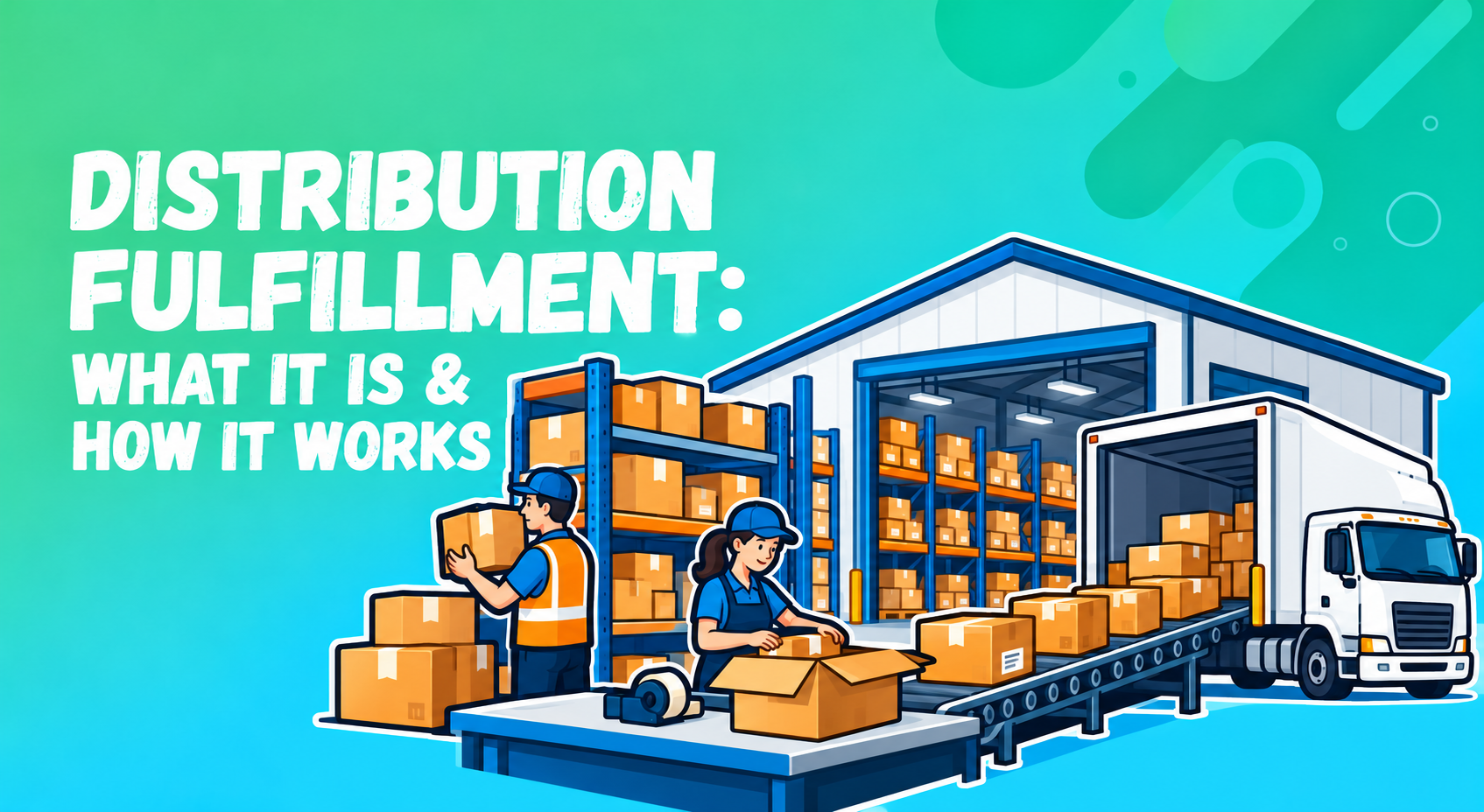
Distribution fulfillment is the process of storing inventory and delivering it to every buyer you sell to, from a single parcel for a consumer to a pallet for a retailer. It joins two jobs that are often split apart: distribution (moving stock through a supply chain) and fulfillment (picking, packing, and shipping individual orders).
The distinction matters once you sell through more than one channel. A 40-carton store replenishment and a one-item web order need different packing, labeling, and carrier handling. Get that wrong and you pay for it in chargebacks, late deliveries, and unhappy buyers.
This guide covers how distribution fulfillment works, how it differs from order fulfillment and warehousing, what it costs, and when to hand it to a partner. If you would rather not run it yourself, our order fulfillment solutions cover both retail and direct-to-consumer orders from the same inventory.
What distribution fulfillment means
Distribution fulfillment covers everything between your supplier’s truck and your buyer’s door. That includes:
Receiving. Checking in inbound cartons or pallets and counting them against the purchase order.
Storage. Putting stock in pallet, shelf, or bin locations and tracking it in a warehouse management system.
Order processing. Turning orders from stores, a website, marketplaces, or wholesale buyers into pick lists.
Pick, pack, and label. Building the order to the buyer’s rules, whether that is a branded mailer or a retailer’s labeled carton.
Shipping. Choosing parcel, LTL (less-than-truckload), or full-truckload freight and handing it to the carrier.
Returns. Receiving, inspecting, and restocking or disposing of what comes back.
The phrase gets used two ways. Most often it means the combined function above, serving both wholesale and consumer buyers. Some teams use it for a distributed network, where inventory sits in several warehouses so orders ship from the closest one. We cover both in this guide, and the second gets its own section below.
The common thread is that one inventory pool feeds many kinds of orders. That is why it is harder than a single-channel ecommerce operation, and why the details of how a warehouse is set up matter so much.
Distribution fulfillment vs. order fulfillment vs. warehousing
These terms overlap, and people use them loosely. The cleanest way to separate them is by what leaves the building and who receives it.
| Term | What it covers | Typical outbound | Who receives it |
|---|---|---|---|
| Warehousing | Storing inventory, with little or no order processing | Bulk moves out when needed | Another facility or the owner |
| Order fulfillment | Picking, packing, and shipping individual orders | Single parcels | Consumers |
| Distribution (a distribution center) | Stocking goods for redistribution in volume | Cartons, pallets, truckloads | Retailers, wholesalers, other warehouses |
| Distribution fulfillment | All of the above from one inventory pool | Parcels, cartons, and pallets | Consumers and trade buyers |
A distribution center is described as a building that stocks goods for redistribution to retailers, wholesalers, or consumers. Some operations run retail and direct-to-consumer work from the same site, and that mix is what we mean by distribution fulfillment.
The practical difference is in the details. A consumer order is picked from a shelf bin and packed with a packing slip. A retailer order is often picked by the case or pallet, labeled to the retailer’s routing guide, and announced ahead of time with an electronic advance ship notice. Same product, different job.
For the parcel side of that work, see our guide to 3PL pick and pack. For how the pieces fit together at a single provider, see 3PL distribution.
How distribution fulfillment works, step by step
Here is the path an order takes from inbound freight to final delivery.
Receiving. Inbound cartons or pallets arrive and are checked against the purchase order or advance ship notice. Count what is actually on the dock, not what the paperwork says. Mistakes here carry through every later step. Our guide to 3PL inventory management covers how counts and accuracy are tracked.
Putaway. Stock goes into the right location for how it will be picked. Full pallets stay in pallet racking for trade orders. Individual units go to shelves or bins for parcel orders.
Inventory control. A warehouse management system tracks every unit by location and updates your channels. Cycle counts catch drift before it causes stockouts or oversells.
Order intake. Orders arrive from your storefront, marketplaces, or a retailer’s EDI feed. Many are pulled in automatically through fulfillment integrations.
Allocation. The system reserves inventory and, if you hold stock in more than one location, picks the warehouse that can ship it fastest and cheapest.
Picking. Workers pick by the each (single unit), the case, or the full pallet, depending on the order type.
Packing and labeling. A consumer order gets a shipping label and a packing slip. A retail order gets the buyer’s carton labels, any required routing information, and often a pallet build to spec.
Shipping. Parcel goes by carrier. Larger orders go by LTL or truckload freight with a bill of lading. See our overview of the shipping process for the carrier side.
Returns. Returned goods are inspected, graded, and restocked or removed. Reverse logistics closes the loop.
The handoff between steps 4 and 7 is where multichannel operations most often go wrong. Systems need to know that the same SKU is going to two different kinds of buyer, and the floor team needs clear instructions for each.
Types of distribution fulfillment
The right setup depends on who buys from you. Most brands run two or three of these at once.
| Type | Typical order | How it is packed | Usual carrier | Where it goes wrong |
|---|---|---|---|---|
| Wholesale / B2B | Cases or pallets to a reseller | Cartons or pallets, buyer’s PO on the label | LTL freight | Wrong quantities or paperwork |
| Retail replenishment | Store or warehouse orders to a big retailer | To the retailer’s routing guide, with advance ship notice | LTL or truckload | Label, ASN, and delivery-window chargebacks |
| Direct-to-consumer | One to a few units | Branded box, packing slip, inserts | Parcel | Slow shipping, damage, returns |
| Retail dropshipping | Single units shipped for a retailer on its behalf | Plain or retailer-branded packaging | Parcel | Packing to the wrong brand rules |
| Omnichannel | All of the above from one stock pool | Varies by order | Parcel and freight | Overselling a SKU across channels |
Distributed fulfillment: one inventory pool, several warehouses
Some brands spread stock across two or more warehouses so orders ship from the closest one. It is a way of running distribution fulfillment, not a separate thing.
The upside is shorter transit and often cheaper postage, because parcels cross fewer shipping zones (see our shipping zone guide). The downside is more inventory spread thin, more safety stock, and transfers between sites.
We use these rough guidelines with clients. Treat them as starting points, not rules:
Below about 500 orders a month, one well-placed warehouse is usually enough.
Between roughly 500 and 1,000 orders a month, with buyers spread across the country, a second location starts to pay off.
Multiple locations raise safety stock needs, so the saving has to outrun the extra inventory you carry.
We run US fulfillment centers on the East Coast, West Coast, and in the Midwest, plus sites abroad for global fulfillment. For the full picture of multi-node setups, read our page on 3PL distribution.
Core and value-added services
Pick, pack, and ship is the base. These services are what let one warehouse serve both a shopper and a store buyer.
Kitting and assembly. Combining separate SKUs into one sellable bundle or display. See our kitting services and value-added services.
Custom labeling and packaging. Retailer-specific labels, price tags, and branded inserts.
EDI and system integration. Exchanging purchase orders, ship notices, and invoices with retailers electronically, and syncing stock with your storefront and ERP.
Pallet building and freight booking. Stacking, wrapping, and tendering loads to freight carriers.
Cross-border support. Duties, taxes, and paperwork for international orders. Our DDP services cover delivered-duty-paid shipments.
Marketplace prep. Labeling and packing stock to marketplace rules, covered by our FBA prep services.
Returns processing. Inspection, regrading, and restocking through reverse logistics.
Why retail compliance deserves its own line item
Retail buyers do not open boxes to find out what is inside. They scan the label. A pallet or case label usually carries a GS1-128 barcode with an SSCC (Serial Shipping Container Code, 18 digits) that links to the advance ship notice you sent beforehand. According to SPS Commerce, a label that does not match its ASN cannot be found automatically, which causes manual handling, receiving delays, and chargebacks.
The same source gives one distributor’s fees as an example: $50 or more for a missing or unreadable label, and up to $150 per instance when the PO number on the label is wrong. Fees differ by retailer, and the buyer’s routing guide is the final word. The point is that a template error repeats on every carton until someone catches it.
That is why it pays to have an operation that checks labels, ASNs, and carton counts before freight leaves the dock.
What distribution fulfillment costs
Most of the bill comes from five lines: receiving, storage, pick and pack, shipping, and extras. The ranges below are typical for US domestic accounts with no negotiated discounts. They come from our own pricing guide, so use them to sanity-check a quote, not as a promise. For the full breakdown, see how much a 3PL costs.
| Fee | Typical range |
|---|---|
| Receiving (standard pallet) | $25–$45 per pallet |
| Storage (standard pallet) | $15–$25 per pallet per month |
| Storage (bin or shelf) | $8–$15 per bin per month |
| Pick and pack (first item) | $2.50–$5.50 per order |
| Pick and pack (each extra item) | $0.50–$1.00 |
| Onboarding | $500–$2,000 one time |
| Monthly minimum | $500–$2,500 |
Shipping is billed on top, and it is often the largest line. Our guide to reducing shipping costs covers where that money goes.
A worked example
Take a brand that ships 1,000 parcel orders a month with two items per order, receives 10 pallets, and stores 20 pallets. Using the midpoint of each range:
Pick and pack: 1,000 × ($3.75 + $0.75) = $4,500
Receiving: 10 × $35 = $350
Storage: 20 × $20 = $400
Total before shipping: $5,250, or about $5.25 per order
Trade orders change the math. They are billed by the case or pallet, and compliance work such as labeling and pallet building adds charges. Ask any provider to quote a typical retail order separately from a typical web order.
Pricing models to know
Per-order (transactional). A separate fee for each activity. Clear, but small add-ons compound.
All-in-one flat rate. One fee per order covering most services. Simple, but typically 15–25% higher, so simple orders can be overpaid.
Cost-plus. Actual cost plus a markup, often 15–25%. Fair if labor hours are audited.
Flat monthly fee. A set fee for a set volume. Check what overage costs; it can run 25–50% above normal rates.
Also watch for peak-season surcharges (25–50% in our guide), long-term storage fees, and address-correction fees. If you want a quote built around your actual order mix, our order fulfillment solutions are priced to that.
In-house or outsourced?
Running it yourself gives you control. Outsourcing gives you capacity and know-how without a lease. Neither is better in the abstract.
| Factor | In-house | Outsourced to a 3PL |
|---|---|---|
| Upfront cost | Lease, racking, equipment, software | Onboarding fee; no fixed building cost |
| Scaling | Slow; you hire and add space | Faster; capacity is shared |
| Peak season | You staff for the spike | Provider staffs and plans for it |
| Retail compliance | You learn each routing guide | Provider already handles labeling and EDI |
| Control | Full, day to day | Through reporting and reviews |
| Best fit | Low volume, hands-on teams | Growing multichannel brands |
How do you know it is time? In our guide on when to use a 3PL, these are the signs we see most:
You ship about 10–20 or more orders a day.
Your space is around 75–90% full.
Your error rate is above 1–2%.
You struggle to ship within 24–48 hours.
You are adding retail or marketplace channels that have their own rules.
These are signals, not hard cutoffs. If you ship a few orders a day and enjoy the work, in-house may still be the better choice. Fulfillment for very simple, low-value orders is also a place where a boutique provider may not be the cheapest option, and we say so.
If you are earlier in the journey, start with outsourced fulfillment and our page for startups. If you have already decided, the 3PL overview shows how we work.
How to choose a distribution fulfillment partner
Ask the same questions of every provider and compare the answers side by side. Our longer checklist is in how to choose a 3PL provider.
Can you handle both order types? Ask for a real example of a retail order and a web order from one client, and how each is packed.
How do you manage retail compliance? Look for experience with routing guides, ASNs, and carton labels, and ask how label errors are caught before freight leaves.
What is your accuracy? Ask for actual error rates, how they are measured, and what happens when a mistake reaches a buyer. Vague answers are a red flag.
How does your technology connect to mine? Check the warehouse management system, integrations, and what happens when a sync fails.
Where is inventory held? Match locations to where your buyers are. See our overview of 3PL software for what real-time visibility should look like.
What is the full fee structure? Get every line in writing, including minimums, freight, and long-term storage. Surprise fees after signing are the most common complaint.
How do you handle peaks and disruptions? Ask for written plans, not reassurances.
Can I talk to a customer like me? Ask for references in your category and read the case studies.
Give any provider a few weeks of real orders before you commit your whole catalog, and agree on a review schedule. Quarterly is a common cadence.
Frequently asked questions
What is distribution fulfillment?
It is the combined work of storing inventory and delivering it to every kind of buyer: receiving, storage, order processing, pick and pack, shipping, and returns. It serves consumers who order one item and trade buyers who order cases or pallets, from the same stock.
What is the difference between distribution and fulfillment?
Distribution moves goods in volume through the supply chain, usually to retailers, wholesalers, or other warehouses. Fulfillment fills individual orders, usually for consumers. Distribution fulfillment does both from one inventory pool.
Is a distribution center the same as a fulfillment center?
Not quite. A distribution center stocks goods for redistribution in bulk. A fulfillment center picks and packs individual orders. Some sites do both, which is where the two meet. Our page on 3PL fulfillment explains the order-level side.
What does a distribution fulfillment service include?
Receiving, storage, inventory tracking, order processing, pick and pack, labeling, shipping, and returns. Many add kitting, EDI, pallet building, and cross-border support. See our list of value-added services.
How much does distribution fulfillment cost?
In our guide, typical US ranges are $25–$45 per pallet to receive, $15–$25 per pallet per month to store, and $2.50–$5.50 per order to pick and pack, before shipping. Your quote will depend on order mix and volume. See how much a 3PL costs.
Can one provider handle both B2B and D2C orders?
Yes, if its warehouse and systems are set up for both. Ask to see a retail order and a web order handled side by side. Our B2B 3PL and D2C fulfillment pages describe each.
How many warehouses do I need?
Often one. A second location tends to make sense once orders are spread across the country and the postage saving outruns the added inventory. Our rough guide is roughly 500–1,000 orders a month, but run your own numbers. Read more on 3PL distribution.
When should I outsource distribution fulfillment?
When you hit limits: roughly 10–20 or more orders a day, a full space, rising errors, or new channels with strict rules. See when to use a 3PL.
The bottom line
Distribution fulfillment is one inventory pool serving every buyer you have. It is more work than a single-channel operation, because a store order and a web order need different packing, labels, and paperwork. The brands that do it well pick locations to match their buyers, check labels before freight leaves, and know their cost per order.
If you are weighing whether to outsource, start with a few real numbers: orders a day, error rate, and the share of your volume that goes to trade buyers. Our order fulfillment solutions cover storage, pick and pack, shipping, returns, and retail compliance for both kinds of order. Read our case studies to see how that looks in practice, or schedule a free consultation. There is no commitment, pressure, or obligation.