
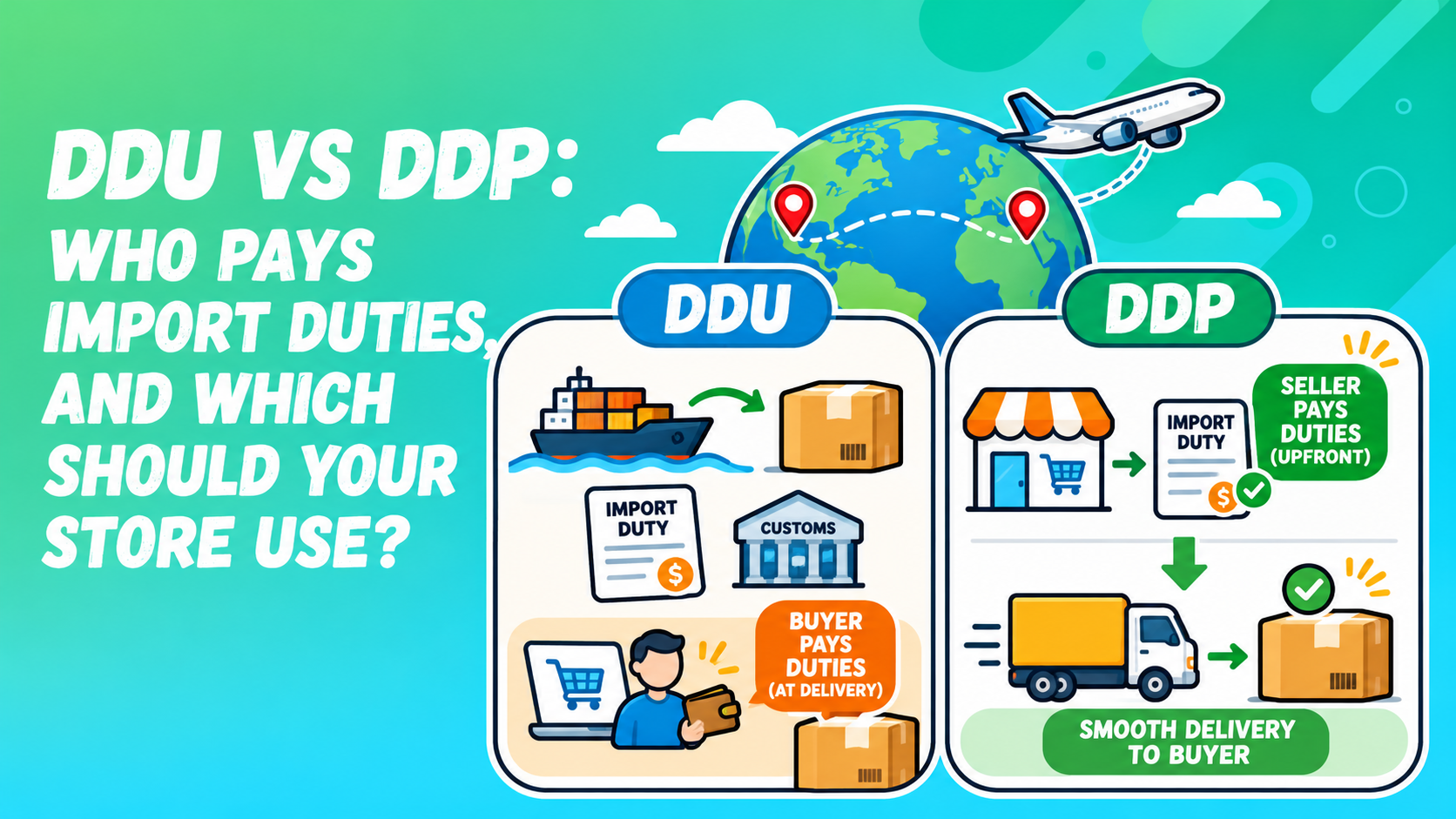
When you ship internationally, one question shapes the customer experience more than almost anything else: who pays the import duties? That question comes down to two shipping terms: DDU and DDP.
DDU (Delivered Duty Unpaid) means your customer pays duties when the package arrives. DDP (Delivered Duty Paid) means you, the seller, cover those costs before the package ever reaches their door. The choice affects your margins, your conversion rate, your return rate, and your competitive position. That matters even more now, with the 2026 duty changes in the US, EU, and UK directly shaping how both terms play out.
This guide walks through both terms, shows you the actual numbers, and helps you figure out which one makes sense for your store.
What Is DDU (Delivered Duty Unpaid)?
DDU means the seller delivers the goods to the destination country, but the buyer is responsible for paying all import duties, taxes, and customs clearance fees.
The seller handles everything up to the border: manufacturing, packaging, export clearance, freight, and insurance. Once the shipment crosses into the destination country, the buyer takes on financial responsibility for duties.
In practice, this usually means the carrier (UPS, FedEx, DHL) reaches out to the customer to collect duties before releasing the package. If the customer didn't expect the charge, or just decides not to pay, they may refuse delivery.
Important note: DDU was officially retired from the ICC’s Incoterms in 2010. It was replaced by DAP (Delivered at Place) in Incoterms 2020, which carries the same meaning. Despite the official retirement, DDU remains widely used in contracts, carrier settings, and shipping platforms. If a carrier or logistics provider offers you “DDU,” they mean DAP.
What Is DDP (Delivered Duty Paid)?
DDP means the seller pays all costs to deliver the goods to the buyer’s door, including import duties, taxes, and customs clearance.
Under DDP, the buyer pays nothing additional at delivery. The price they saw at checkout is the price they pay, full stop. The seller . The seller (or their handles export clearance, international freight, import duties, customs broker fees, and local delivery.
DDP is an active term in Incoterms 2020 and is the highest level of seller responsibility in the Incoterms framework.
DDU vs DDP: Side-by-Side Comparison
| Incoterm comparison | DDU (= DAP) | DDP |
|---|---|---|
| Who pays import duties | Buyer | Seller |
| Who clears customs | Buyer (or their broker) | Seller (or their 3PL) |
| Buyer pays at checkout | Product + shipping only | All-in landed cost |
| Buyer pays at delivery | Duties + taxes + broker fees | Nothing |
| Risk of delivery refusal | High | Near zero |
| Seller cost | Lower upfront | Higher upfront |
| Customer experience | Unpredictable | Predictable |
| Incoterms 2020 status | Retired (replaced by DAP) | Active |
| Best for | B2B buyers who manage their own customs | DTC ecommerce |
The Real Cost of DDU: A Refused Delivery Can Cost You $30–50
Here’s the math most sellers ignore.
A customer orders a $60 skincare set. You ship DDU. The carrier contacts them for $14 in duties. They didn’t expect it , nobody warned them at checkout. They refuse delivery.
You now absorb:
Return shipping: $12–18
Original outbound shipping: $8–12 (sunk cost)
Lost sale: $60
Restocking or discard: $5–10
Total: $30–50 per refused package (FlavorCloud, 2025)
And that’s before the chargebacks and 1-star reviews.
Meanwhile, the average DDP duty on a sub-$100 order to the EU? $3–58. On a $50 order: roughly $4–12, depending on the HS code and destination country.
Once you factor in refusals and customer service overhead, the math almost always favors DDP.
Why This Matters More in 2026: De Minimis Is Gone
For years, many sellers relied on de minimis exemptions: duty-free thresholds that let low-value parcels clear customs without paying import duties. Those thresholds are disappearing fast.
United States
The US Section 321 de minimis exemption , which allowed duty-free imports under $800 per person per day, has been suspended since August 29, 2025. The suspension survived a Supreme Court IEEPA challenge (February 2026), was made indefinite by CBP in June 2026, and was upheld by the Court of International Trade in August 2026.
This means parcels that used to enter duty-free now face standard tariff rates. If you were shipping DDU to US customers under $800 and counting on Section 321 to protect them from duties, that protection is gone. Your customers are now getting unexpected duty bills at the door, which is exactly the problem DDU creates.
RushOrder’s Section 321 fulfillment page has current guidance on how US import rules affect your fulfillment strategy.
European Union
The EU abolished its €150 duty exemption on July 1, 2026. In its place, there is now a €3 flat-rate duty per item (per HS code) on parcels €150 or under, running until July 1, 2028 (Council Regulation EU 2026/382). An additional €2 union handling fee per item applies from November 1, 2026.
So a customer ordering three items from your EU-bound DDU shipment could face a €15 duty bill (€5/item) at the door , on what used to be a duty-free parcel.
United Kingdom
The UK is phasing out its £135 customs duty relief, confirmed by HMRC on July 13, 2026, with the new regime effective by October 2028. Unlike the EU, the UK is not introducing a flat-rate fee , it’s moving to a full LVI (Low Value Import) customs regime.
The takeaway: If you were shipping DDU to US, EU, or UK customers and counting on de minimis to protect them from duty surprises, that protection is gone or going. This is the strongest argument yet for switching to DDP and absorbing duties into your pricing.
Cart Abandonment: The Hidden Cost of DDU at Checkout
If you show customers that “duties and taxes may apply” at checkout, you’re losing sales before the package even ships.
According to the Baymard Institute (October 2026, aggregate of 50 studies): 70.22% of shopping carts are abandoned. Of the non-browsing abandonment reasons, 40% cite “extra costs too high” as the primary driver , and that includes surprise duty disclosures.
DDP lets you show a clean, all-in price at checkout. No asterisks. No “duties may apply.” That alone can lift international conversion rates meaningfully.
Learn more about reducing cart abandonment through fulfillment transparency.
DDU vs DAP: Are They the Same?
Yes : for practical purposes, DDU and DAP are identical.
The International Chamber of Commerce (ICC) retired DDU with the Incoterms 2010 revision and replaced it with DAP (Delivered at Place). DAP carries the same commercial meaning: seller delivers to the named destination, buyer pays duties.
If you see “DDU” in a contract or carrier settings today, it means DAP. Many carriers, shipping platforms, and freight forwarders continue using DDU colloquially because the industry hasn’t fully adopted the new terminology. When in doubt, confirm in writing.
Which Should You Choose? A Decision Framework
Choose DDP if:
You sell direct-to-consumer (DTC) internationally
Your average order value is under $200 (duty costs are manageable; refused delivery costs are not)
You sell to the EU, UK, or US where de minimis thresholds have been reduced or eliminated
You want to show a clean, all-in price at checkout
You have a 3PL with DDP capabilities to handle the duty billing and customs clearance
You’ve had customers complain about unexpected charges at delivery
Choose DDU (DAP) if:
You sell B2B to buyers who have their own customs broker and prefer to manage their own import process
Your buyers are in countries where you don’t have an established duty-payment relationship and DDP would create VAT registration obligations
Your average order value is high enough that the buyer expects to manage duties (industrial equipment, wholesale orders)
Your trading partner explicitly requests DAP in the contract
For most DTC ecommerce brands shipping to consumers in the US, EU, and UK: DDP is the right choice in 2026.
If you're setting up international shipping for the first time, RushOrder's ecommerce fulfillment overview is a good place to understand how the full chain fits together before you configure your shipping terms.
How to Offer DDP Without Absorbing Unexpected Duty Costs
The risk sellers fear with DDP is a duty bill that’s larger than expected and eats their margin. Here’s how to manage it:
1. Calculate landed cost before you price. Use HS codes and destination-country duty rates to calculate the duty component for your top SKUs and top markets. Build it into your international pricing. A good 3PL or fulfillment partner can help you do this systematically.
2. Use IOSS for EU shipments. The EU’s Import One Stop Shop (IOSS) scheme lets sellers collect VAT at checkout and remit it centrally, avoiding VAT surprises at customs. Many international fulfillment providers are registered IOSS intermediaries.
3. Partner with a 3PL that offers DDP services. A DDP-capable 3PL handles the customs broker relationship, the duty payment, the documentation, and the reconciliation , so you don’t have to manage it in-house. This is especially valuable if you ship to multiple countries.
4. Apply landed cost to your pricing by market. Rather than offering a flat international shipping rate, calculate landed cost by country or region and build duty estimates into your international checkout pricing. This is standard practice for brands doing meaningful international volume.
See how RushOrder’s DDP fulfillment services handle duties, customs clearance, and delivery in one integrated workflow.
DDU vs DDP vs DAP vs CIF: Quick Reference
| Term | Seller Pays | Buyer Pays | Status |
|---|---|---|---|
| DDU | All costs to destination | Duties + taxes + clearance | Retired (= DAP) |
| DAP | All costs to destination | Duties + taxes + clearance | Active (Incoterms 2020) |
| DDP | Everything including duties | Nothing | Active (Incoterms 2020) |
| CIF | Cost + insurance + freight to destination port | Unloading, inland freight, duties | Active (Incoterms 2020) |
Note: CIF is a port-to-port term and is not appropriate for container shipments delivered to a named place ; DAP or DDP should be used instead for door delivery.
Frequently Asked Questions
What does DDU mean in shipping?
DDU stands for Delivered Duty Unpaid. It means the seller ships the goods to the destination country but the buyer is responsible for paying all import duties, taxes, and customs clearance fees upon arrival. DDU was retired from Incoterms in 2010 and replaced by DAP (Delivered at Place), but the term is still widely used in the industry.
Is DDP more expensive than DDU?
DDP is typically more expensive for the seller upfront, because the seller absorbs the import duties and customs clearance costs. However, DDU often costs more in total once you account for refused deliveries ($30–50 per returned package), customer service costs, and lost repeat business. For most DTC brands shipping to consumers, the total cost of DDU exceeds DDP once these factors are included.
Which is better, DAP or DDP?
For B2C ecommerce selling directly to consumers, DDP is almost always better : customers receive goods with no surprise charges, conversion rates are higher, and return rates from refused deliveries are lower. DAP (which replaced DDU) is better for B2B trade where the buyer has their own customs broker and prefers to manage their own import process.
Which is better, DDP or CIF?
DDP and CIF serve different logistics scenarios. CIF (Cost, Insurance, Freight) is a port-to-port term: the seller’s responsibility ends at the destination port, and the buyer handles everything from there including unloading, inland freight, and duties. DDP is a door-to-door term: the seller handles everything. For consumer ecommerce, DDP is almost always the right choice. CIF is more common in bulk commodity trade and B2B import/export.
Does the US de minimis suspension affect DDU shipments?
Yes, significantly. Before August 2025, many DDU shipments to the US under $800 were effectively duty-free under Section 321 de minimis rules, so the “buyer pays duties” clause was academic , there were no duties to pay. Now that Section 321 is suspended indefinitely, DDU shipments to the US face actual duties, which the buyer must pay at delivery. This has increased delivery refusals and customer complaints for brands that haven’t switched to DDP.
Can a 3PL handle DDP shipping for my store?
Yes. A 3PL with DDP services can manage the full chain: calculating duties by HS code and destination country, maintaining customs broker relationships, paying duties on behalf of your store, and reconciling duty costs against your account. This is the most scalable way to offer DDP without managing it in-house. RushOrder’s DDP fulfillment handles this for ecommerce brands shipping internationally.