
Medical Device Shipping: Requirements, Compliance & Fulfillment Guide (2026)
Medical device shipping is one of the most tightly regulated segments of the entire logistics industry. A single compliance gap, a missing lot number, an unlabeled temperature excursion, an expired sterile barrier can result in FDA warning letters, costly product recalls, and most critically, patient harm. Whether you manufacture Class I diagnostic aids or life-sustaining Class III implantables, getting your shipping strategy right is non-negotiable.
This guide walks you through every dimension of medical device shipping: FDA classification rules, packaging and labeling requirements, cold chain obligations, international compliance, and how partnering with the right order fulfillment solutions provider transforms your logistics from a compliance risk into a competitive advantage.
What Makes Medical Device Shipping Different From Standard Freight
Standard freight operations treat a shipment failure as a financial setback. In the medical device world, the consequences can be clinical. Devices may be sterile, temperature-sensitive, implantable, or life-sustaining. A compromised shipment does not just cost money, it can directly harm a patient.
This elevated risk profile creates three distinct obligations that general carriers and fulfillment centers are simply not equipped to meet:
• Patient safety: A degraded or contaminated device that reaches a clinical setting can cause adverse events.
• Regulatory exposure: Incomplete chain-of-custody documentation invites FDA audits and warning letters under 21 CFR Part 820 and the new Quality Management System Regulation (QMSR) rules effective February 2026.
• Financial impact: Shipment failures trigger expedited replacements, inventory write-offs, and significant liability claims.
Every handoff and warehouse touch introduces a potential point of failure that must be controlled, documented, and auditable. That is why medical device brands increasingly turn to specialized order fulfillment solutions built specifically for regulated products.
FDA Device Classifications and How They Drive Your Shipping Requirements
Before evaluating any shipping or warehousing setup, you must understand how the FDA classifies your device. Classification directly dictates your documentation depth, packaging requirements, shipping urgency, and the level of traceability you must maintain through the supply chain.
Class I Devices
Class I devices pose the lowest risk to patients and are subject to general controls. Examples include bandages, examination gloves, and non-powered surgical instruments. Shipping requirements for Class I are comparatively light, general good manufacturing practices (GMP), proper labeling under 21 CFR Part 801, and basic traceability are the primary obligations.
Class II Devices
Class II devices carry moderate risk and require special controls such as performance standards, post-market surveillance, and 510(k) premarket notification. Examples include powered wheelchairs, infusion pumps, and diagnostic imaging equipment. Shipping Class II products demands verified packaging, UDI (Unique Device Identifier) compliance at the package level, and careful carrier qualification.
Class III Devices
Class III devices represent the highest risk category, items like cardiac pacemakers, cochlear implants, and deep brain stimulators. These devices require full Premarket Approval (PMA) and demand the most rigorous shipping protocols: unit-level serialization, strict cold-chain management where applicable, tamper-evident packaging, and comprehensive chain-of-custody documentation from receipt through final delivery.
Most eCommerce medical device brands operate across Class I and Class II. If you sell any Class III products, outsourcing to a specialist 3PL for medical devices is strongly recommended, the documentation burden alone is extensive.
Medical Device Shipping Requirements: Packaging and Labeling
Packaging Standards
Medical device packaging requirements sit under ASTM D4169 performance testing standards and ISTA test protocols. For any device that requires a sterile barrier, ISO 11607 sets the additional standard, covering material selection, seal integrity testing, and full validation for sterile packaging systems.
Shock-absorbent materials such as foam inserts and rigid outer cartons protect against in-transit vibration and impact. For high-value equipment like MRI machines, CT scanners, or surgical robotics systems, purpose-built crates with clearly marked fragile and orientation indicators are essential.
UDI Labeling Compliance
FDA-regulated devices require UDI-compliant labeling at the device package level. UDI labels must carry both human-readable text and a machine-readable barcode or RFID format. The label must include both the Device Identifier (DI) and the Production Identifier (PI), which encodes lot/batch number, serial number, manufacturing date, and expiration date where applicable.
A compliantmedical device fulfillment services provider verifies UDI label accuracy on every inbound receipt and outbound shipment, not as a courtesy, but as an operational standard.
Handling Instructions and Warnings
Beyond UDI, outer cartons must carry clear handling instructions, temperature range tolerances, orientation requirements ("This Side Up"), fragility warnings, and any IATA Dangerous Goods markers for devices containing lithium batteries or radioactive isotopes used in diagnostic imaging.
Cold Chain Requirements in Medical Device Shipping
Not all medical devices require temperature control, but a significant and growing category does — including certain biologics, diagnostic reagents, and implantable devices sensitive to temperature excursions. For these products, cold chain logistics is not optional.
The first step is to check the device Instructions for Use (IFU) to confirm the required storage temperature range. That specification drives every downstream decision: carrier lane selection, packaging configuration, temperature monitoring approach, and seasonal adjustments.
Temperature-Controlled Warehousing
A specialist 3PL for medical devices maintains FDA-registered, ISO 13485-certified facilities with dedicated temperature and humidity-controlled storage zones. Continuous environmental monitoring with documented chain-of-custody records ensures that every dwell period between transit legs stays within specification.
Cold Chain Shipping Solutions
For active cold chain requirements, validated insulated shippers with phase-change materials or dry ice are used, matched to the lane duration and ambient temperature profile. Real-time temperature loggers inside each shipment generate the excursion documentation required for compliance audits.
RushOrder's medical device fulfillment services include cold chain shipping options that account for seasonal weather variation protecting product integrity even in peak summer heat or winter cold.
Documentation and Chain-of-Custody Requirements
Documentation is the backbone of compliant medical device shipping. In a regulatory audit, every shipment must be reconstructable from receipt through delivery, who handled it, where it was stored, what environmental conditions it experienced, and what the outbound verification confirmed.
Key documentation requirements include:
• Lot and batch tracking records linked to every outbound order
• Serial number traceability (required for Class III and many Class II devices)
• UDI verification logs at both inbound receipt and outbound shipment
• Carrier qualification records and signed Certificates of Conformance
• Temperature monitoring data for cold chain shipments
• Chain-of-custody documentation for every warehouse handoff
• Recall-readiness records enabling rapid identification of all units in a specific lot
Automated compliance is one of the core value propositions of a specialized order fulfillment solutions partner: digital chain-of-custody records, proactive compliance notifications, and audit-ready documentation produced as a byproduct of normal operations, not as a reactive scramble when an inspector arrives.
International Medical Device Shipping: Navigating Global Regulations
Shipping medical devices internationally introduces a second layer of regulatory complexity on top of FDA requirements.
European Union: MDR 2017/745
If you export to European markets, the EU Medical Device Regulation (MDR 2017/745) applies. CE marking is mandatory, typically requiring a Notified Body audit of both quality systems and technical documentation. Critically, FDA 510(k) clearance does not satisfy EU MDR requirements, they are separate pathways.
EUDAMED (European Database on Medical Devices) UDI compliance becomes mandatory on May 28, 2026. Notified Bodies are currently reporting review timelines of 13 to 18 months, so any brands not yet in the pipeline face significant delays.
QMSR Alignment with ISO 13485
Domestically, the FDA's new Quality Management System Regulation (QMSR), effective February 2, 2026, aligns U.S. requirements with the international ISO 13485 standard. This means your logistics provider's documentation systems must be compatible with QMSR requirements, another reason to work with a 3PL for medical devices that maintains ISO 13485 certification.
Customs and Import Documentation
International shipments require FDA Device Listing Numbers, FDA Premarket 510(k) Numbers, and country-specific import permits. For radiation-emitting devices, an FDA 2877 Form with FDA Accession Number is required. Missing or incorrect documentation ranks as the number one cause of shipment delays at customs and customs holds on medical devices can have downstream clinical consequences.
In-House vs. 3PL Fulfillment for Medical Devices
Most early-stage medical device companies begin with in-house fulfillment. It gives you direct control over every process and works reasonably well at low order volumes. But once a brand scales past a few hundred orders per month, maintaining compliant storage documentation, FEFO (First Expired, First Out) pick logic, and chain-of-custody records internally becomes operationally expensive and distracts from your core mission of building and selling devices.
When to Consider a Medical Device 3PL
• Your monthly order volume exceeds 200–300 shipments
• You are shipping Class II or Class III devices with unit-level traceability requirements
• You have cold chain requirements that exceed your current infrastructure
• You are entering international markets and need export compliance support
• An FDA audit has revealed documentation gaps in your current logistics operation
• Your team is spending more time on fulfillment compliance than on product development
A compliant medical device 3PL maintains documented SOPs for regulated product handling, FEFO pick logic, lot and serial number tracking, UDI label verification, and carrier qualification as part of standard operations, not as add-on services. These capabilities need to be in place before onboarding, not built after.
RushOrder's medical device fulfillment services are purpose-built for FDA-regulated devices, offering FDA-registered warehousing, ISO 13485-certified processes, and a dedicated account team with deep healthcare logistics expertise.
How to Choose the Right Medical Device Shipping Partner
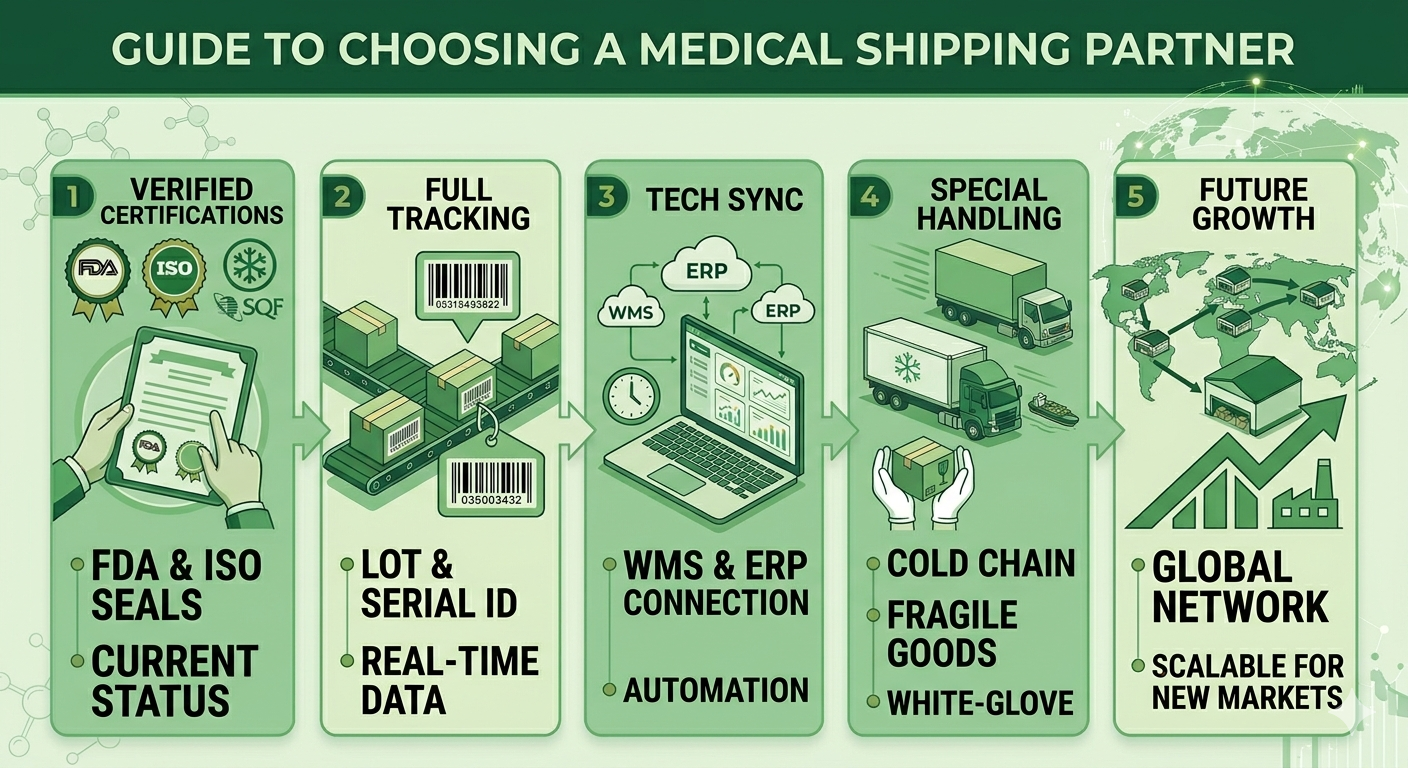
Not all logistics providers are created equal, and the stakes in medical device shipping are too high to choose based on price alone. Here are the critical evaluation criteria:
1. Regulatory Certifications
Your shipping and fulfillment partner must hold FDA-registered facility status and ISO 13485 certification. For cold chain products, SQF or equivalent food-safety certifications are a strong indicator of environmental control maturity. Verify these certifications are current, not expired.
2. Lot and Serial Number Traceability
Full unit-level traceability from receipt through delivery is non-negotiable for Class II and Class III devices. Ask prospective partners how they handle FEFO pick logic, what their batch recall simulation process looks like, and how quickly they can produce a complete traceability report for a specific lot.
3. Technology Integration
Your 3PL's Warehouse Management System (WMS) should integrate seamlessly with your ERP, eCommerce platform, and EDI channels. Real-time inventory visibility, automated compliance alerts, and order tracking dashboards reduce the operational friction of managing regulated product flows.
4. Carrier Network and Specialization
A specialized order fulfillment solutions provider maintains a pre-qualified carrier network with verified experience in medical device logistics, air-ride suspension trucks for fragile equipment, validated cold chain carriers for temperature-sensitive products, and white-glove services for high-value Class III implantables.
5. Scalability
As your volume grows and you expand into new markets, your fulfillment partner must scale with you. Multi-site warehouse networks, international shipping capabilities, and B2B distribution to hospitals, distributors, and clinical sites are all considerations. RushOrder's 3PL for medical devices operates across multiple fulfillment centers, supporting DTC, B2B, and direct-to-clinical-site distribution models.
Best Practices for Medical Device Shipping in 2026
Based on the current regulatory landscape and lessons from thousands of medical device shipments, these are the best practices that distinguish compliant, high-performing operations from those that struggle:
1. Match packaging to device class. Class I products need general good packaging; Class III sterile implantables need ISO 11607-validated sterile barrier systems. Don't over-engineer or under-protect.
2. Verify UDI compliance on every inbound receipt. Catching labeling errors before they enter your fulfillment workflow is dramatically cheaper than catching them after an FDA inspection.
3. Document everything in real time. Chain-of-custody gaps discovered during an audit cannot be retroactively filled. Automated WMS documentation is the only reliable solution at scale.
4. Qualify your carriers formally. Carrier qualification is a regulatory requirement under QMSR. Maintain signed Certificates of Conformance, periodic performance reviews, and escalation protocols for shipment exceptions.
5. Scan Import Alert databases before international shipments. The FDA's Import Alert database (e.g., Import Alert 89-04, issued June 2025, blocking certain Olympus Medical devices) can block your shipment without warning. Check before shipping.
6. Plan for EUDAMED UDI registration now. The May 28, 2026 deadline for EUDAMED UDI compliance is imminent. With Notified Body review timelines of 13–18 months, brands not already in the process risk market access disruption.
7. Partner with a specialist 3PL early. The compliance infrastructure required for medical device shipping, FDA-registered facilities, ISO 13485 processes, FEFO logic, lot tracking, is expensive to build internally. Outsourcing to a specialist medical device fulfillment services provider from an earlier stage is almost always more cost-effective.
Common Mistakes in Medical Device Shipping (And How to Avoid Them)
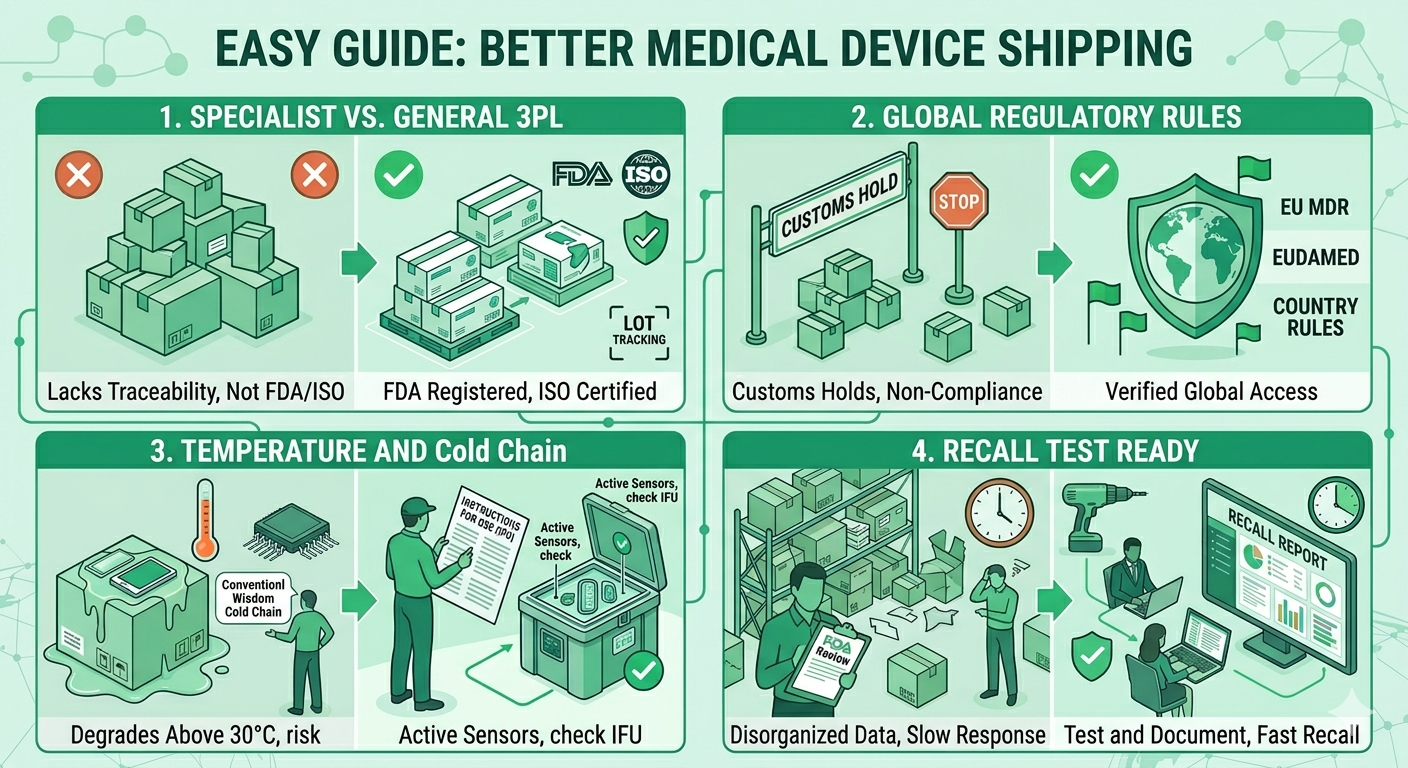
Choosing a General 3PL Instead of a Specialist
General eCommerce fulfillment providers lack FDA-registered facilities, ISO 13485 processes, and the lot traceability systems medical devices require. The cost savings on fulfillment fees are quickly wiped out by the first compliance incident or product recall.
Underestimating International Regulatory Complexity
FDA clearance does not equal global market access. EU MDR, EUDAMED registration, and country-specific import regulations are separate requirements. Brands that ship internationally without verified compliance often face costly customs holds or forced product destruction.
Neglecting Cold Chain Validation for Non-Obvious Products
Many brands assume their device doesn't need temperature control — only to discover that the adhesive on the sterile packaging degrades above 30°C, or that the device's electronic components are sensitive to humidity extremes. Always check the IFU, not just conventional wisdom.
Failing to Test Recall Readiness
Every medical device company must be able to execute a rapid, accurate recall if a safety issue is identified. If your fulfillment partner cannot produce a complete list of all affected units: by lot, by shipment, by destination, within hours, your recall process is broken. Test it before the FDA does.
RushOrder: Specialized Order Fulfillment Solutions for Medical Device Brands
Choosing the right fulfillment partner is one of the most consequential operational decisions a medical device company makes. RushOrder offers comprehensive order fulfillment solutions purpose-built for regulated healthcare products, combining the speed and technology of a modern eCommerce 3PL with the compliance rigor medical devices demand.
Our medical device fulfillment services include:
• FDA-registered, ISO 13485-certified warehousing across our fulfillment network
• Full lot and serial number traceability with UDI compliance verification on every inbound and outbound movement
• FEFO pick logic and automated expiry management
• Temperature and humidity-controlled storage zones for sensitive devices
• Cold chain validated shipping with real-time temperature monitoring
• Comprehensive chain-of-custody documentation and audit-ready reporting
• B2B distribution to hospitals, clinics, distributors, and healthcare systems
• International shipping with export compliance support
Our 3PL for medical devices team provides dedicated account management from specialists who understand the regulatory environment not generalist customer service reps learning medical device compliance on the job.
Whether you are scaling a Class I wellness device brand or managing complex Class III implantable distribution, RushOrder's order fulfillment solutions provide the infrastructure, expertise, and compliance framework you need to ship with confidence.
Frequently Asked Questions: Medical Device Shipping
What are the FDA requirements for shipping medical devices?
FDA requirements for shipping medical devices include proper device classification (Class I, II, or III), UDI-compliant labeling under 21 CFR Part 801, validated packaging appropriate to the device's sterility and fragility requirements, and chain-of-custody documentation. Class II and Class III devices require formal lot and serial number traceability. The QMSR, effective February 2026, also requires documented carrier qualification processes.
Do all medical devices need cold chain shipping?
No — but more devices require temperature control than many brands realize. Check the device's Instructions for Use (IFU) to confirm storage requirements before selecting a shipping approach. Certain biologics, diagnostic reagents, and implantable devices with adhesive or electronic components do have temperature sensitivity. When in doubt, consult a specialist medical device fulfillment services provider for guidance.
What is UDI compliance in medical device shipping?
UDI (Unique Device Identifier) compliance requires that medical device packages carry labels with both human-readable text and machine-readable barcodes or RFID encoding the Device Identifier (DI) and Production Identifier (PI). The PI includes lot/batch number, serial number, manufacturing date, and expiration date. A compliant fulfillment partner verifies UDI accuracy on every inbound and outbound shipment.
Can a regular 3PL handle medical device shipping?
Technically yes, but practically not safely. Medical device shipping requires FDA-registered facilities, ISO 13485-certified processes, FEFO pick logic, full lot traceability, UDI verification, and carrier qualification protocols. General 3PLs are not built for these requirements. A specialist 3PL for medical devices already has these systems in place, reducing your compliance risk and the cost of building those capabilities internally.
How does international medical device shipping differ from domestic?
International shipments require compliance with destination-country regulatory frameworks in addition to FDA rules including EU MDR 2017/745 and CE marking for European markets, EUDAMED UDI registration (mandatory from May 28, 2026), country-specific import permits, and customs documentation including FDA Device Listing Numbers and Premarket 510(k) Numbers. FDA clearance does not satisfy EU MDR requirements.
Conclusion: Get Medical Device Shipping Right From the Start
Medical device shipping is not an operational afterthought, it is a core component of your product's safety profile, your regulatory standing, and your brand's reputation in the healthcare market. The consequences of getting it wrong extend far beyond a delayed shipment or a lost package.
The brands that thrive in this space build their logistics infrastructure on the same compliance-first principles they apply to manufacturing: rigorous documentation, verified processes, specialist partners, and a relentless focus on traceability. The right order fulfillment solutions partner is not just a warehouse, it is an extension of your quality management system.
Ready to build a compliant, scalable medical device shipping operation? Explore RushOrder's medical device fulfillment services or learn more about our 3PL for medical devices capabilities. Our team of healthcare logistics specialists is ready to help you ship smarter, faster, and fully audit-ready.