
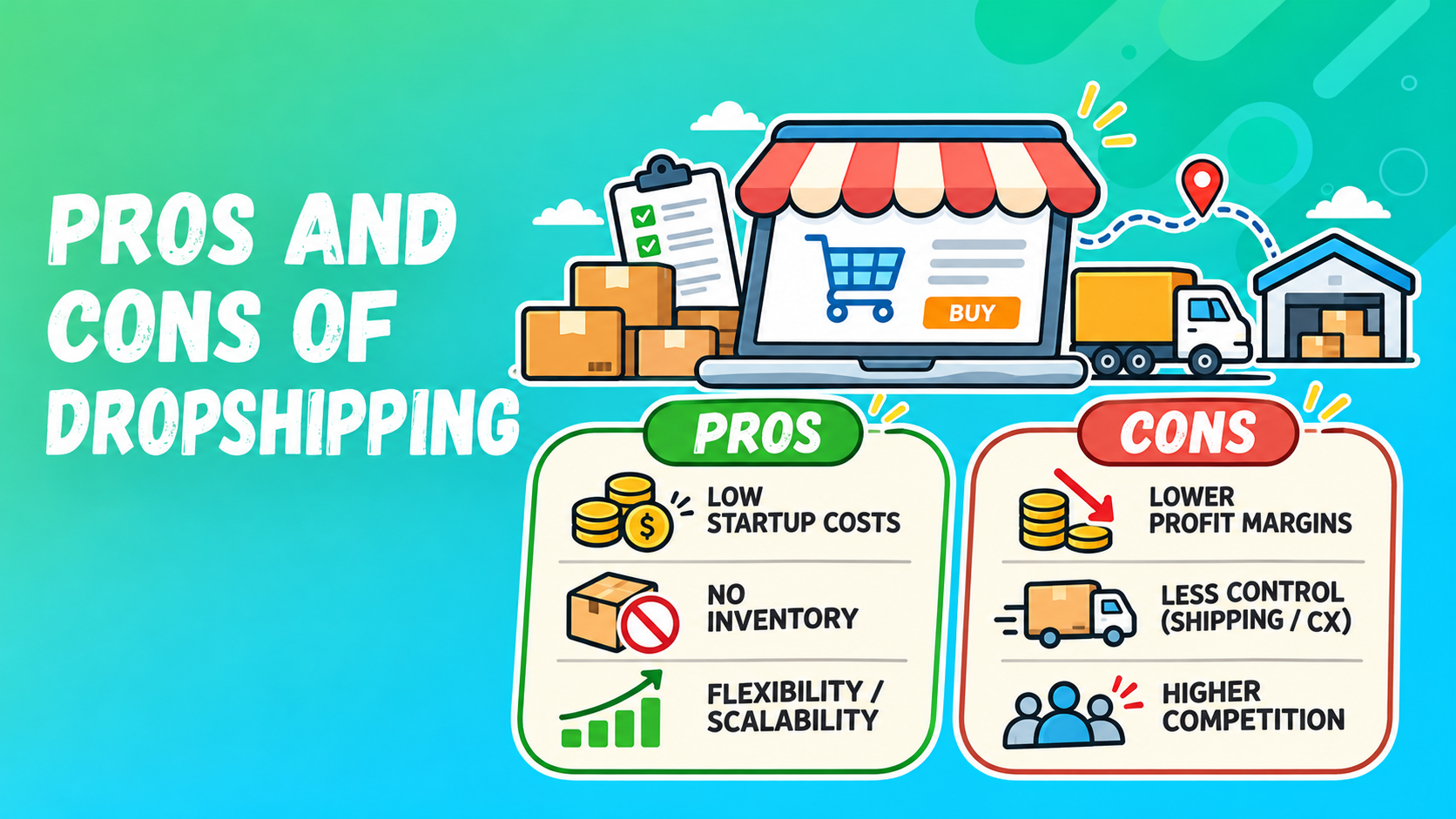
Dropshipping is one of the most popular ways to start an ecommerce business, and also one of the most misunderstood. The model sounds simple: you list products, a supplier ships them directly to your customer, and you keep the margin. No warehouse, no inventory risk, no upfront stock.
In practice, it is more complicated than that. Dropshipping works well for some sellers and kills margin for others. Whether it makes sense depends on your product category, your supplier relationships, your shipping terms, and what customers in your target markets now expect at checkout.
This guide covers the honest pros and cons of dropshipping in 2026, including how recent changes to US, EU, and UK import duty rules have shifted the math.
How Dropshipping Works
In a standard dropshipping arrangement, you run the storefront and handle marketing. When a customer places an order, you forward it to a supplier or manufacturer, who ships the product directly to the customer under your brand (or in a plain box, depending on the arrangement).
You never touch the inventory. You pay the supplier's wholesale price, charge the customer retail, and keep the difference minus your platform fees, advertising costs, payment processing, and any returns.
The key variables that determine whether this model is profitable: your gross margin, your supplier's reliability, how shipping and customs are handled, and how often things go wrong.
Pros of Dropshipping
1. Low Startup Cost
You do not need to buy inventory before you sell it. This means you can start an ecommerce business with a fraction of the capital required by a traditional retail model. There are no warehouse costs, no bulk purchase commitments, and no risk of being left with unsold stock.
This is the main reason dropshipping attracts first-time sellers. The barrier to entry is genuinely low compared to ecommerce fulfillment models that require you to stock and ship your own inventory.
2. Fast Market Testing
Because you are not committing capital to inventory, you can test new products quickly. If a product does not sell, you have not lost money on stock. This makes dropshipping a reasonable way to validate demand before investing in a larger inventory position through a 3PL or your own warehouse.
3. Wide Product Range
You can list a large catalog without worrying about storage space or carrying costs. Some successful dropshipping stores list thousands of SKUs across multiple suppliers. This variety would be impossible to manage with owned inventory at the same stage.
4. Location Independence
Dropshipping requires no physical fulfillment operation. You can run the business from anywhere with an internet connection, since the supplier handles all warehousing and shipping logistics.
5. Easier to Scale (Up to a Point)
When an order volume increases, you do not need to hire warehouse staff or expand storage space. The supplier absorbs the volume. This makes scaling the top line straightforward, though it also means you have limited control over what happens to fulfillment quality as volume grows.
Cons of Dropshipping
1. Thin Margins
This is the central problem with dropshipping. Because you are buying at wholesale and selling at retail, your gross margin per unit is often in the 15 to 30 percent range, sometimes lower. After paying for advertising (a significant cost for most dropshippers), platform fees, payment processing, and returns, net margins are frequently in the single digits.
There is little room for surprises. One wave of refused deliveries or unexpected customs charges can erase a month of profit.
2. No Control Over Shipping and Fulfillment Quality
Your supplier picks, packs, and ships the order. If they ship the wrong item, use poor packaging, or drop the ball on timing, your customer blames you. You have limited ability to enforce quality standards without significant order volume and a strong supplier relationship.
3. DDU Shipping Creates Customer Experience Problems
Most dropship suppliers ship on DDU (Delivered Duty Unpaid) terms by default. This means import duties and taxes are collected from your customer at the door, as a surprise charge they did not see at checkout.
Customers who get an unexpected duty bill often refuse the delivery. A single refused delivery can cost $30 to $50 when you account for return shipping, the lost sale, and customer service time (FlavorCloud, 2025). And according to the Baymard Institute (October 2026, aggregate of 50 studies), 40 percent of non-browsing cart abandonments cite extra costs as the primary reason. DDU's hidden-until-delivery charges directly feed that problem.
The fix is DDP shipping (Delivered Duty Paid), where the seller absorbs duties upfront. The challenge for dropshippers is that most suppliers will not switch to DDP without specific negotiation, and many cannot offer it at all.
See our DDU vs DDP guide for a full breakdown of how these shipping terms work.
4. Limited Control Over Customs Declarations
Your supplier fills out the customs paperwork. If they use incorrect HS codes or misstate the product value, that can result in delays, additional inspections, or penalties that fall on the importer of record, which may be you or your customer depending on how the shipment is configured.
This is especially relevant after the 2026 changes to de minimis thresholds. Low-value parcels that previously entered markets duty-free no longer do in the US, EU, and UK, which means the customs declaration on every parcel matters more than it used to.
5. De Minimis Changes Have Narrowed the Dropshipping Advantage
One of the quiet advantages dropshipping used to offer was that low-value parcels often entered destination countries duty-free under de minimis thresholds. That has changed significantly.
In the US, the Section 321 de minimis exemption (duty-free imports under $800) has been suspended indefinitely since August 2025. In the EU, the previous 150-euro duty exemption was abolished on July 1, 2026, replaced by a 3-euro flat-rate duty per item on parcels under 150 euros, plus a 2-euro union handling fee per item from November 2026. The UK is phasing out its 135-pound customs duty relief by October 2028.
For dropshippers sourcing from overseas suppliers and shipping DDU, these changes mean customers in the three largest English-language ecommerce markets are now receiving duty bills they did not expect. That is a conversion and retention problem.
Read more about how these changes affect your international fulfillment strategy.
6. Returns Are Complicated
Returns in a dropshipping model often require the customer to ship the item back to a supplier in another country, which is slow, expensive, and difficult to coordinate. Many dropshippers offer refunds without requiring a return for low-value items, which protects the customer experience but further compresses an already thin margin.
7. Supplier Dependency and Reliability Risk
If your supplier runs out of stock, changes their pricing, or goes out of business, your store is immediately affected. With no owned inventory as a buffer, a supplier failure can mean you are selling products you cannot fulfill. Managing multiple suppliers helps but adds operational complexity.
8. Branding and Customer Experience Limitations
Most dropship suppliers ship in generic or unbranded packaging. Unless you negotiate custom packaging (which typically requires higher minimum order volumes), your customer's unboxing experience reflects the supplier, not your brand. This makes it harder to build the kind of repeat purchase loyalty that drives long-term ecommerce business value.
Who Dropshipping Works Best For
Dropshipping makes the most sense in a specific set of circumstances.
New sellers validating product-market fit. If you want to test whether a product sells before committing to inventory, dropshipping is a low-risk way to find out. Once you have validated demand, moving to a 3PL fulfillment model gives you more control over quality, shipping speed, and customer experience.
Sellers in low-competition niches with strong supplier relationships. If you have negotiated favorable pricing and DDP shipping terms with a reliable supplier, and you operate in a niche where competitors are not yet offering faster or better-branded alternatives, dropshipping can be a solid long-term model.
Businesses using dropshipping as a supplement, not a core model. Some ecommerce brands use dropshipping for overflow SKUs or new product lines while handling their core catalog through owned inventory or a 3PL. This hybrid approach captures the flexibility of dropshipping while maintaining quality control on the products that matter most.
Where it is harder to make work: High-competition markets, products that require fast domestic shipping, categories where packaging and unboxing experience matter, and any situation where your supplier defaults to DDU shipping into markets that have tightened de minimis rules.
Dropshipping vs Holding Inventory: A Quick Comparison
| Comparison | Dropshipping | Holding Inventory (3PL) |
|---|---|---|
| Startup cost | Low | Higher (stock purchase required) |
| Margin | Thin (15-30% gross) | Better (more control over landed cost) |
| Shipping speed | Depends on supplier location | Faster with domestic 3PL |
| Customs handling | Supplier controls | You or your 3PL controls |
| DDU/DDP choice | Often limited by supplier | Full control |
| Brand experience | Limited | Full control |
| Returns | Complex, international | Simpler with domestic stock |
| Scalability | Easy top-line scaling | Scales with more planning |
| Best for | Testing, niche markets | Established products, repeat buyers |
Frequently Asked Questions
Is dropshipping still worth it in 2026?
For the right seller in the right niche, yes. But the model is harder than it was three years ago. Rising advertising costs, the end of de minimis duty exemptions in the US and EU, and customer expectations for fast shipping have all raised the bar. Dropshipping works best when you have a reliable supplier, strong margins, and either DDP shipping terms or customers in markets where duties are predictable.
What is the main disadvantage of dropshipping?
The combination of thin margins and limited control. When something goes wrong with fulfillment, shipping, or customs, you bear the customer service and financial cost with relatively little margin to absorb it. DDU shipping from overseas suppliers makes this worse by creating unexpected charges for customers at delivery.
Can you dropship with DDP shipping?
Yes, though it requires either negotiating DDP terms with your supplier or working with a fulfillment partner who can receive inventory from your supplier and reship under DDP with proper customs handling. RushOrder's DDP services are designed for exactly this use case.
Does dropshipping work for international orders?
It can, but international dropshipping requires more attention to shipping terms, customs compliance, and de minimis rules than domestic dropshipping. The 2026 duty changes in the US, EU, and UK make DDU shipping to consumers in those markets significantly riskier than it was before. See our DDU vs DDP guide for the specifics.
What is a good gross margin for dropshipping?
Most dropshippers target 20 to 30 percent gross margin as a minimum to leave room for advertising, returns, and platform fees. Below 20 percent, net profitability after all costs is very difficult to sustain. Categories with higher margins (specialty products, branded niches, B2B) tend to work better than commodity categories.
Summary
Dropshipping offers a genuinely low barrier to entry and real flexibility for testing new products. Those advantages are real. But the model comes with thin margins, limited quality control, complicated customs handling, and an increasingly hostile environment for DDU shipping as de minimis exemptions disappear in the US, EU, and UK.
If you are evaluating dropshipping, the honest question is not whether the model works in theory but whether your specific supplier, product category, and target markets make it viable in practice.
If you are ready to move beyond dropshipping or want to offer DDP shipping to protect your customer experience: